

On this page
- What a WETT inspection actually is
- Why your insurer is asking for one
- The three SITE levels, and which one you need
- Which WETT professional can perform which level
- What the inspector measures, and the code behind it
- What it costs in Canada, and why WETT does not set the price
- How to verify your inspector before you book
- If your report comes back Not Compliant or Unable to Inspect
- Frequently asked questions
What a WETT inspection actually is
A WETT-certified professional evaluates your wood-burning appliance and its venting, then checks both against the applicable codes, standards and the manufacturer's instructions. That is the job. WETT Inc., the non-profit training association behind the program, is not a government regulator, and most of the confusion here starts there.
WETT certifies people, not homes, stoves or companies
WETT puts it in one sentence: "appliances or companies cannot be 'WETT certified.' Only individuals are certified, and what they provide is an official inspection report, not a WETT certificate."
You'll still see "WETT certified wood stove" in listings and "WETT certified company" on vans. Usually that means somebody there holds a certification, or a test laboratory listed the appliance. Neither says anything about the person walking into your house. Ask which individual holds it, and in which class.
What you actually receive
You get a written report on an official WETT form, with the inspector's certification number on it. It covers what could be seen: appliance type, markings, clearances, code compliance. Every section carries one of four marks: Compliant, Not Compliant, Not Applicable or Unable to Inspect (UTI).
Read the UTI lines first. They don't mean the component passed. They mean it could not be seen at all.
Why your insurer is asking for one
Three separate things get tangled here. Your provincial building and fire codes govern how the appliance had to be installed, and your authority having jurisdiction can require proof. Your policy is a private contract, so your insurer can make an inspection a condition of coverage. WETT sits outside both. It does not set insurance or legal requirements: it trains and registers people, and says it does not regulate or resolve business-practice disputes.
Common reasons for a WETT inspection include insurance requirements, real-estate transactions, a system malfunction, and general safety or maintenance concerns.
Primary heat versus secondary heat
To an insurer, a stove you light on cold evenings is not the same object as one that heats the house all winter. Backup heat is the cheaper category.
Broker BlueCouch Insurance puts the usual premium addition for a WETT-inspected secondary-heat stove at $50 to $400 CAD a year, more for older or primary-heat installations. An archived ThinkInsure page put it at 10%, or $100 or more, depending on the provider. Both are brokers' figures, not market averages.
What happens if you don't tell your insurer about the appliance
Brokers are blunt about this one. Leave the appliance off the declaration and the company can deny the claim and cancel the policy. Tell your insurer the stove exists. Ask what they need. Then book.
The three SITE levels, and which one you need
SITE is WETT's standardized inspection process, short for System Inspections and Technical Evaluation. It defines three levels, and Level 1 covers most insurance and real-estate requests.
| Level | What it covers | Typically requested for | Access required |
|---|---|---|---|
| Level 1, Visual | All visible components of the appliance and venting; required clearances measured; stove doors, dampers and ground-accessible clean-out doors operated; chimney inspected from the ground | Home insurance, real-estate transactions, fire-code compliance, peace of mind before use | Nothing dismantled |
| Level 2, Technical | Everything in Level 1, plus hands-on review of accessible components; may remove doors, panels or flue pipes; attic inspection; roof-level chimney access | Follow-up when Level 1 finds concerns; long disuse; modifications or component replacement; insurer or authority request | Ladders, hand tools, attic and roof access |
| Level 3, Invasive | Access to concealed components; opening walls or ceilings; disassembly of masonry or prefabricated chimneys; examination of liners | Confirmed or suspected damage, such as after a chimney fire; components unreachable at Level 2; authority or insurer-mandated investigation | Permit and written consent typically required; repairs not included |
Level 1: Visual
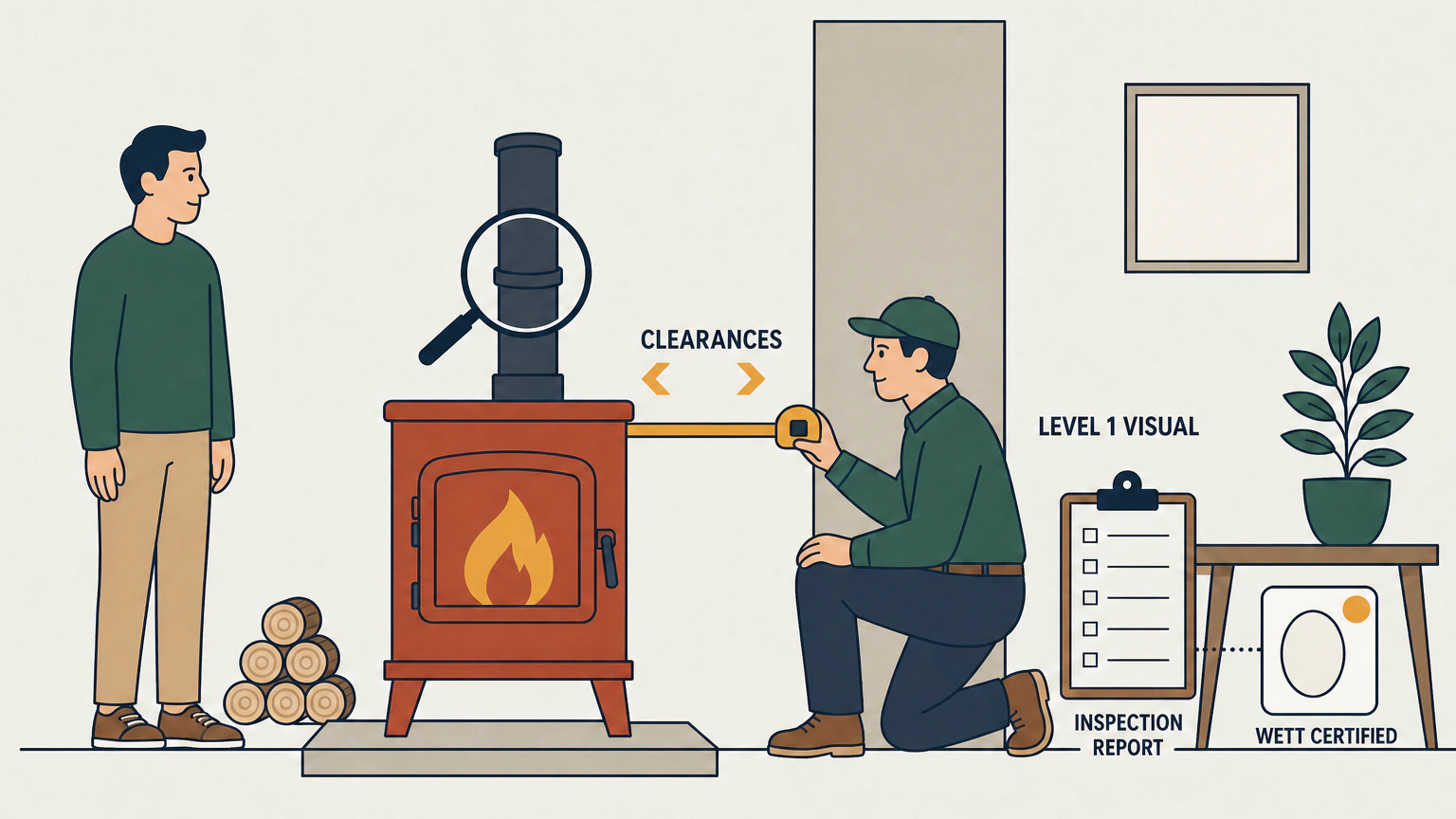
Nothing comes apart. A Visual inspection uses no tools beyond a flashlight, mirror and measuring tape, and the inspector works through every visible part of the appliance and its venting, measures the clearances, operates the door, the damper and any ground-accessible clean-out, then views the chimney from the ground.
Level 2: Technical
Everything in a Visual inspection, and then the hands go on. Doors, panels or flue pipes may come off, the inspector goes into the attic for the concealed runs, and up to the roof to reach the chimney. You end up here after a Level 1 concern, long disuse, modifications, or an insurer's request.
Level 3: Invasive
This one opens walls or ceilings, partly dismantles chimneys and examines liners. A permit and written consent are typically required and repairs are not included, so agree the scope before anybody starts cutting. An Invasive inspection follows confirmed or suspected damage, such as a chimney fire.
Which WETT professional can perform which level
"WETT certified" on its own tells you almost nothing about what a person may inspect. The class decides. Book the wrong one and you have paid for a visit that cannot produce the report you need.
| Certification class | What they do | Inspection levels they may perform |
|---|---|---|
| SITE Basic Inspector | Inspects only | Visual (Level 1) |
| Technician | Installs and services wood-burning systems | Visual and Technical (Levels 1 to 2) |
| Chimney Sweep | Cleans and maintains the full system | Visual and Technical (Levels 1 to 2) |
| SITE Comprehensive Inspector | All of the above; is also a technician and/or sweep | Visual, Technical and Invasive (Levels 1 to 3) |
One wrinkle is WETT's own. Its FAQ and inspections pages put technicians and sweeps at Visual and Technical. Its "Finding a WETT Professional" page says those two can also do "some Invasive work." We're flagging the gap rather than picking a winner.
The booking mistake this causes
Here is how a week disappears. An insurer reads a Level 1 report, sees a concern and escalates to an Invasive inspection. The homeowner rebooks the sweep from the first visit, then learns that the requested scope may require a SITE Comprehensive Inspector. Another week gone. Say which level you need when you book.
What the inspector measures, and the code behind it
Every distance the inspector writes down comes from one document: CSA B365, Installation code for solid-fuel-burning appliances and equipment, a National Standard of Canada published by CSA Group. It covers installing, altering and maintaining solid-fuel appliances, indoors or outdoors: furnaces, boilers, stoves, ranges, space heaters, factory-built fireplaces and water heaters.
Clearances to combustibles
Clearance is the distance between a hot surface and anything that can burn. Those distances are requirements, which is why an appliance that has "worked fine for twenty years" can still come back Not Compliant. The code is not impressed by a clean record.
CSA Group lists CSA B365:25, the 2025 ninth edition, as current and the 2017 edition as withdrawn. Ask your building department which edition applies in your area.
What B365 does not cover
Four things sit outside the code's scope: incinerators, site-built fireplaces, process equipment and portable appliances. The second catches people out. A masonry fireplace built on site is not a factory-built appliance, so it is judged against different requirements. Say so when you book.
The findings that come up most often
Examples of Not Compliant findings include creosote in the chimney, clearances short of what the code and the appliance's listing require, and an installation that does not match the manufacturer's instructions. None is a demolition order. Each has a route out: sweeping, shielding or repositioning, and a technician's visit.
Red flag: signals worth a second look
- "We'll give you a WETT certificate." No such document exists. Ask for the report and the inspector's certification number.
- "Your report is valid for five years." WETT sets no expiry. Ask your insurer what window they accept, in writing.
- A price quoted as "the standard WETT rate." WETT does not regulate what its certified professionals charge. Compare written quotes from two or three firms.
- An inspector who cannot name a class covering the level you were asked for. Ask which class they hold, and check the directory.
- A report marked Unable to Inspect where your insurer expected findings. Ask what blocked access, and whether a Technical inspection clears it.
What it costs in Canada, and why WETT does not set the price
WETT states that its authority does not include regulating how much WETT-certified professionals charge. What you're quoted moves with the level, the chimney's complexity, the number of storeys and how far someone drives to reach you.
Where a WETT inspection fits alongside a home inspection
Buyers assume the two come together. They do not. A standard home inspection may visually inspect the wood appliance, but it does not verify code compliance or insurability, and some inspectors hold both qualifications. Book them as two line items and compare quotes through home inspection services.
| Service | Advertised or measured figure (CAD) | Source of the figure |
|---|---|---|
| WETT inspection, advertised list prices | From roughly the low $200s upward: $249 from an Ontario firm, "starts at $200" in Victoria, $225 base plus $70 per extra storey and $125 an hour of travel in Winnipeg | Vendor list prices read from three companies' own pages, 11 August 2026; not a survey, not an average |
| Who sets the price | WETT does not regulate rates | WETT Inc.: its authority does not include regulating what WETT-certified professionals charge |
| Home inspection (a different, adjacent service) | National average $349; typical range $297 to $415; minimum $214, maximum $517 | IndustryOversight.ca's own aggregate, based on 921 cost profiles; location-adaptive; not a WETT-inspection price |
How to verify your inspector before you book
Verification protects you, and we'd do it before money changes hands. If someone sells you an inspection at the door, check them the same way.
- Ask your insurer, in writing, which inspection level they require.
- Ask your insurer how recent the report must be for them to accept it.
- Search WETT's Search for Professionals tool by service, city or town, and province.
- Confirm the individual's name appears: WETT certifies individuals, not companies.
- If they are not listed, ask WETT's national office to confirm certification by email or phone.
- Check that their certification class covers the level your insurer asked for.
- Ask to see the WETT photo ID card with a current-year sticker.
- Confirm the report will be issued on an official WETT inspection form.
- Confirm the inspector's certification number will appear on the report.
- Ask what the quoted price includes, and what travel or extra-storey charges apply.
- Get the quote in writing before the visit.
The WETT directory and the photo ID card
The Search for Professionals tool takes three inputs: service (inspections, chimney sweeping or installations), your city or town, and your province. Only members in good standing are listed, so a lapsed, suspended or revoked certification will not appear.
A blank result is not a glitch. It is information, and WETT's fallback is to confirm certification by email or phone.
The photo ID card is your second check, valid only with a current-year sticker, though carrying it is not mandated. Ask too whether the person is fully certified or a candidate still gaining experience, since insurers differ on accepting a candidate's report. Once you know the class you need, compare local chimney sweep and air duct services or browse Ontario professionals by city.
What to ask when you book
Five questions in one call: which level, which certification class, whether the report comes on an official WETT form, whether the certification number will appear on it, and what the price includes.
If your report comes back Not Compliant or Unable to Inspect
Neither result is a verdict on your home. Not Compliant means a named item does not meet the code or the manufacturer's instructions. Unable to Inspect means a component could not be seen, so nothing was assessed there.
The two need opposite things. The first needs work done and documented. The second needs access, which often means a Technical inspection rather than a repair.
Ask your insurer which items they need cleared, and by when.
Getting the work done, and by whom
Each finding belongs to a different trade. Creosote and venting maintenance go to a WETT-certified sweep. Chimney structure, liner and masonry work go to masonry contractors. Appliance faults, shielding and installation defects go to a WETT-certified technician.
Pro tip: you can separate the inspection from the repair
The person who found the problem is not required to be the person who fixes it, and a second quote is normal, not an insult. Ask for it itemized, so code-required work is visible separately from optional upgrading. Keep the invoices. Your insurer will want them.
Re-inspection and going back to your insurer
A follow-up inspection produces a new report on a new WETT form, and WETT expects the earlier reports to be shared with the new inspector. Send your broker the new report, the invoices and any permit paperwork. Then ask for written confirmation that the condition is satisfied. Without it you have a tidy folder and an open file.
Frequently asked questions
How long is a WETT inspection good for?
There is no fixed expiry. WETT's position is that a report discloses the conditions present at the time of the inspection, that inspectors cannot guarantee conditions beyond that date, and that each insurer has its own guidelines for how long it will accept a report. Ask your insurer what window they use.
Do I need a WETT inspection for home insurance?
Usually yes, if there is a wood-burning appliance in the house. It is a condition set by your insurance company rather than a legal requirement. The level they want is almost always Level 1 (Visual). Ask your insurer, in writing, which level they require and how recent the report must be.
What does a WETT inspector look for?
Compliance of the appliance and its venting with applicable codes, standards and the manufacturer's instructions. In practice that means appliance type and markings, clearances to combustible materials, the condition and assembly of the venting and chimney, floor protection, and whether the installation matches what the appliance was listed for.
What is the difference between a Level 1 and a Level 2 inspection?
Access. Level 1 (Visual) is non-invasive: the inspector reviews visible components, measures clearances, operates doors and dampers, and views the chimney from the ground. Level 2 (Technical) adds hands-on access, which may include removing doors, panels or flue pipes, inspecting the attic and reaching the chimney at roof level.
Can a wood stove fail a WETT inspection?
Not in those words. WETT-certified professionals do not pass or fail a system, and they do not certify installations. Each section of the report is marked Compliant, Not Compliant, Not Applicable or Unable to Inspect. Your insurer, or your authority having jurisdiction, decides what a Not Compliant finding means for your policy or permit.
How much does a WETT inspection cost?
It varies by level, appliance, chimney complexity, number of storeys and travel distance. WETT does not regulate what its certified professionals charge, so there is no WETT-set rate to compare against. Advertised list prices from individual Canadian firms start in the low $200s CAD, so get two or three written quotes.
Is a WETT inspection the same as a home inspection?
No. They are separate services with separate scopes. A standard home inspection may visually inspect the solid-fuel system but does not verify code compliance or insurability, while a WETT-certified individual assesses the appliance and its venting against the applicable codes. Some hold both qualifications and will quote them together, which is convenient but still two pieces of work.
This is general information, not a substitute for having a WETT-certified professional look at your own appliance, and it cannot override your policy or your local code. One thing that is not a scheduling question: a suspected chimney fire, or smoke spilling into the room, is an emergency.