

On this page
- The short answer, and the number that limits your risk
- How a lien actually lands on your title
- The holdback: the money that protects you from paying twice
- Holdback and lien deadlines, province by province
- Before you release the final payment: the check that takes twenty minutes
- How to find out whether a lien is already on your title
- A lien has been registered. Here is the order of operations
- What a lien does — and does not do — to a sale or a refinancing
- How to hire so this never starts
- Frequently asked questions
The short answer, and the number that limits your risk
Yes. In every Canadian province, and often at the hands of someone you've never met.
Your contractor got paid. The tiler, the framer or the lumberyard did not, so the law lets them come at the one asset in this story that can't move: your land. Your proof of payment isn't the defence you'd expect it to be.
The protection is the holdback. In Ontario, British Columbia, Alberta and Newfoundland and Labrador you're required to keep back 10% of what you pay out, and that money forms part of the statutory fund unpaid subcontractors can claim against. Quebec works differently, and gets its own section below.
So "can a contractor put a lien on my house" is a yes with three limits. Holdback rules constrain your exposure. The window closes on a countable date, 30 to 90 days out. And a lien can be taken back off your title.
Final invoice on the counter? Start with the holdback. Lien already registered? Skip to the order of operations.
How a lien actually lands on your title
A construction lien, called a builders lien in British Columbia and a legal hypothec in Quebec, is a claim registered against your land. Not against your contractor's bank account. That's the whole problem in two sentences.
Who can register one (it is not only your contractor)
Anyone who supplied services or materials to the improvement can claim. The general contractor, the framer, the tiler, the lumberyard, the outfit that rented out the excavator, the workers on site, and in Ontario architects by name in the Construction Act.
Not one of them needs a contract with you. The claim attaches to the property their work improved.
Why paying your contractor in full does not stop it
You pay the general contractor. The general contractor doesn't pay the tiler. The tiler's claim lands on your title.
That's deliberate. These statutes secure the person who did the work by charging the property, rather than leaving them to chase a middleman who may already be insolvent. The holdback is what you get in exchange.
What the clock is counting from
Every deadline here runs from an event, never from an invoice date. Get the event wrong and every date after it is wrong too.
Substantial performance is the one most people have heard of. In Ontario it's a defined test: the improvement is ready for use, and what's left could be finished for 3% of the first $1,000,000 of the contract price, 2% of the next $1,000,000 and 1% of the balance. Completion, abandonment, termination or a claimant's last supply may be the trigger instead.
Write down the event that applies to your job and the date it happened. You'll need it twice.
The holdback: the money that protects you from paying twice
What the law makes you keep, and why it is not optional
The holdback is a duty on whoever is paying, not a negotiating position.
Ontario makes every payer retain 10% of the price of the services or materials as they're supplied, whether you pay in instalments or settle up at the end. British Columbia, Alberta and Newfoundland and Labrador land on the same 10%, each measured its own way. So when a contractor tells you holdbacks are a big-commercial-job thing, they're wrong in all four of those provinces.
What 10% is actually worth on a Canadian job
A percentage is hard to feel until you attach it to a real invoice. Our own cost profiles for general contractors in your area and roofing contractors put the arithmetic in dollars.
| Job type | Typical price range on IndustryOversight.ca | The 10% you hold back |
|---|---|---|
| General contractor project | $3,328 to $52,786 | $333 to $5,279 |
| Kitchen renovation | $13,840 to $36,706 | $1,384 to $3,671 |
| Bathroom renovation | $6,258 to $15,596 | $626 to $1,560 |
| Roofing | $5,509 to $10,761 | $551 to $1,076 |
| Residential concrete | $4,098 to $12,603 | $410 to $1,260 |
Those ranges are IndustryOversight.ca's own aggregate of the cost profiles behind our category pages, not a market survey. On the $25,454 national average project, the money you're holding is $2,545.
The mistake that turns a holdback into paying twice
The expensive mistake is a generous one. The site looks finished, everybody shakes hands, and you release the last 10% that afternoon.
Then a subcontractor registers. The money you were keeping for exactly this moment is in someone else's account, and you're paying for the same tile twice.
Skipping the holdback altogether doesn't save you either. In Ontario an owner is personally liable for the holdback the owner was required to retain, kept or not.
Red flag: do not release the holdback because the contractor asks nicely.
There's nothing sinister about a contractor asking for the last payment on the last day, and nothing rude about saying not yet. Once the lien period has run and the money is otherwise due, it's theirs, and in Ontario you have 14 days from the liens expiring to hand it over.
Holdback and lien deadlines, province by province
Liens are entirely provincial, and the provinces don't merely number the same rules differently. They run different clocks, from different events, on different bases. These five are the ones whose statutes we read.
| Province | The statute | What you must hold back | How long a claimant has to register | The owner-liability rule |
|---|---|---|---|---|
| Ontario | Construction Act, R.S.O. 1990, c. C.30 | 10% of the price of services or materials as supplied (s. 22(1)) | 60 days from the earlier of publication of a certificate or declaration of substantial performance and the contract being completed, abandoned or terminated (s. 31(2)); a subcontractor's can also run from its own last supply (s. 31(3)) | What is owed to that claimant and, subject to the holdback rules, the least amount a payer owes (s. 17(1)) |
| British Columbia | Builders Lien Act, S.B.C. 1997, c. 45 | 10% of the greater of the value of work and material provided and the payments made (s. 4(1)); a separate account unless that value is under $100,000 (s. 5(8)) | 45 days from a certificate of completion, or from completion, abandonment or termination of the head contract (s. 20); your holdback period ends at 55 days (s. 8) | For all claimants under one contractor, the greater of what that contractor is still owed and the required holdback (s. 34(1)) |
| Alberta | Prompt Payment and Construction Lien Act, R.S.A. 2000, c. P-26.4 | 10% of the value of work done and materials furnished, held 60 days, or 90 days if the improvement is mainly concrete (ss. 18(1), 18(1.2)) | 60 days from the last supply of materials, services or work; 90 days for concrete (s. 41) | The major lien fund plus the minor lien fund, and no more (s. 25) |
| Quebec | Civil Code of Québec, arts. 2724, 2726 to 2728 | No statutory holdback. The legal hypothec exists without being published (art. 2726) | Subsists 30 days after the work is completed unless a notice is registered and served on you inside those 30 days; extinguished six months after completion unless an action is published or a prior notice registered (art. 2727) | The increase in value the work gave the property; any claimant other than a workman who did not contract with you is limited to work supplied after written notice of their contract (art. 2728) |
| Newfoundland and Labrador | Mechanics' Lien Act, R.S.N.L. 1990, c. M-3 | 10% of the value, held 30 days after completion or abandonment (s. 12(1)) | 30 days after completion or abandonment of the contract, the last material, the service or the work (s. 22) | No more than the sum payable by you to the contractor (s. 10) |
Holdback Release Checker
How much to keep back, and the day it becomes safe to pay it out.
Enter what the services, work and materials supplied so far are worth. Not the full contract price.
$25,000 is close to the $25,454 national average across the 701 general-contractor cost profiles published on this site.
Use the date of the event you picked above, not the date on an invoice.
This is the holdback for the one statutory event you pick. A certificate can start a second holdback for work supplied after it, and the two are not added together here. Check the event and the date before you act on the number.
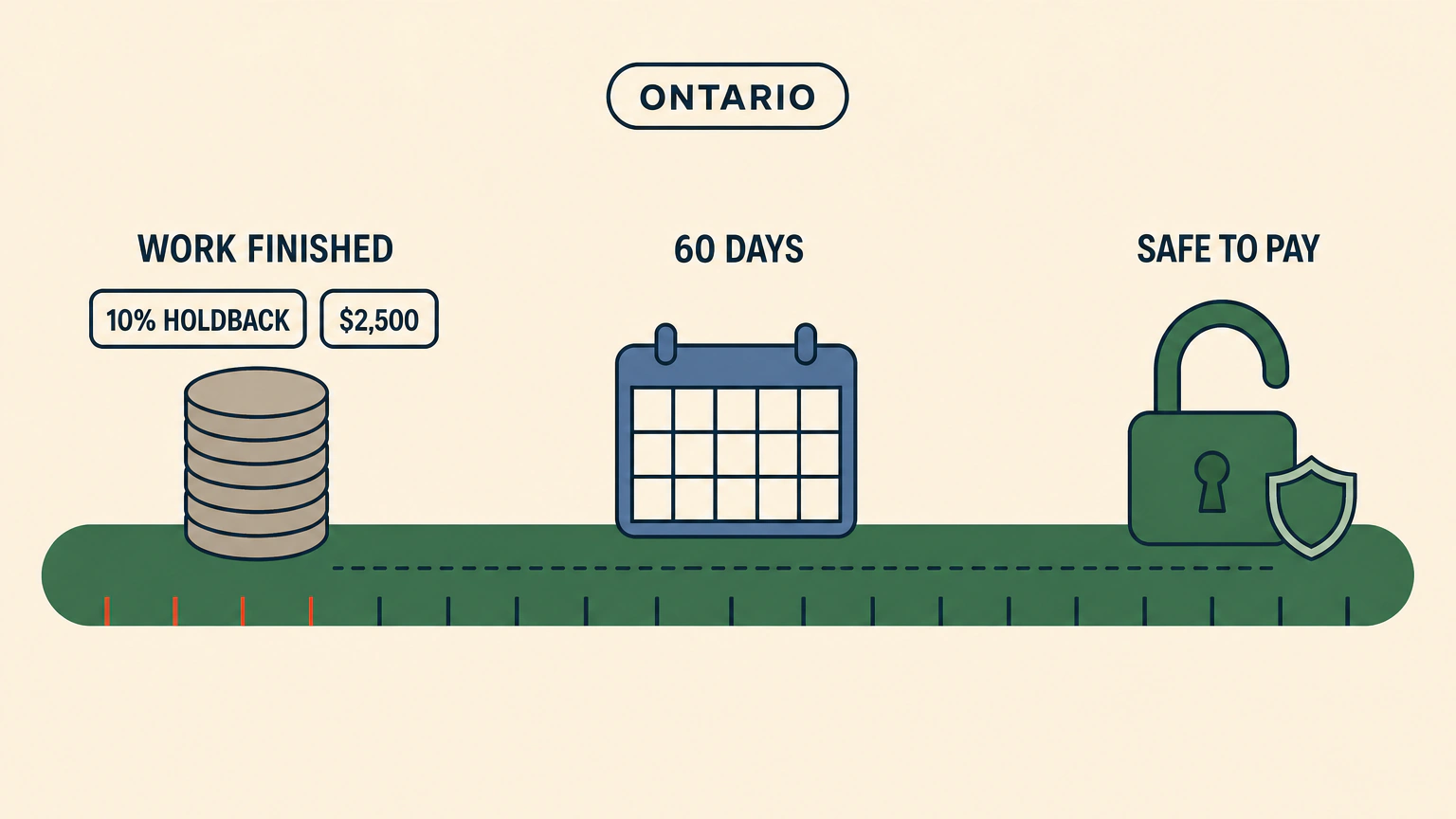
Hold back $2,500
Do not release it before 1 October 2026
Earliest release date: 1 October 2026
The rule
Ontario: 10% of services and materials actually supplied. The 60-day period ends 30 September 2026; release is after that period. Construction Act, R.S.O. 1990, c. C.30, ss. 22(1), 31(2).
Worked example: Ontario, contract completed on 1 August 2026.
- Statutory holdback calculation base$25,000
- Holdback rate10%
- Hold back$2,500
- Holdback period60 days
- Last protected day30 September 2026
- Earliest release date1 October 2026
General information, not legal advice. Lien deadlines are strict and they move. Check the current section with your province's statute publisher, or talk to a lawyer in your province, before you act on a date.
Ontario: 10% and a 60-day window
Ontario is easy to state and easy to miscount. You hold 10%, and claimants get 60 days, counted from whichever comes first: publication of a certificate or declaration of substantial performance, or the day the contract is completed, abandoned or terminated.
Once the liens expire, the clock points at you: pay the holdback within 14 days. If you're replacing a contractor mid-job, start with contractors across Ontario.
British Columbia: 10%, 45 days to file, 55 days to release
British Columbia runs two clocks, which is exactly why people misread it. Claimants have 45 days to file. Your holdback period runs 55 days, from the certificate of completion if one was issued, and otherwise from completion, abandonment or termination of the head contract.
That ten-day gap isn't sloppy drafting. It's there so a lien filed on the last possible day still lands before your money leaves.
Alberta: 60 days, or 90 if the job is mainly concrete
Alberta holds 10% for 60 days, counted from the certificate of substantial performance, or from completion of the contract if nobody issued one.
Then comes the part that catches people. Where the improvement is primarily concrete, each of those periods becomes 90 days. Count 60 on a driveway, footings or flatwork and you'll release the money a month early.
Quebec: no holdback, but watch for written notices
Quebec gives you no holdback to hold. What it gives instead is the legal hypothec, which belongs to anyone who took part in the construction or renovation and exists without being published anywhere you could look it up.
It disappears 30 days after the work is completed, unless a notice of the claim is registered and served on you inside those 30 days. And a claimant other than a workman who never contracted with you can claim only for work supplied after written notice of their contract reached you.
Which makes the mail the whole ball game here. Read every written notice, and keep it.
Newfoundland and Labrador: 30 days, and a hard cap on what you owe
Newfoundland and Labrador runs the shortest clock of the five: 10% retained for 30 days after completion or abandonment, with claims registered inside 30 days of completion, abandonment or the last supply.
The Mechanics' Lien Act then caps your side of it in one blunt line. You owe no more than the sum payable by you to the contractor.
If your province is not in this table
Manitoba, New Brunswick, Nova Scotia, Prince Edward Island and Saskatchewan each run their own statute on the same two ideas: a percentage held back, and a deadline to register.
We won't guess their numbers for you, and you shouldn't assume 10% either. Manitoba's Builders' Liens Act sets 7.5% of each payment, held at least 60 days. One province over, a different number.
To find yours, search your province's statute publisher for "builders lien" or "mechanics lien".
Before you release the final payment: the check that takes twenty minutes
None of this is an accusation against your contractor. It's twenty minutes standing between you and paying for the same job twice, and any contractor worth keeping has been asked before.
- The work is genuinely finished, not "finished except for a few things".
- You know the date the work was completed, abandoned or terminated, and wrote it down.
- You counted your province's statutory days from that date and know the release date.
- You asked your contractor, in writing, for the list of subcontractors and suppliers.
- You hold written confirmation, a statutory declaration or an email, that each was paid.
- You ran a title search dated after the deadline passed, and it is clear.
- Every payment is documented: contract, invoices showing a GST/HST number, bank records.
- Nobody served you a written notice of lien or, in Quebec, notice of their contract.
How to find out whether a lien is already on your title
Where to search, by province
A lien lives on your title, so a title search settles the question, and you don't need a lawyer to order one.
Ontario searches run through the Electronic Land Registration System, with a Teraview search-only account or the OnLand portal at onland.ca. British Columbia uses the Land Title and Survey Authority, which lists a title search at $11.06. Alberta titles come through SPIN2, ARLO or a registry agent. Newfoundland and Labrador's Registry of Deeds charges $5 for search results. Quebec's registre foncier is searched online or through a notary.
What a lien looks like when you find one
Four things, in this order: who registered it, how much they claim, the date they registered, and which contract they say it comes under.
The date is the one to circle. A claim registered after the window closed is vulnerable, and knowing that before you phone anybody changes the call.
A lien has been registered. Here is the order of operations
Step 1: read it before you pay anything
Compare the amount claimed against what's genuinely still owed, and against the holdback sitting in your account. Then check the registration date against your province's deadline, counted from that completion date you wrote down.
Don't pay anyone on the strength of a phone call. A voice claiming it's owed money for your kitchen is not a registered claim.
Step 2: put the problem back where it belongs
This is your general contractor's mess before it's yours. Write to them the same day. Ask for proof the subcontractor was paid, and say plainly that the holdback is there to settle a legitimate claim.
A claimant who gets paid can register a discharge. Often that's the entire fix.
Step 3: vacate, pay, or let it expire
Three routes clear a title. The claimant signs a discharge, usually because they were paid. A court order vacates the registration. Or the lien expires on its own.
That last route is real, because registering is only half the claimant's job. A preserved lien then has to be perfected: the claimant starts an action and, in Ontario, registers a certificate of action, within a further 90 days. Alberta allows 180 days plus a certificate of lis pendens, British Columbia one year. A lien nobody perfects in time expires.
What it costs to vacate a lien in Ontario
Brace yourself. Vacating by motion is priced by statute, and the price is the whole claim: you pay into court, or post security equal to, the full amount claimed plus the lesser of $250,000 or 25% of it as security for costs. So a $40,000 lien needs $50,000 in court, plus legal fees.
For condominium common elements, only the portion attributable to your own common interest counts.
It buys a clean title while the dispute grinds on, and it's neither an admission nor a payment to the claimant.
When to stop reading and phone a construction lawyer
Four triggers, and one is enough. The amount is large relative to the job. The deadline analysis isn't obvious from your documents. The claimant has started an action. A sale or refinancing is booked.
We're not your lawyer, and a lien is a legal proceeding with strict deadlines, so take your own dates and documents to one in your province. An hour of advice costs less than a missed step.
What a lien does — and does not do — to a sale or a refinancing
A lien clouds your title. It doesn't, on its own, take your house.
It stops transactions. A purchaser's lawyer finds it on a title search, a lender may not advance funds onto an encumbered title, and closing becomes conditional on the lien being discharged, vacated or paid from the proceeds. The claim you could have settled in a week out of the holdback turns into an emergency five days before closing.
Deal with a known lien before you list.
How to hire so this never starts
The cheapest lien is the one nobody registers, and that work happens at the beginning. On a new build or a major project, start with licensed home builders and get the documents right while everyone still likes each other.
A written contract, a GST/HST number, and a receipt for every payment
The cash discount is the most expensive money you'll ever save. Federal guidance is blunt about it: an under-the-table arrangement leaves you with no warranty, no recourse for poor workmanship, added liability exposure, and nothing to prove what you paid when a claim arrives.
So: a written contract, invoices showing a GST/HST number, and a receipt or bank record for every payment. The Office of Consumer Affairs puts the rest in one line: keep payments to a minimum, check your province's construction lien legislation, and expect the law to require a holdback.
Signed under pressure at your own front door? Different problem, with its own way out: when you can cancel a home-services contract you have signed.
The three questions that surface an unpaid-subcontractor problem early
Ask these at the kitchen table on day one, not in the driveway at the end.
Who are the subcontractors and suppliers on this job? Will you give me a statutory declaration that they have all been paid before I release the holdback? Will a certificate of substantial performance be issued, and when?
The answers matter. So does the reaction.
Pro tip: raise the holdback at signing, when it costs nothing.
One line in the contract prevents a fight later: "The owner will retain the statutory holdback required by the applicable provincial Act and release it on the statutory date, on receipt of a statutory declaration that all subcontractors and suppliers have been paid." Present it as what it is, the law's requirement rather than your suspicion.
Frequently asked questions
Can a contractor put a lien on my house if we never signed a written contract?
Yes, and the missing paperwork doesn't help you. Lien rights come from the statute, not from any contract with you. Ontario gives a lien to anyone who supplies services or materials to an improvement for an owner, contractor or subcontractor, and a subcontractor never had a contract with you anyway. A verbal deal is still a contract, and still lienable.
How long does a contractor have to file a lien in Ontario?
Sixty days, counted from an event rather than an invoice. A contractor's lien expires 60 days after the earlier of publication of a certificate or declaration of substantial performance and the date the contract is completed, abandoned or terminated. A subcontractor's clock can run instead from that person's own last supply, so two claimants on one job can be working to different deadlines.
How do I find out whether there is already a lien on my house?
Order a title search from your provincial land registry. Ontario runs through the Electronic Land Registration System or OnLand, British Columbia through the Land Title and Survey Authority at $11.06, Alberta through SPIN2, ARLO or a registry agent, Newfoundland and Labrador through the Registry of Deeds for $5, and Quebec through the registre foncier. A lien shows as a registration on your title.
Can I sell my house if there is a lien on it?
You can list, and you can sign a deal. Closing is where it stops. The buyer's lawyer will find the registration, the buyer's lender may refuse to advance onto a clouded title, and the amount gets held back or paid out of your proceeds. Clearing it before you list is cheaper, and a great deal calmer.
What does it cost to get a lien removed from my property?
In Ontario, vacating a registration by motion costs the full amount claimed plus the lesser of $250,000 or 25% of it, paid into court or posted as security, and then your legal fees on top. That money returns to you if the claim fails. The cheap routes: a discharge signed by a claimant who's been paid, or plain expiry.
I am doing a home renovation — do I need a special holdback account?
Of these five provinces, only British Columbia, and only above the threshold. There you need a separate holdback account at a savings institution unless the aggregate value of work and material on the contract is less than $100,000. Ontario, Alberta and Newfoundland and Labrador want the money retained, not parked in an account of its own. Quebec has no holdback at all.
What happens if the contractor misses the lien deadline?
The lien stops existing. A claim nobody registers expires at the deadline, and a registered claim nobody perfects expires too. One registered after the window closed can be discharged or vacated by the court. The debt itself survives, so the claimant can still sue whoever owes them. Your land is out of it.
If a final invoice is waiting on you tonight, do one thing before you sign anything: write down the completion date, and count your province's days from it. Everything else follows from that date. Our editorial standards are on the Who We Are page.