

On this page
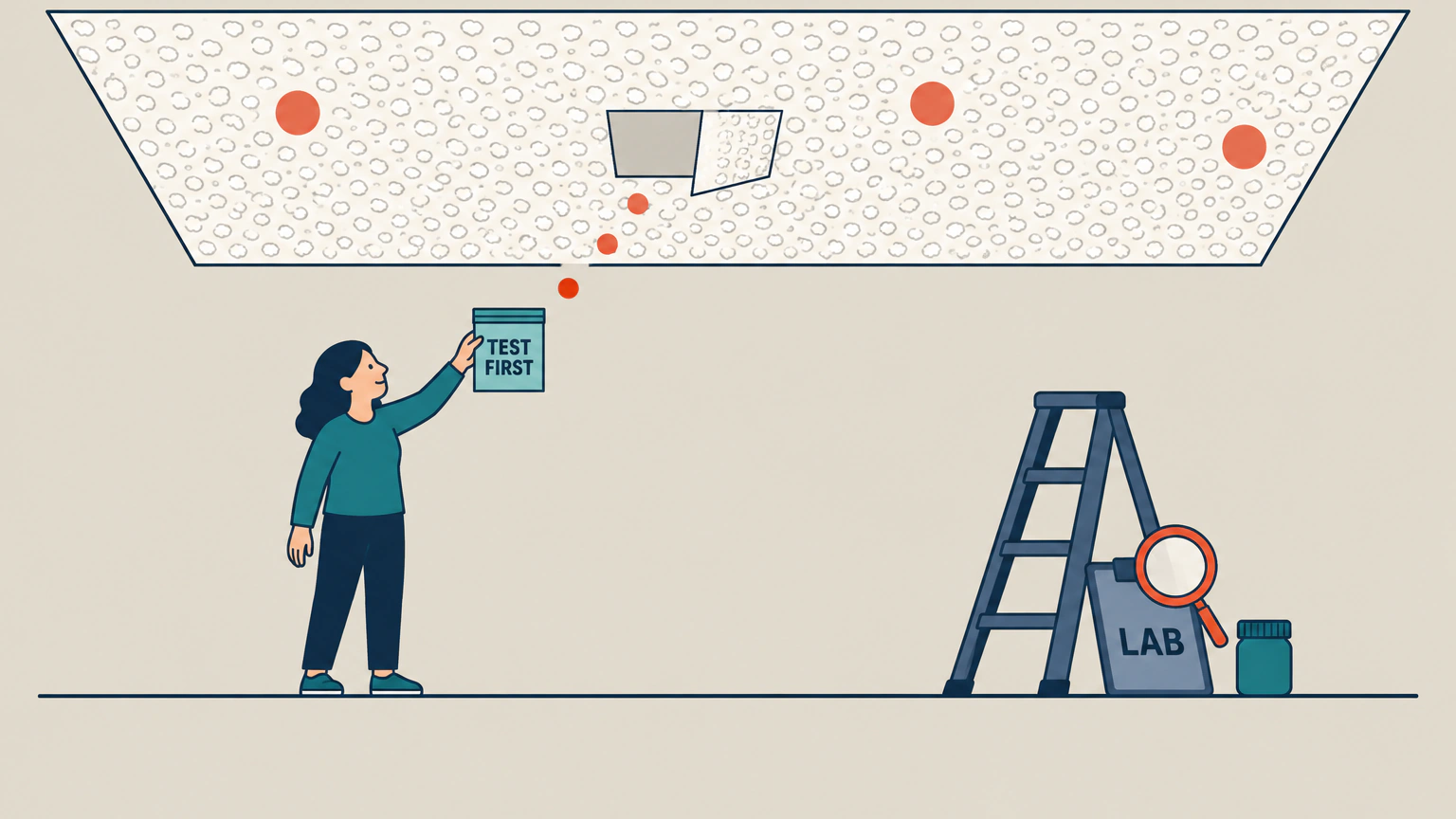
Start with the test, not the quote
A painter has walked through the house and left you a number per square foot. It looks reasonable. It might even be reasonable. But that price was set by measuring your ceiling. What the ceiling is made of decides which work controls apply, and its size still affects the bill.
You can't tell by looking, and neither can the contractor
Asbestos fibres are microscopic. A ceiling with asbestos in it looks exactly like a ceiling without, and so does the dust it makes when you scrape it. Nobody on site can settle this by eye, and anyone who says they can is guessing with your family's air. It's the same shape of problem as radon, where how radon testing works in Canada also starts with a number from a lab rather than a hunch.
The trade words don't help either. Canadians call this a stipple ceiling, a stucco ceiling, a textured ceiling or a popcorn ceiling depending on the province and the crew. Those names describe textured finishes, and what you call it changes nothing about what's in it.
The year is where most homeowners get stuck. Ontario's Ministry of Labour puts it carefully: asbestos "can be found in buildings built in Canada, especially if they were built prior to 1986." Read that as a hint about where to look, never as a date that clears anything. Health Canada's instruction is the plain one, and it applies whatever year the house went up: "hire a professional to test for asbestos before renovating or remodelling."
How many samples a real test takes
Ontario's asbestos regulation doesn't leave the method up to the sampler. It adopts a specific US EPA bulk materials test method, and it sets a floor on how many samples come out of a ceiling. For surfacing material, a category that names "acoustical plaster on ceilings" outright, the minimum is three samples for an area under 90 square metres (about 970 square feet). From 90 to under 450 square metres it's five. At 450 and over, seven.
For one area of matching ceiling texture under 90 square metres, the minimum is three samples. Ontario requires a competent worker to take them at random from across that material. One clean sample from one corner doesn't clear the whole ceiling. It's a sample of one corner, and ceilings get patched, sprayed in stages and repaired by different hands over the decades.
Those numbers bind Ontario work. Nothing stops you asking for the same count anywhere else in the country, and a consultant who can explain why they took three is the one you want.
Pro tip: Ask the lab, not the removal company, to take the samples. The firm bidding on the abatement has an obvious interest in the answer. If the same company does both, get the result in writing with the sample locations marked and the lab's own name on it.
One positive sample settles the material it came from
Here's the rule that saves the most money and the most arguing. Under Ontario's regulation, if one sample comes back at 0.5 per cent asbestos or more by dry weight, two things happen at once. The lab doesn't have to analyze more samples from that same area of matching material. And the whole area of homogeneous material that sample came from is "deemed to be asbestos-containing material."
Read that twice if you're holding two quotes that disagree. A clean result from another corner doesn't cancel that positive result. The whole area of matching material counts as asbestos-containing.
The rule cuts the other way too, and this is the half people miss. Homogeneous means uniform in colour and texture. Your texture coming back clean says nothing about the drywall joint compound underneath it, which is a different material and was a common home for asbestos in its own right. If your plan involves taking the ceiling apart rather than skimming over it, ask what else got sampled.
What the job costs once you know
So the result lands. From here there are three paths: ordinary removal, abatement or covering. The lab result decides which are available. The size of the job still affects the price.
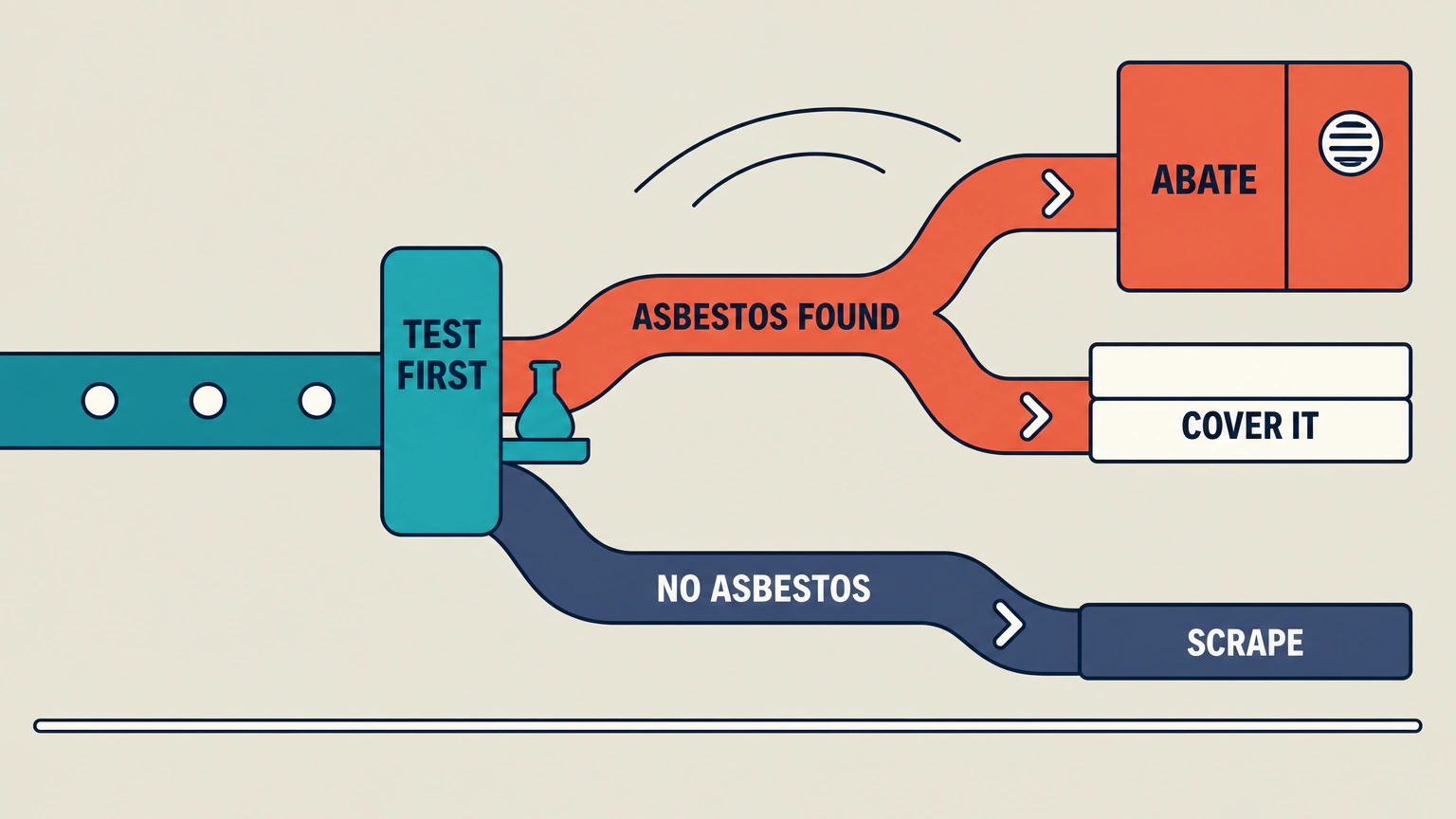
The three trades this job splits into
Three different trades share this work, and you may end up hiring two of them. The sampling belongs to the consultants and hygienists listed under mould inspection and indoor air quality companies, who pull the material and send it to an accredited lab.
A clean result hands the ceiling to a drywall crew. A positive result needs an asbestos contractor. In Ontario, removing more than one square metre of friable ceiling texture needs Type 3 controls, including a sealed enclosure and filtered air. The quote should spell out the containment, protective gear and waste handling.
Our own figures give the shape of each of those three bills.
| Who you are hiring | What they do on this job | Average | Typical range | Cost profiles behind it |
|---|---|---|---|---|
| Indoor air quality, mould and industrial hygiene | Takes the samples and sends them to an accredited lab | $669 | $299 to $1,042 | 658 |
| Drywall and plaster | Scrapes, skim coats and refinishes a ceiling that came back clean | $1,782 | $998 to $2,621 | 633 |
| Damage restoration | Builds the containment and does the abatement when the result is positive | $2,602 | $1,458 to $6,243 | 786 |
These are our own cost profiles for each category, not asbestos prices, and they show the shape of each trade's ordinary bill rather than what your ceiling will cost.
They're also priced to one location instead of the whole country, so treat them as a snapshot. Some contractors publish per square foot prices for their own crews, which is a fine thing to compare against and a poor thing to plan on.
What actually moves the number
Ceiling height is the first multiplier. High or vaulted ceilings need more access equipment. Room count matters alongside total area, because each room is its own setup, mask off, scrape, clean and reset.
Painted texture is the one that surprises people. Bare texture soaks up water and comes off wet in sheets. Paint can make the texture harder to soften and scrape. Ask whether the ceiling has ever been painted before you take any per square foot number seriously.
Disposal is a line of its own if the result was positive: asbestos waste doesn't go in your bin or a rented disposal bag, and not every landfill will accept it.
Then there's the item most homeowners never see coming: the finishing work. Texture got sprayed onto ceilings in the first place so nobody had to make them perfectly flat. Under it, the joints are often taped and nothing more. Scrape the texture off and you've exposed unfinished work, so drywall and plaster contractors then have to skim the entire ceiling, sand it and prime it before a painter can start.
Who is allowed to do the work where you live
Ottawa banned the product. The provinces govern the work, and they answer the same question three different ways. Before you let one of the damage restoration companies on your shortlist start on a positive ceiling, find out what your province makes them do first. WorkSafeBC calls asbestos exposure the leading cause of work-related deaths in British Columbia. That's why all this paperwork exists.
| Province | What rules must the contractor follow? | What has to happen before work starts | Where you check |
|---|---|---|---|
| British Columbia | Since 1 January 2024, employers offering asbestos abatement work to others must hold a WorkSafeBC Asbestos Abatement Licence. Independent operators who employ nobody are exempt. People doing the work must be certified. | WorkSafeBC tells homeowners to check the contractor's licence before work starts. | Search WorkSafeBC's public Asbestos Abatement Licence Registry by company name, account number or licence number. |
| Ontario | The job is classified as a Type 1, Type 2 or Type 3 operation under O. Reg. 278/05. | Taking down more than one square metre of friable asbestos ceiling is a Type 3 operation. Before starting, the constructor on a project, or the employer on other work, must notify a Ministry of Labour inspector orally and in writing. One square metre or less is Type 2. | Ask for the written notice. It has to name the address, the work, the start date and the supervisor in charge. |
| Alberta | The employer must train workers to handle asbestos safely. Workers entering an asbestos restricted area need a Director-approved course and their original valid certificate. | The employer must notify a Director at least 72 hours before work that may release asbestos fibres. No notice means no start. | Ask which day the notification went in. Alberta takes it through an online asbestos project notification form. |
Three provinces, because three is what we could check against the regulator itself rather than fill in by inference. Every province runs its own occupational health and safety rules for this work. They diverge more than you'd expect. If you're in Quebec, the body you want is the CNESST. Everywhere else it's your provincial workplace safety authority. Its asbestos pages carry the notice rules and any training requirement, and that's the office to ask, not the contractor.
British Columbia licenses the company and certifies the crew
British Columbia gives you a public registry to check. WorkSafeBC's own words: as of 1 January 2024, "asbestos abatement contractors must be licensed to operate in British Columbia, and anyone performing asbestos abatement work must complete mandatory safety training and obtain certificates." B.C. was the first jurisdiction in Canada to require it.
The list is the Asbestos Abatement Licence Registry, and anyone can look a company up on it by legal name, licence number or WorkSafeBC account number. WorkSafeBC tells homeowners plainly to make sure the contractor holds a valid licence before letting them carry out the work.
Two details are worth carrying into the phone call. First, abatement work in B.C. is broader than removal. Identifying suspect material and collecting samples both count, so the consultant who takes your sample is covered too. Second, a one-person operator who employs nobody isn't required to hold a licence, though every person doing the work still has to be trained and certified. So a name missing from the registry might be a warning or might be a sole operator, and it's worth one question before you assume the worst. That's the same habit as checking what a WETT inspection actually certifies instead of taking a certificate at face value.
Ontario classifies the job by how much comes down
Ontario uses work classifications for this. For friable ceiling texture, the class turns on how much you disturb.
Take down more than one square metre (about 11 square feet) of friable asbestos ceiling and you have a Type 3 operation. That's most of any real ceiling. Before Type 3 work starts, the constructor responsible for a project must notify the nearest Ministry of Labour inspector, orally and in writing. For other work, the employer gives the notice. The written notice has to name who is giving it, the owner, the address, what the work is, the start date and expected duration, and the supervisor in charge. One square metre or less is a Type 2.
Ask for a copy. It lets you check that the required notice went in before work began.
A companion rule blocks the obvious dodge. The class runs on "the total area on which work is done consecutively in a room or enclosed area, even if the work is divided into smaller jobs." A ceiling sliced into a string of one square metre pieces is still one Type 3 job, whatever the invoice says. Protective clothing and respirators are required for Type 2 work too.
Alberta wants notice before anyone opens a bag
Alberta has a hard stop in its OHS Code. An employer removing or abating asbestos, or renovating a building that contains it, "must notify a Director of the activity at least 72 hours before beginning the activities that may release asbestos fibres." The next subsection is the one with teeth: nobody may start that work if the notice hasn't gone in.
Notice goes through an online asbestos project notification form, and every project needs a fresh one. It isn't an approval. Alberta says so on its own page. The province doesn't review the contractor's work procedures, and the employer stays responsible for them.
On training, the Code puts the duty on the employer, and a worker entering an area restricted because of asbestos has to have finished a Director-approved course and to carry the original valid certificate. Ask to see one.
Check the section before you rely on it. The 72-hour notice duty is in section 36 of Alberta's OHS Code. Section 40 covers worker health assessments.
You may be able to leave it and cover it
Removal isn't the only ending. A ceiling that came back positive and is sitting up there intact is a different problem from one that's crumbling, and sometimes the right move is to stop scraping and start covering.
When covering is the right call, and when it isn't
Ontario's regulation makes the case in one line: removing more than a square metre of friable asbestos material is a Type 3 operation, and enclosing that same material is a Type 2. The two classes need different controls. Health Canada says asbestos left undisturbed or sealed behind walls and floorboards poses no significant health risk.
In practice, covering means new drywall over the old ceiling. A crew straps the existing framing, hangs fresh board across it and finishes that. The old texture stays where it is, sealed behind the new sheet.
Now the case against. You lose a little ceiling height, which a low basement can't spare. The asbestos is still in your house, so whoever renovates after you needs to know where it is. Don't cover damaged, sagging or water-stained material before a consultant has assessed it. The whole logic of enclosing is that the material stays undisturbed.
Hiring, in the right order
Four calls, in an order that matters, because two of them can't be made honestly until the first one is done. None of this needs you to know anything about asbestos. It needs you to ask for pieces of paper and then read them.
Four calls, and the order matters
Ring a removal company first and you'll get a price for removal, which is a confident answer to a question nobody has asked yet.
- The lab or the indoor air quality consultant, for the sample and the result in writing
- The drywall and plaster contractor, only once the result is in your hand
- An abatement contractor, if the result is positive and you still want the ceiling gone
- Your municipality's waste line, to ask where asbestos waste is accepted and what it costs to drop off
What a straight quote shows you
None of these is a judgment about quality. Each one is a thing you can find on a piece of paper, or fail to find.
- The lab report, named and attached, with the sample locations marked
- The work classification in words, and the reason for it
- Who files the notice with the regulator, and on what date
- What happens to the ceiling after the texture is off: skim coat, prime, paint, or bare board
- How the waste leaves your house and where it goes
- A fixed price for the finishing work, not just for the scraping
Item four is where budgets break. A scraped ceiling still needs priming and painting, and if that work isn't in the quote you'll be hiring interior painters separately at the end, on a schedule set by someone else.
Five things worth a second question
Finding one doesn't mean the contractor is crooked. It means the quote in front of you is missing something, and the fix is a question rather than a walkout.
Red flags:
- A quote that prices the scrape but never mentions a test. Ask for the lab report before you sign anything.
- A contractor who splits one room into small jobs to avoid Type 3 controls. In Ontario the area is counted across the whole room, consecutively, however the job is split.
- A price per square foot with no line for skim coating. The texture usually hides joints that were never finished.
- An abatement quote in British Columbia from a company that is not on WorkSafeBC's registry. Look the name up yourself.
- Anyone promising a result without a lab analysis. In Ontario, samples must also meet the regulation's collection method and minimum count.
If someone has already scraped it
Stop the work. Right now, before you read the rest of this.
Get everyone out of the room and keep them out, pets included. Close the door and shut off any forced air system that moves air from that room through the rest of the house. Don't vacuum. Don't sweep. A household vacuum blows fine fibres straight back out into the room and a broom lifts settled dust into the air, so both leave you worse off than doing nothing.
Leave the debris where it is and have a professional collect samples for testing. The result tells you whether the debris contains asbestos. It can't tell you how much anyone breathed in.
Then call your province's workplace safety regulator and describe what happened. They handle this routinely. If a contractor did the scraping, that call matters for the crew as well, because the rules that got skipped were written for them.
We can tell you what the regulators require and what the trades charge. We can't tell you what a particular exposure means for a particular person, and that question belongs with a doctor.
Questions homeowners ask
Does my popcorn ceiling have asbestos?
Nobody can answer that without a lab. Age narrows it down: Ontario's Ministry of Labour says asbestos turns up in Canadian buildings "especially if they were built prior to 1986", so a ceiling from the 1960s through the 1980s earns a test. Plenty of older ceilings come back clean, though, and the year alone has never cleared one. A proper set of samples and a written result is the only honest answer.
Is a stipple ceiling the same as a popcorn ceiling?
The names overlap. Stipple, stucco ceiling, textured ceiling and popcorn ceiling describe textured finishes, but not one identical material. The rules don't care what you call it: Ontario's regulation reaches all of it as surfacing material, a category that names acoustical plaster on ceilings outright.
When did Canada stop putting asbestos in ceiling texture?
There's no clean date. Ontario's own guidance points at buildings "built prior to 1986" as the place to look. That's a hint, not a cut-off. Canada's 2018 asbestos regulations govern importing, selling, manufacturing and using the product. They generally exempt asbestos integrated into a structure before the ban took effect.
Can I scrape an asbestos popcorn ceiling myself?
Ontario's asbestos regulation exempts owners of a private home occupied by them or their family. It also exempts owners of buildings with up to four dwellings if they or their family live in one. That exemption doesn't make scraping safe, remove duties on a hired crew or cancel asbestos waste rules. The fibres and the disposal problem are identical either way.
Do the home asbestos test kits sold in Canada work?
A mail-in kit gives you a container and access to a lab, and the lab is the part that counts. Skip anything promising an answer from a hand microscope. Ontario requires a bulk material analysis run to a set method, with representative samples from each area of matching material. Before you buy, check that the price includes the analysis.
What if we already scraped it before anyone tested?
Stop, and keep everyone out of the room. Don't vacuum and don't sweep, because both put settled fibres back into the air. Leave the debris alone and have a professional collect a sample for testing. Call your provincial workplace safety regulator to describe what happened and ask which cleanup controls apply.