

On this page
What Health Canada asks you to do, in three moves
Three moves, and they don't change from province to province. Measure for a long stretch, in a room you actually use. Compare your average to one number. If you're above it, get the level down inside a year.
Health Canada publishes a national guideline and recommends you follow it, so testing an existing home is yours to start. Building codes used in Canada do include radon measures for new construction, and provinces and territories decide which code rules apply. The guideline number itself is national: the answer is the same in Halifax, Regina and Kelowna.
The guideline is 200 Bq/m3, and it is a yearly average
The Canadian guideline is 200 Bq/m3, and the wording rewards a close read. Health Canada recommends corrective action "if the average annual radon level exceeds 200 Bq/m3 in the normal occupancy area of a building". Average, not a peak. Annual, not a Tuesday. And in the part of the house you live in, not wherever the detector happened to sit.
That sentence is why the timing and placement rules are so fussy. Health Canada is just as plain about the risk: "there is no level that is considered risk free", and "it is the choice of each homeowner to decide what level of radon exposure they are willing to accept". Two hundred is where Health Canada asks you to act, not the border between safe and unsafe.
Where the number applies, and where it does not
Health Canada defines the "normal occupancy area" as any part of a building where a person is likely to spend more than four hours a day.
A finished basement counts when it holds a family room, guest room, office or workshop. A basement apartment counts, and Health Canada says so in as many words. A crawl space doesn't. Neither does an unfinished basement, a cold room, a storage area, a furnace room or a laundry room, because you pass through those rather than live in them.
So a reading beside the washing machine tells you about your laundry room, not about the guideline. The rule reaches past houses too: it covers schools, hospitals, long-term care residences and other indoor workplaces where people spend more than four hours a day.
The only test that counts runs 91 days in the heating season
Here's the sentence that decides whether your result means anything: "Testing should be conducted so that a minimum of 91 days of the test is during the heating season." Heating season is Health Canada's term for the stretch when your heat is running, and it "can span different durations depending on the region and climate patterns". Across most of the country, that means roughly October to March.
Radon runs higher in the cold months, because windows stay shut and warm air rising inside the house pulls more soil gas up through the foundation. A winter test gives a conservative estimate. A July test can flatter you.
If fewer than 91 of your test days fell in the heating season and the result came back under 200, Health Canada says it may be underestimating your annual average. It asks you to test again next heating season. That's a year gone.
Start in October. Later is fine, but leave the detector in longer: Health Canada recommends three to twelve months. The week the furnace comes back on is also the week to check the carbon monoxide alarm rules in Ontario against what's on your ceilings.
Health Canada also asks for a fresh test the next heating season after changes that can affect radon. A basement renovation or a new furnace counts. So do energy retrofits: new windows, added insulation, sealing up drafts. Tightening a house is good for the gas bill and can push the radon level up, which is where insulation contractors come in. Serious digging beside the house counts too, exterior waterproofing and new drainage included, so book the retest when you book the basement waterproofing contractors.
Why a three day reading tells you almost nothing
Radon levels move. They rise and fall hour to hour and month to month with the weather, the wind, the soil and how you're running the house that week. A short reading catches one slice, and that slice can sit well above or well below your true annual average.
Health Canada's measurement guide takes up this exact question. Someone watching an electronic monitor asks what to do when the hourly numbers go above 200 while the long-term average stays below. The answer: short swings above the guideline are normal, and decisions belong to the longest and most representative average you have.
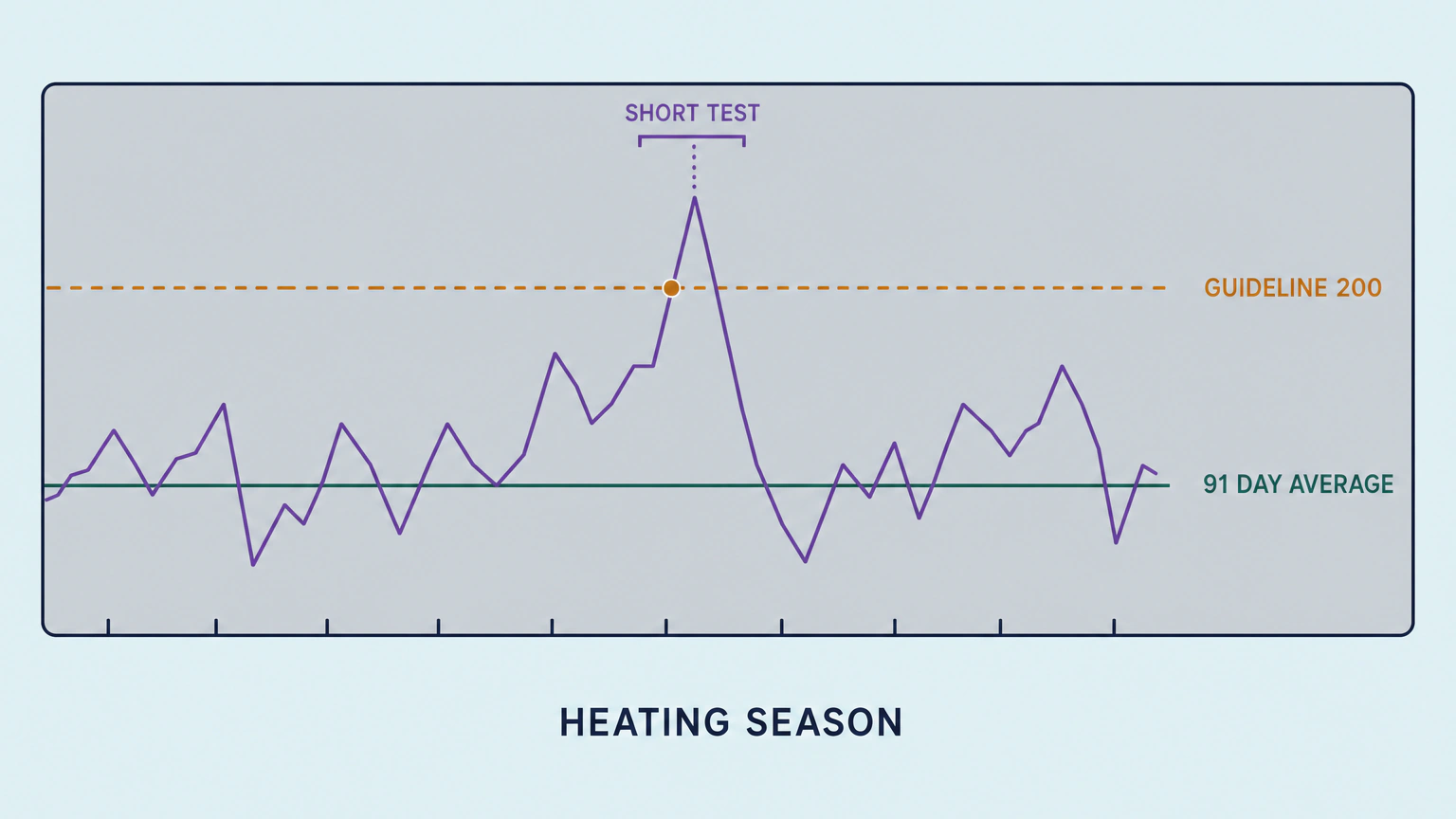
A short test can land on a spike well above 200 Bq/m3, or on a quiet week well below it. The 91 day average is the number Health Canada asks you to act on.
A kit you mail in, or a certified professional
Most people should buy a long-term mail-in kit and stop shopping. It's a detector, instructions and a return envelope, and Health Canada puts the cost of testing at $30 to $60. Provincial health pages differ a little: HealthLink BC says about $30 to $50, Manitoba Health $50 to $100. Buy one, run it, mail it back.
The other two routes solve other problems. An electronic monitor gives a live reading plus a long-term average you read yourself, which suits anyone testing more than one home. Pick a model that has passed C-NRPP performance testing, and read the average rather than tonight's figure. A certified measurement professional handles the placement and gives you a report, which helps when another party needs the result documented.
| Route | What it costs | What you get | When it is the right choice |
|---|---|---|---|
| Long-term mail-in kit | About $30 to $60 (Health Canada); HealthLink BC publishes $30 to $50, Manitoba Health $50 to $100 | A detector, instructions, a return envelope and a lab report of your average over the test period, in three to six weeks | Almost every homeowner testing their own home for the first time |
| Electronic radon monitor | Bought once and reused; choose a model that has passed C-NRPP performance testing | A live reading plus a long-term average you read yourself after 91 days, and a device you can lend on afterwards | Anyone who wants to watch the number, or who will test more than one home |
| C-NRPP certified measurement professional | Quoted per job; no national published rate | A long-term measurement placed and reported by a professional | A sale or purchase, an unusual building, or a result another party needs documented |
Where the detector goes, and where it must never go
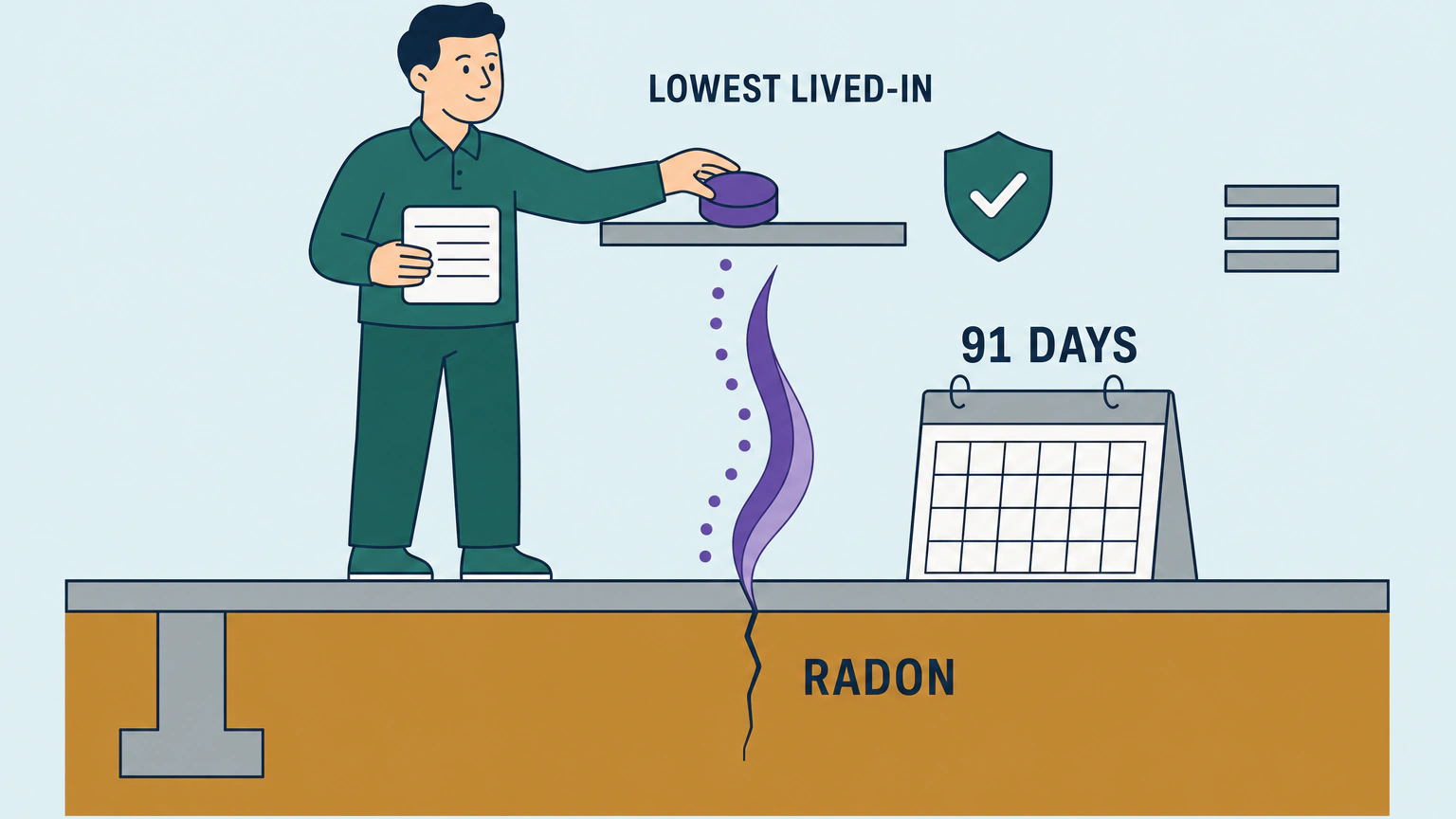
Placement is where do-it-yourself testing goes wrong, and Health Canada's instruction sheet is blunt about it. The device goes on the lowest lived-in level, at breathing height, on something flat. Then you leave it alone.
- On the lowest level of the home you actually live on, for more than four hours a day
- At breathing height, between half a metre and two metres off the floor
- On a flat surface such as a table, shelf or desk, or hung from the wall or ceiling
- Not in a kitchen, bathroom, laundry room, closet or unfinished basement
- Not near a window, door, vent or exterior wall
- Not near a fireplace, a heat source or direct sunlight
- Not near a television, fridge, microwave or other appliance
- Left alone for the full 91 days, with the start date, end date and room written down
Keep the lab report when it arrives, with those three details beside it. If you sell the house, or argue with an installer about whether the system worked, that's your evidence.
Reading your result, including the grey zone around 200
Three to six weeks after you mail the detector back, the lab reports a number. Here's the context.
Compare that number, and only that number, to 200 Bq/m3. A lab report from a passive kit is already an average across the whole test, which is what the guideline asks for. An electronic monitor is different: the screen may show the last day or the last week, so go into the device or the app for the long-term average first.
At 200 or above, the two year window is gone
Health Canada's current instruction is one sentence: "If you've tested your home, and the radon level is above the Canadian guideline of 200 Bq/m3, Health Canada recommends that you take corrective action to lower the level within 1 year." The higher your number, the sooner you should move. The fix should get the level as low as you practically can, not just under the line.
Now the part that matters if you've been reading around. Health Canada used to split that deadline in two: under two years between 200 and 600 Bq/m3, under one year above 600. That was its own wording until sometime between the autumn of 2024 and the spring of 2025. It's gone now.
You'll meet the old rule on Canadian pages you would reasonably trust. The Canadian Lung Association's radon page still tells a reader between 200 and 600 to repair the home in the next two years. If somebody told you that you had two years, you have one.
The 25 per cent wobble around borderline results
Repeat the same test under the same conditions and the result can still differ. Health Canada points to North American standards from the Canadian Standards Association and the American National Standards Institute, which "consider it acceptable for repeated results to vary by up to plus or minus 25%". A result slightly below 200 may truly be over the guideline. A result slightly above may truly be under.
So a result near 200 deserves a close look. Health Canada doesn't turn the plus or minus 25 per cent allowance into a fixed decision band. It says only that a result slightly below the line may be over it, and one slightly above may be under.
Below the guideline is also not the same as zero. About a quarter of the homes in the 2024 Cross-Canada Survey sat between 100 and 199 Bq/m3, and Health Canada is clear that no level is risk free. Lowering your exposure still lowers your risk.
We're relaying Health Canada's guidance, not judging your risk. If somebody in the house smokes, used to smoke, or has lung disease, take the number to a doctor as well as to a mitigator.
Fixing a high reading, and who should do it
The standard fix is active soil depressurization, also called sub-slab depressurization. A pipe goes through the foundation floor. A small fan draws the soil gas out from under the slab and sends it outside through an exterior wall or above the roof line before it can get into the house. Health Canada says a system "can be installed in less than a day" and will cut the level by more than 80 per cent in most homes.
Everything else does less. Sealing cracks helps, though the seals age and need looking after. Extra ventilation helps too, and Health Canada puts a figure on it: in most homes a heat recovery ventilator might reduce radon levels by 25 to 50 per cent, at $1,500 to $3,500 installed. An HRV is work for HVAC contractors and a reasonable thing to own. It isn't a substitute for the pipe and the fan when your number is well over the guideline.
Red flag: three pitches worth a pause. A free radon test that arrives with a contract to sign on the spot. A three day reading used to sell a mitigation system that same afternoon, when the decision needs a 91 day average. And a quote from somebody who won't give you a certification number you can check. The move is the same every time: slow down, get the long-term number, and check it against the public list before you pay anything. If you already signed at the door, your cancellation rights are the ones we set out in is duct cleaning worth it in Canada.
What the fix costs, from two sources that disagree
Nobody publishes a reliable national price for a radon fix, and the two Canadian sources worth quoting disagree. Health Canada's consumer fact sheet puts reduction at $2,000 to $4,000, depending on the size and design of the home. Take Action on Radon says its own data shows a system ranging from $3,000 to $11,000, and reports an average of about $2,700 across hundreds of systems installed between 2013 and 2021.
Those figures don't fit together neatly. Take Action on Radon doesn't explain why its roughly $2,700 historical average sits below its current $3,000 lower bound. We couldn't find a current Canadian figure that reconciles them, and we looked. Get two written quotes, and treat every published number, these included, as a sanity check rather than a price.
| Source | Figure published | What the figure is based on |
|---|---|---|
| Health Canada | $2,000 to $4,000 | Its own consumer fact sheet, which says the cost depends on the size and design of the home and the work needed |
| Take Action on Radon | $3,000 to $11,000 | The organisation's own data on the range of installed systems, on its reducing-radon page |
| Take Action on Radon | About $2,700 on average | Hundreds of mitigation systems installed between 2013 and 2021, from its Radon Reduction Sweepstakes reports |
Check the certification number before you hand over a deposit
C-NRPP, in its own words, "provides training and certification to radon professionals". It also runs the two tools you want before money changes hands. C-NRPP says its list of certified professionals can be searched by province and postal code. A separate check lets you type in one professional's certification number and confirm it.
So ask for the number, then check it yourself. It takes a minute and tells you more than any brochure. Take Action on Radon describes C-NRPP as a program run by the Canadian Association of Radon Scientists and Technologists, with oversight by Health Canada.
Get the scope in writing before you pay a deposit, with the follow-up test in it. Measuring is the only way to know the level actually came down. Health Canada asks you to test again the next heating season after the system goes in, then every five years while an active system runs.
Who should test first, and when to book it
Every Canadian home should be tested, and some should be tested this month. The best national numbers come from the 2024 Cross-Canada Survey, run by the Evict Radon National Study team with Health Canada, CAREX Canada and the BC Centre for Disease Control. Among the single-detached, semi-detached and row-type homes it covers, 17.8 per cent were at or above 200 Bq/m3, roughly one in five. Another 24.2 per cent were between 100 and 199. The weighted geometric average was 84.7 Bq/m3.
The spread across the country is wide.
| Region, as the survey groups it | Share at or above 200 Bq/m3 |
|---|---|
| Canada overall | 17.8 per cent (about 1 in 5) |
| Atlantic Canada | About 1 in 3 |
| Central Canada (Ontario and Quebec) | About 1 in 6 |
| Prairies and Northwest Territories | About 1 in 5 |
| Pacific Interior and Yukon | About 1 in 3 |
| Pacific Coastal (BC coast, Lower Mainland, Vancouver Island) | About 1 in 75 |
Those are the survey's own regional groupings, and they hide plenty. Two houses of the same design on the same street can land on opposite sides of the guideline.
Hold two numbers together. The older Cross-Canada Survey from the late 2000s put the national figure at 6.9 per cent, and Health Canada's printed reduction guide still says approximately 7 per cent. The 2024 survey says 17.8 per cent. We're not going to pick the scarier number and drop the other one: the newer and larger survey found far more high homes, and 17.8 per cent is its current estimate for those housing types. A regional share is a reason to test, never an answer.
Renters, basement apartments and the four hour rule
A basement apartment sits inside the guideline's normal occupancy area, and Health Canada says so directly. That makes radon a live question for tenants and small landlords, and the four hour rule settles it. Spend more than four hours a day down there and the guideline is about your air.
If you rent, test the unit you live in and send the result to your landlord in writing. Keep a copy. Health Canada's testing guidance applies to homes, but every province and territory writes its own tenancy rules on repairs and entry, so a dated written record is the useful thing you can produce on your own.
If you own the unit, the upfront fix is usually a few thousand dollars, and a verification test shows whether the system lowered the radon level.
Buying or selling, and what a radon result does to a deal
Health Canada's long-term radon test takes at least 91 days, which may not fit a transaction's subject-removal period. Health Canada points to a holdback clause as one possible way to finish the test after transfer and release funds for testing and mitigation if needed. A certified measurement professional can handle the long-term test, but does not shorten the protocol.
Our own cost profiles put a Canadian home inspection at about $349, with most falling between $297 and $415. That's what home inspectors charge, and a radon measurement is a separate purchase.
If you're selling a house with a system in it, say so and show the verification test. A mitigated home with a working fan and a measurement behind it beats an untested one.
Questions Canadian homeowners ask about radon
How long does a radon test have to run?
At least 91 days, and at least 91 of those days have to fall inside the heating season. Health Canada recommends three to twelve months, and a longer test estimates your annual average better. You can't compare a short reading to the guideline at all. If your test misses the heating season and comes back low, run another one next winter.
What counts as a safe radon level in Canada?
There isn't one. Health Canada says plainly that no level is considered risk free. The guideline is 200 Bq/m3, the point where it recommends corrective action. Below that, lower is better: the survey's 100 to 199 Bq/m3 group was 24.2 per cent.
What should I do if my result is 200 Bq/m3 or higher?
Get the level down within one year, sooner if the number is high. Hire a mitigation professional certified by C-NRPP, ask for the certification number, and check it before paying a deposit. Expect a pipe through the foundation floor and a fan. Health Canada says the system can be installed in less than a day, and a follow-up measurement shows whether it worked.
How much does it cost to fix a high radon level?
A few thousand dollars, with real spread. Health Canada publishes $2,000 to $4,000. Take Action on Radon publishes $3,000 to $11,000, plus an average of about $2,700 across hundreds of systems installed from 2013 to 2021. Health Canada says the cost depends on the size and design of the home and the work needed. Get two written quotes.
Are free radon test kits available in Canada?
Sometimes, and it's local rather than national. Some libraries and community groups lend electronic radon monitors, but Health Canada says short library loans are screening only. You still need a long-term test of at least three months during the heating season. Free kit giveaways also depend on local campaigns. Ask your library, your municipality and your public health unit before you buy.
How often should I test again?
Test again the next heating season after a basement renovation, a new furnace, new windows or insulation, major digging beside the foundation, or new structural damage where it meets the ground. Retest if your last test missed the heating season and came back under 200. With a system running, Health Canada asks for a test every five years.
Order a long-term detector this month. Put it on the lowest floor you actually live on, at breathing height, well away from the kitchen and the laundry. Set a reminder for 91 days. And if the number comes back at 200 or higher, check the certification number before anybody drills a hole in your floor.