

On this page
The short answer
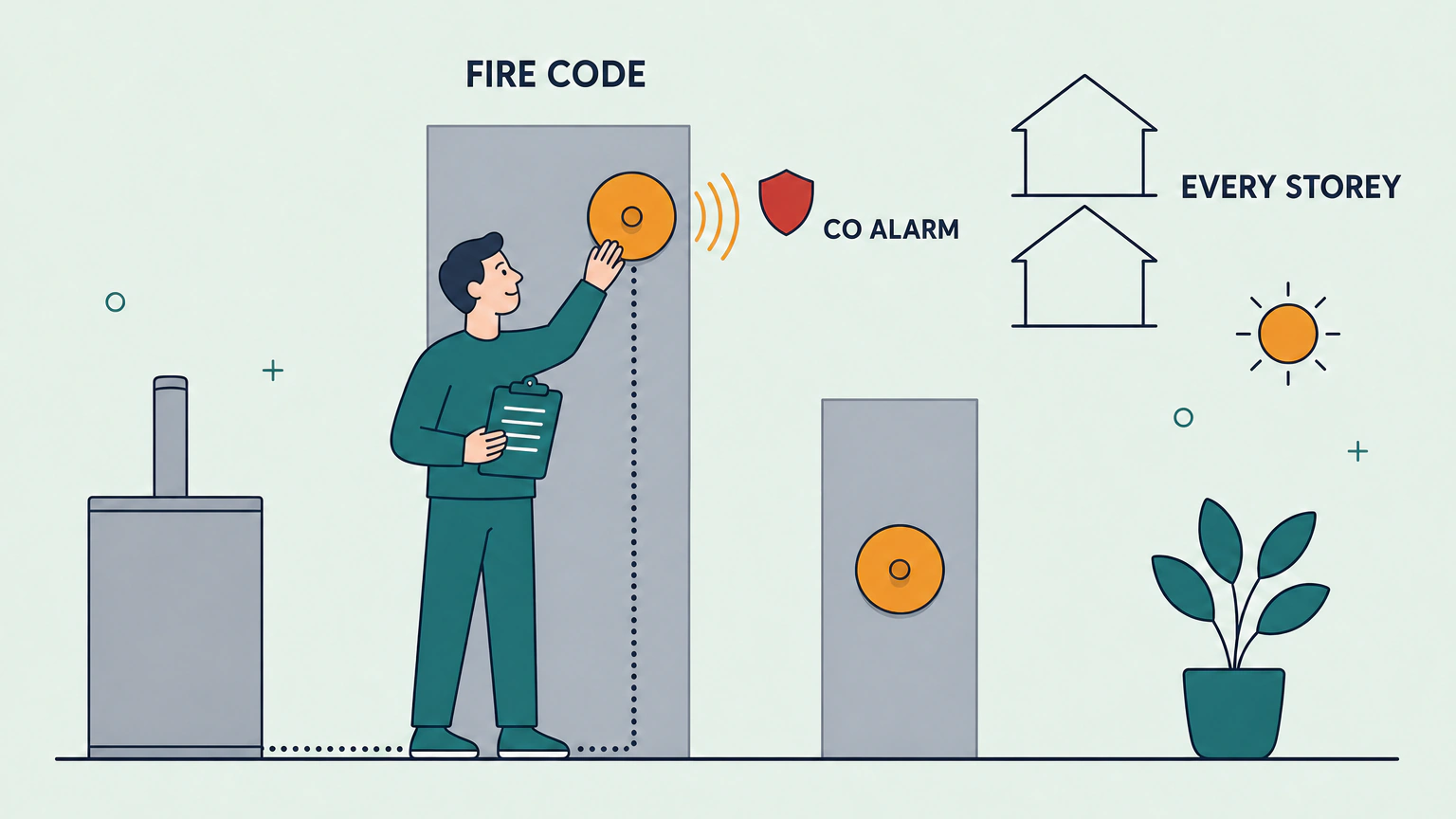
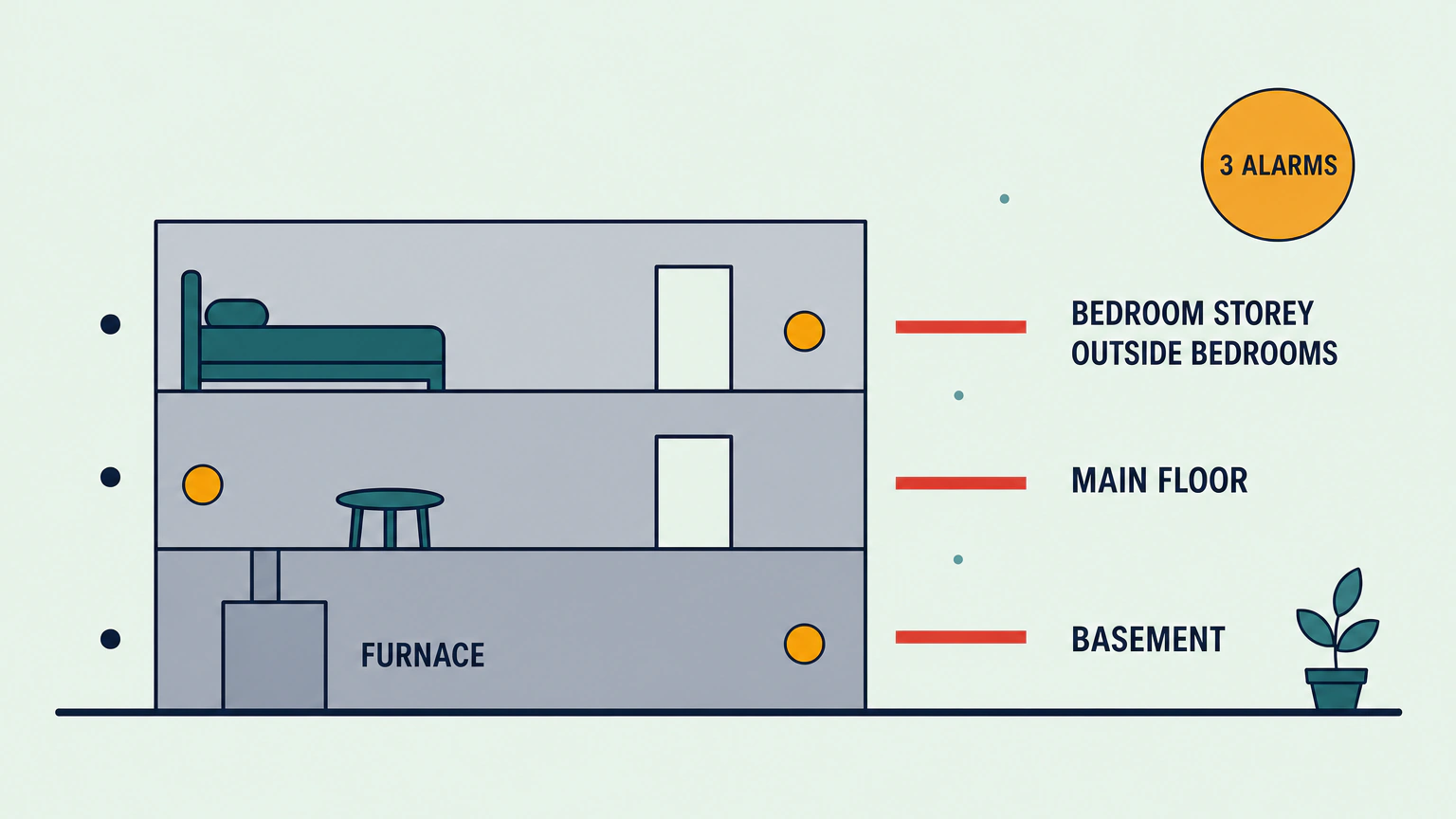
Count the storeys in your home, and count the basement as one of them. Put one alarm in the hallway or area outside each sleeping area; on every storey without one, put one anywhere on that storey. If one storey has two separate sleeping areas, it needs two alarms. For most Ontario houses that means one, two or three devices. Note the wording as you shop: the Fire Code calls these alarms, never detectors.
What changed on January 1, 2026
The rule before 2026, and the rule now
The old rule, from O. Reg. 194/14, asked for one thing: an alarm adjacent to each sleeping area in the suite. A furnace in an unfinished basement two floors below the bedrooms needed nothing of its own.
O. Reg. 87/25 revoked that section and replaced it, in force January 1, 2026 under its section 97(2). Five things moved.
| Requirement | Before January 1, 2026 | Since January 1, 2026 | Where it says so |
|---|---|---|---|
| Where alarms go | Adjacent to each sleeping area | Adjacent to each sleeping area, and on each storey without one | 2.16.2.1(1) |
| What triggers the rule | Fuel-burning appliance, fireplace or storage garage | Adds heating air from a forced-air fuel-burning appliance outside the building | 2.16.1.1(1) |
| Buildings covered | Residential occupancy | Residential or care occupancy, retirement homes named | 2.16.1.1(1) and (3) |
| Units beside a service room or garage | Adjacent to each sleeping area | Adds one on each storey of the unit without a sleeping area | 2.16.2.1(2) and (3) |
| Homes built to the current Building Code | Not addressed | Does not apply where alarms went in under the Building Code as it read on or after January 1, 2025 | 2.16.1.1(2) |
The exemption almost nobody mentions
Sentence 2.16.1.1(2) switches the entire section off for a building where carbon monoxide alarms "have been installed in the building in accordance with the Building Code as it read at any time on or after January 1, 2025". Not a softer rule. The section simply does not apply.
That covers buildings where the alarms were installed through new construction or renovation under the Building Code as it read on or after January 1, 2025. It turns on the same question as when an Ontario project needs a permit: which code your work was built under. If you are unsure, assume the retrofit rule applies, and ask your local fire department, which enforces the Fire Code in your area.
Does the rule apply to your home at all
The four triggers, in the Code's own words
Sentence 2.16.1.1(1) applies the section to every building containing a residential occupancy or a care occupancy where the building contains "a fuel-burning appliance", "a fireplace", or "a storage garage", or where the occupancy "is served by a forced-air fuel-burning appliance not contained within the building".
A fuel-burning appliance burns natural gas, propane, oil or wood: furnace, water heater, gas range, wood stove, fireplace insert. A flue, named alongside them at 2.16.2.1(1), is the pipe or chimney carrying those gases out. A storage garage is defined in Division A as a building or part of a building intended for parking motor vehicles with no provision for repairing them, which is why an attached garage counts.
All-electric homes, detached garages and cottages
Some readers are not caught at all. An all-electric home with no fireplace, no wood stove and no attached garage contains none of the triggers, so Section 2.16 does not apply. A detached garage is a separate building, so it is not a trigger either.
Cottages are covered. The Office of the Fire Marshal names detached and semi-detached houses, townhouses and cottages as the home types the rule reaches.
None of that makes carbon monoxide impossible. Ontario warns about barbecues in a garage, generators near windows and doors, and vehicles left running indoors, so an alarm still earns its keep.
Apartments and condo units work differently
In a unit, what your walls touch matters as much as what sits inside them.
| Where you live | An alarm is required if | And it goes |
|---|---|---|
| House, semi, townhouse or cottage | the home has any of the triggers above | adjacent to each sleeping area, and on each storey without one |
| Apartment or condo unit with its own appliance, flue or fireplace | Section 2.16 applies to the building and the appliance, flue or fireplace is inside your unit | the same, applied within your unit |
| Unit sharing a wall, floor or ceiling with the service room or garage | that appliance or storage garage adjoins your unit | the same, applied within your unit |
| Unit heated by air from an appliance elsewhere in the building | your unit is directly heated by that forced-air appliance | the same, plus directly heated public corridors, no more than 25 m apart in an undivided corridor |
The check further down this page is built for houses. In an apartment or condo unit, work from this table instead.
How many alarms you need, and where each one goes
How the Fire Code counts a storey
Division A defines a storey as the portion of a building between the top of one floor and the top of the floor above it, or, where there is no floor above, between the top of the floor and the ceiling. Nothing there turns on whether the space is finished, so a basement is a storey.
A bungalow with a basement is therefore two storeys: one alarm outside the bedrooms, one in the basement. A two-storey house with a basement is three. Split-level homes can be harder to classify under the Code's storey definition, so confirm the count with your local fire department.
Adjacent to each sleeping area means the hallway, not the bedroom
This is the detail almost every article on this subject loses. On a storey with bedrooms, the alarm does not go inside a bedroom. Ontario's guidance is explicit: adjacent to each sleeping area "means the hallway or area outside the sleeping area", for example the hallway nearest multiple bedrooms.
Where bedrooms on one storey open off two separate hallways, each hallway serves its own sleeping area and needs its own alarm.
Sentence 2.16.2.1(8) adds the test that matters at 3 a.m. An alarm adjacent to a sleeping area must be audible throughout it even with the doors closed.
Check your own home
The check below applies the same reading of the regulation to your own house: six questions about storeys, sleeping areas, what your home burns and what you already own. It covers houses, semis, townhouses and cottages, and returns the legal minimum.
Check your own home
Answer six questions about your house and you'll see what the Ontario Fire Code has required since January 1, 2026. This check covers houses, semis, townhouses and cottages. Apartment and condo units follow a different rule, set out in the table above.
The Fire Code counts a basement as a storey. A storey is the space between the top of one floor and the top of the floor above. If you have a split-level and aren't sure how many storeys the Code counts, ask your local fire department.
Bedrooms off one shared hallway can count as a single sleeping area. Bedrooms reached by separate hallways, or in separate parts of the house, may each need their own alarm.
What the Fire Code requires
Your home needs 3 carbon monoxide alarms.
You have 1. Add 2.
- 1 adjacent to the sleeping areas, one for each separate sleeping area, in the hallway or space outside the bedrooms rather than inside a bedroom.
- 2 on the storeys that have no sleeping area. On those storeys the alarm can go anywhere on the storey.
This is the legal minimum. Bedrooms that share one hallway may form one sleeping area. Bedrooms served by separate hallways or separate areas may need separate alarms. An alarm next to a sleeping area must be audible inside the bedrooms with the doors closed.
Source: O. Reg. 213/07, Fire Code, Division B, Sentences 2.16.1.1(1) and (2) and 2.16.2.1(1), as consolidated from January 1, 2026.
The answers this check starts from, for a three-storey home with bedrooms on one storey:
- Storeys, counting the basement3
- Storeys with a bedroom or sleeping area1
- Separate sleeping areas in total1
- What the home hasA fuel-burning appliance
- Working carbon monoxide alarms now1
- Alarms installed under the Building Code on or after January 1, 2025No
If you have a question about your own building, contact your local fire department. It enforces the Fire Code in your area.
Buying, mounting and replacing an alarm
Which alarms are legal in Ontario
Sentence 2.16.2.1(6) accepts an alarm meeting CSA-6.19 or UL 2034. The Office of the Fire Marshal's buying advice is simpler: look for the mark of a recognized testing agency, such as CSA, ULC or ETL. Combined smoke and carbon monoxide units are permitted.
Sentence 2.16.2.1(5) is the part that saves money. For an alarm required by Section 2.16, hardwired, battery-operated and plug-in devices are all permitted, so this retrofit rule does not necessarily require hiring anyone. Replacing a hardwired unit is the one case for calling licensed electrical contractors.
Where on the wall or ceiling it goes
Much of the advice online says to mount these alarms low on the wall. Ontario's rule does not. Sentence 2.16.2.1(7) requires the alarm to be placed at the manufacturer's recommended height, and only where the manufacturer has recommended no height does the Code fall back on "on or near the ceiling". The leaflet in the box is the legal standard for your device.
When it expires, and why a new battery will not help
Alarms wear out, and replacing them is a duty rather than a suggestion. Article 6.3.4.7 says a carbon monoxide alarm "shall be replaced within the time frame indicated in the manufacturer's instructions", and the replacement must meet the same standards as the original.
Those time frames are shorter than people expect. Kidde says its carbon monoxide alarms reach the end of a 7 or 10 year lifespan, that the unit then chirps roughly every 30 seconds with a flashing red light, and that replacing the battery will not stop it, because the sensor is finished, not the cell.
The ten-minute check before the heating season 1. Count the storeys, including the basement. 2. Note where the alarms are, and whether the bedroom-floor one sits outside the bedrooms. 3. Take each alarm off its bracket and read the date on the label. 4. Press and hold the test button until it sounds. 5. Replace batteries in battery-operated units, then test again. 6. Replace any alarm past the date in its instructions. 7. Stand in each bedroom, door closed, while someone tests the hallway alarm. 8. Book the annual inspection of the furnace, water heater, fireplace and vents. 9. Clear snow and debris from outside vents and chimneys. 10. Teach everyone which pattern means smoke and which means CO.
What the sounds mean, and what to do
These patterns are Kidde's guidance for its own alarms. Manufacturers set their own signals, so check your manual.
| What you hear or see | What it usually means | What to do |
|---|---|---|
| Four short beeps, five seconds of silence, four short beeps, repeating | Carbon monoxide sensed | Get out and call 9-1-1 from outside |
| One chirp about every 60 seconds | Low battery | Replace the battery, then test |
| One chirp about every 30 seconds with a flashing red light | End of life or a fault; a new battery will not stop it | Replace the alarm, it can no longer detect CO |
| "Err" or a number on a digital display | An error code, or a live reading | Treat any number as CO, get out and call 9-1-1 |
| Three long beeps repeating on a Kidde combination unit | Smoke sensed | Treat it as a fire alarm |
Red flag: three things that are not compliance Taking the battery out to stop a chirp. Article 6.3.4.6: no person shall disable a carbon monoxide alarm. A 30-second chirp usually means the unit can no longer detect anything. One alarm in the hallway and nothing in the basement. A furnace storey with no bedroom on it needs its own alarm. An alarm bought years ago and never dated. The duty runs from the manufacturer's instructions, not from how the device looks.
Four beeps means get everyone out
Four short beeps, five seconds of silence, then four short beeps again is the alarm condition. Ontario's instruction leaves no room for interpretation: get everyone out of the home immediately and call 9-1-1 or your local emergency number from outside the building.
Not after opening windows. Not after checking the furnace. Carbon monoxide is invisible and has no smell, and its early symptoms belong to a dozen harmless things. The alarm is the only thing in the house that can tell the difference.
Who is allowed to find and fix the cause
Once the fire service has cleared the building, something still produced the gas. Section 3(1) of O. Reg. 215/01, under the Technical Standards and Safety Act, 2000, says no person shall perform the functions of a certificate holder without first obtaining a certificate from the director. Its certificate classes include gas technician 1, 2 and 3 and oil burner technician 1, 2 and 3.
Prevention runs on the same trades. Ontario's guidance is to have appliances, chimneys and vents cleaned and inspected by professionals every year before cold weather, work for HVAC contractors near you and chimney and vent cleaning companies. If your trigger is a wood stove, read what a WETT inspection actually covers. And a safety inspection isn't a duct-cleaning package sold at the door: is duct cleaning worth it in Canada.
Pro tip: the question to ask before you book Ask which certificate the technician attending will hold. For gas or oil work, expect a gas technician or oil burner technician certificate.
Our own aggregate runs $3,866 to $7,466 across 911 HVAC cost profiles and $166 to $520 across 662 in electrical: platform-wide averages across all jobs in a category, not the price of an inspection.
Renting in Ontario: who is responsible, and what a breach costs
Under Articles 2.16.1.2 and 6.3.4.2, only the landlord counts as the owner for these rules, so installing and maintaining the alarms is the landlord's job, never the tenant's.
Give the tenant a copy of the manufacturer's maintenance instructions. Test the alarms annually and after every change of tenancy, after a battery is replaced, and after any change to the electrical circuit. Keep every alarm and its power supply working.
Tenants have one duty: tell the landlord as soon as you know an alarm is disconnected, not operating, or impaired. Article 6.3.4.6 binds everyone equally: no person shall disable a carbon monoxide alarm.
The penalties aren't symbolic. Under section 28(3) of the Fire Protection and Prevention Act, 1997, an individual convicted of an offence faces a fine of not more than $50,000 for a first offence and not more than $100,000 for a subsequent one, or up to a year in jail, or both. Section 28(4) sets a corporation's ceilings at $500,000 and $1,500,000. Fire services also ticket smaller matters under the Provincial Offences Act, in amounts set by a court schedule.
Frequently asked questions
How many carbon monoxide alarms do I need in an Ontario house?
One adjacent to each sleeping area, plus one on every storey without a sleeping area. Count the basement as a storey: a two-storey house with a basement and the bedrooms upstairs needs three, in the upstairs hallway, the main floor and the basement.
Do I need a carbon monoxide alarm if my home is all electric?
Not under Section 2.16. It applies only where the building has a fuel-burning appliance, a fireplace or a storage garage, or is heated by air from an appliance outside it. An all-electric home with none of those is outside the rule.
Does a carbon monoxide alarm expire?
Yes, and replacing it is a legal duty. Article 6.3.4.7 requires an alarm to be replaced within the time frame in the manufacturer's instructions. Kidde puts its carbon monoxide alarms at a 7 or 10 year lifespan, so read the label on the back of yours.
Why is my carbon monoxide alarm chirping every 30 seconds?
On a Kidde alarm that usually means end of life or a fault, not a flat battery. Kidde says a quick beep every 30 seconds with a flashing red light means the unit has reached the end of its lifespan and will not stop for a new battery.
Do landlords have to provide carbon monoxide alarms in Ontario?
Yes. For rental suites the Fire Code treats only the landlord as the owner, so installation and maintenance are the landlord's duty. The landlord must also test the alarms annually, after a battery change, after a change to the circuit and on every change of tenancy.
Can the alarm go on the ceiling, or does it have to be low on the wall?
Follow the manufacturer's instructions. Sentence 2.16.2.1(7) requires the alarm to be placed at the manufacturer's recommended height, and only where no height is recommended does the Code default to on or near the ceiling. No Ontario rule requires alarms low on the wall.
Is a combination smoke and carbon monoxide alarm allowed in Ontario?
Yes. Ontario's guidance notes that many devices combine a smoke alarm and a carbon monoxide alarm in one unit. A combined device still has to meet CSA-6.19 or UL 2034 on the carbon monoxide side, and everyone should know which pattern is which.
Verified against O. Reg. 213/07 (Fire Code), consolidation period beginning January 1, 2026, e-Laws currency date August 12, 2026, with O. Reg. 87/25, O. Reg. 215/01, the Fire Protection and Prevention Act, 1997, and the Office of the Fire Marshal's fact sheet of December 17, 2025.
Once the alarms are sorted, the appliance behind them is the part with a season attached. Book the annual inspection before the furnace starts up, and browse Ontario professionals by city.