

On this page
What a central air conditioner replacement costs in Canada
Canadian pages on central air conditioner prices don't agree on one number, because each one prices a slightly different job. Here's what six of them publish, and the job behind each figure.
What six Canadian price pages publish for a central AC replacement
| Source | Where | Installed price it publishes | What the figure covers |
|---|---|---|---|
| Home Depot Canada installation program | Canada | $5,000 to $8,000, $5,500 average | A 2-ton unit in a 1,500 sq ft home, before tax, old unit removed, disposal extra |
| FurnacePrices.ca | Canada | $4,000 to $7,000 | Average installed price, from quote requests made through the site |
| Homeowner.ca | Canada | $5,500 to $8,000; budget installs from $3,500 | A 2 to 3 ton system with basic electrical work, a thermostat and startup |
| Custom Contracting | Ontario | $3,500 to $8,500 | Installed, for most homes |
| Dynamic Heating and Cooling | Hamilton | $3,500 to $7,500; larger or high-efficiency systems $10,000 and up | Fully installed |
| Patterson Mechanical | Manitoba | $3,500 to $5,000; high-efficiency $5,000 to $7,500 | A same-size swap reusing the existing electrical and ductwork |
These are the ranges each page publishes, not quotes. Home Depot Canada says its figures exclude tax. The other five pages don't say whether tax is included.
Five of the six ranges cover everything from $5,500 to $7,000. The exception is Patterson Mechanical's same-size swap in Manitoba, which reuses the wiring and ducts already in the house and tops out at $5,000. The pages part ways at the edges, and that's where your own house decides the price.
If you want one anchor, use Home Depot Canada's. It's the only figure pinned to one unit size in one house size: $5,500 on average for a 2-ton unit in a 1,500-square-foot home, before tax.
Why two quotes for the same house can be thousands apart
Start with the coil, the part that sits on your furnace. Whether it gets replaced is often the biggest single swing between two quotes. FurnacePrices.ca puts the coil and line set together at $400 to $800 of a typical $5,500 job. Custom Contracting, an Ontario contractor, prices a new coil alone at $800 to $1,800 installed. The two figures don't agree, and that's the lesson. Ask for the coil as its own line, so you can see what you're paying for it.
After the coil, the rest of the list runs roughly in order of how much it moves the price:
- the unit's size in tons, and its SEER2 rating (the efficiency score, where a higher number means less power for the same cooling);
- the electrical work, such as a new circuit, a disconnect switch beside the outdoor unit, or sometimes panel work;
- the line set, the pair of copper refrigerant pipes between inside and outside;
- moving the outdoor unit, or pouring it a new pad;
- taking the old unit away, which Home Depot Canada lists with "disposal fees extra".
Where you live matters too. Home Depot Canada's own province tables price the same two-ton models higher in BC and Alberta than in Ontario, by $300 to $1,000 at either end of every range.
Size is the one driver nobody should guess at. The right size comes from a heat-gain calculation, not from square footage. Our furnace guide explains how a heat-gain calculation sizes the equipment. If you're planning insulation work anyway, do it first. Cutting the heat your house gains before anyone sizes the new unit is the cheapest way to need a smaller one.
Replacing the furnace and the AC together
The coil sits on top of the furnace, so the two jobs share a piece of equipment and a visit. That's how a furnace quote ends up with an AC line on it. FurnacePrices.ca puts a combined furnace and central AC install at $7,500 to $12,000 in Canada, with most homeowners paying $8,500 to $10,500. Our furnace guide covers the furnace side of the same job.
The fair yardstick is age. Save on Energy, Ontario's electricity-saving program, gives a central AC's average lifespan as 15 to 20 years. Our view: a working AC under 15 years old isn't a reason to sign a bundle. If the furnace has to go and the AC is 18 and tired, pricing them together makes sense. If the AC is 8 and keeps the house cool, ask for a furnace-only price beside the bundle and compare.
Is R-410A banned in Canada?
No. Canada's rule for refrigerants in equipment is the Ozone-depleting Substances and Halocarbon Alternatives Regulations, and it caps refrigerants product by product. Its list of capped products has six entries, and the home ones are fridges and freezers. The only air conditioning product on it is the commercial or industrial chiller, a large system built for big buildings. A central air conditioner in a house isn't on the list, and the rule hasn't been amended since 2020.
HRAI, the heating and cooling industry's national association, says it plainly: "There are currently no limits to shipping AC or Heat Pumps charged with legacy A1 refrigerants but, practically, they are being phased out by the OEMs to comply with regulations in the United States." OEMs are the equipment makers. HRAI's "legacy A1" refrigerants are the old non-flammable ones, R-410A among them.
So why did the shelves change? The US Environmental Protection Agency capped new residential and light commercial air-conditioning and heat-pump systems at a global warming potential of 700 for installations from January 1, 2025. There is an exception when every specified component was made or imported before that date. Global warming potential, or GWP, measures how much a gas heats the planet compared with carbon dioxide. HRAI adds that most of the air conditioners sold in Canada come from US-based manufacturers. A US rule became a Canadian fact on the showroom floor.
That could change. Environment and Climate Change Canada's 2024 review of the regulation said "The addition of controls on products containing HFCs including refrigeration, air conditioning and heating equipment ... is being considered." Being considered isn't law, so judge a quote on today's rule.
If your quote is for an R-410A unit
It's legal to buy one and legal to install it. The part to weigh is servicing it over its life.
Canada caps how much HFC refrigerant, the family R-410A belongs to, can be brought into the country or made here each year. That cap is called the HFC allowance. It sits at 60% of the base level from 2024 through 2028, then drops to 30% in 2029, 20% in 2034 and 15% from 2036. The allowance for new HFCs shrinks over the unit's 15 to 20 years. That is a fair reason to ask what a recharge might cost later, and whether the R-410A unit's price reflects that. It isn't a reason to refuse one.
If your coil is young and already R-410A, a like-for-like outdoor swap onto it can be the cheapest honest answer.
Red flag: Two things nobody can truthfully tell you in 2026
One is that Canadian law makes it illegal to install an R-410A air conditioner. The other is that your working R-410A unit has to be replaced because of a ban. Neither is true under the federal regulation as it stands. What's true is narrower: new units mostly use a new refrigerant, and the yearly federal allowance for HFCs like R-410A keeps shrinking. If a salesperson leads with a ban, ask them to show you the rule. If the pitch started with a knock, read up on your cancellation rights when the sale started at your door before you sign.
What changes when the new unit runs on R-454B
Most new outdoor units run on lower-GWP refrigerants in a class HRAI describes as A2L: "non-toxic, but slightly flammable." R-454B is one of them, and it's the one Carrier sells as Puron Advance. Puron is Carrier's name for R-410A, and its own FAQ is blunt about mixing them: "No, Puron Advance is not a drop-in replacement for Puron." The company says R-454B "should not be used in R-410A systems."
A slightly flammable refrigerant changes the work, too. HRAI says the move "will require technicians to be retrained." Carrier says all of its fan coils "will have full leak detection systems already installed in the equipment when shipped." That's Carrier's promise about Carrier's own indoor units, not a rule for every coil on every furnace, so ask what the coil on your quote comes with.
For you, it comes down to two things. Ask whether the installer is trained on the new refrigerant. And expect the old R-410A coil on your furnace to come out, which puts the coil line at the centre of the quote.
The indoor coil is half of your air conditioner
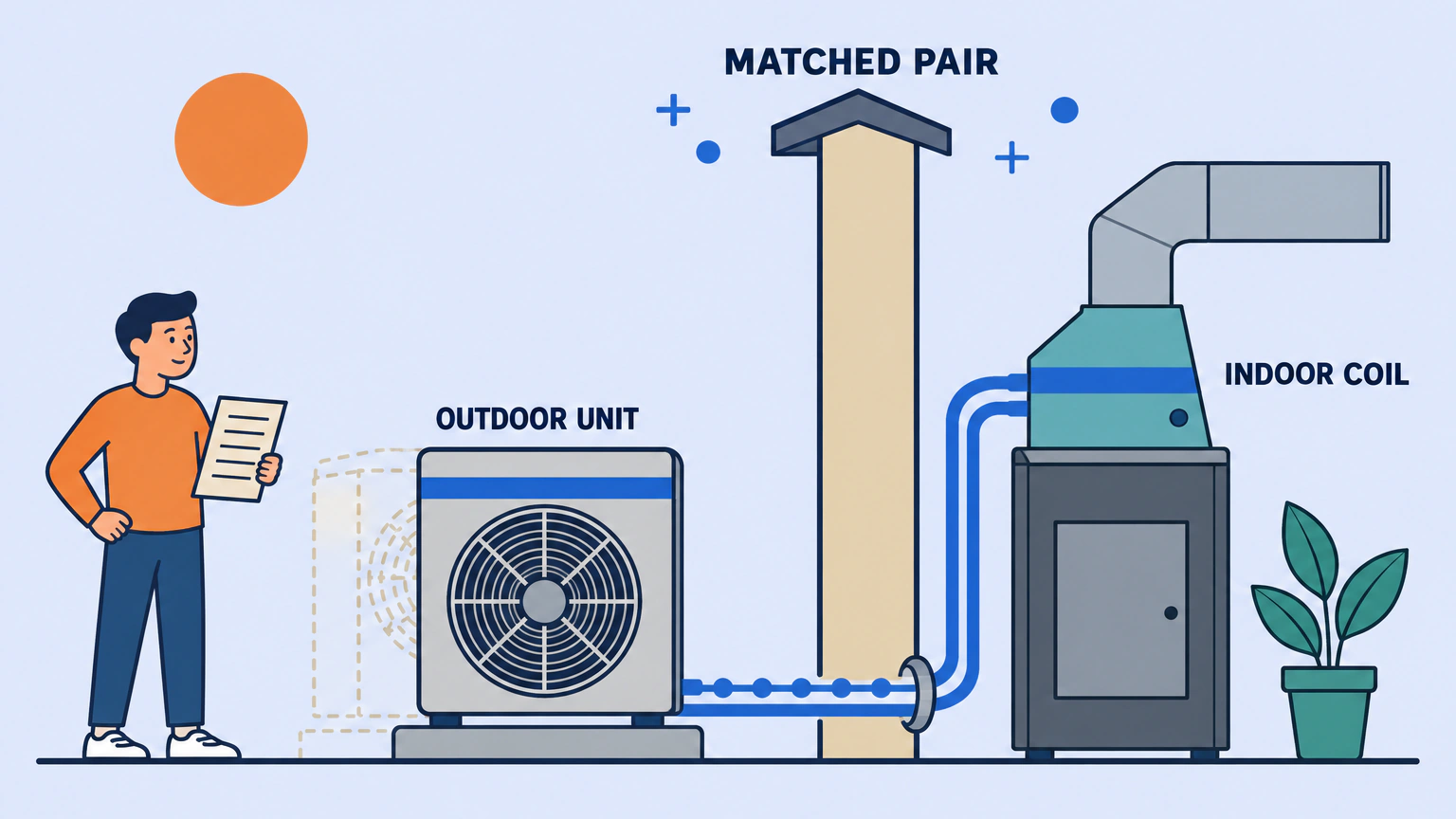
A central air conditioner is a split system. The box outside holds the compressor and a big fan, and people call it the condenser or the outdoor unit. Inside, a second coil sits on top of your furnace, where the furnace blower pushes house air across it, and two copper pipes called the line set run between the two halves. All of it is charged with one refrigerant, and the halves are built to work as a pair.
Carrier puts the consequence in two sentences: "Full furnace coils are not interchangeable. The refrigerant designed for the indoor coil must match that of the outdoor unit."
So a quote for a new R-454B outdoor unit with no coil line on it is incomplete, unless it says, in writing, why your existing coil can stay. This is also where two quotes for the same house split apart. Say one includes a new coil and the other doesn't. At Custom Contracting's $800 to $1,800 for a new coil installed, that one line can be most of the difference between them, and the cheaper quote may simply be the unfinished one.
Line sets are the good news. Carrier says "Linesets can be reused as long as they continue to meet local building codes." It adds that there's no system reason to swap them, because R-454B uses the same type of oil as the old refrigerant. Ask whether yours is being reused, and why it still qualifies.
Repair it, swap the outdoor unit, or replace the pair
Every honest AC quote is one of four shapes. Each replaces something different and leaves you on a different refrigerant.
Four shapes an AC quote can take
| The quote | What gets replaced | Refrigerant afterwards | The question to ask |
|---|---|---|---|
| Repair | The failed part, such as a compressor, a fan motor or a leaking coil | The same as now | What made the part fail, and is that being fixed too? |
| New outdoor unit, same refrigerant | The outdoor unit only, matched to your existing R-410A coil | R-410A | Is my existing coil an approved match for this unit? |
| New matched system | The outdoor unit and the indoor coil, with the line set reused only if it still meets code | A new refrigerant such as R-454B | Which coil model is on the quote, and is the line set staying or being replaced? |
| Heat pump in the AC's place | The outdoor unit and the indoor coil, swapped for a heat pump pair | Whatever the new model is built for | Is the model on NRCan's cold-climate list, and has the rebate been pre-approved? |
The first two shapes keep you on the refrigerant you have. The third moves you to the new one and puts a new coil on the furnace. The fourth does the same with a heat pump, which also heats. Of these four shapes, only a heat pump qualifies under the Ontario Home Renovation Savings Program. A quote is allowed to be any of the four. It has to say which one it is.
When the part that died is the compressor
The compressor is the pump in the outdoor unit, and it's the expensive part. When one fails, the diagnosis includes the outdoor coil, filters and ductwork, along with refrigerant, electrical and control faults.
So a compressor quote on a young system should say what killed the old one, and what's being done about it. On an older R-410A system near the end of its 15 to 20 years, the same money often belongs in a new matched system or a heat pump.
Who's allowed to install your new AC
In Ontario, the law answers this one. Residential AC work belongs to compulsory trades, which means only people holding the right papers may do it. Skilled Trades Ontario lists the Residential Air Conditioning Systems Mechanic (313D) and the Refrigeration and Air Conditioning Systems Mechanic (313A) among the province's 23 compulsory trades. To work in one, a person must hold a Certificate of Qualification, a Provisional Certificate or a Registered Training Agreement. The first is the certificate a journeyperson earns by passing the trade exam, and the last is the agreement an apprentice works under while learning on the job.
The refrigerant has its own rule. Ontario's O. Reg. 463/10 says "No person shall service or test refrigeration equipment that contains a refrigerant unless the person is certified". The same regulation bans letting refrigerant escape into the air or into a building. So the old unit's refrigerant has to be recovered, not released.
The electrical side belongs to the Electrical Safety Authority, or ESA. In its words, "only Licensed Electrical Contractors (with some exemptions, such as HVAC installers) are legally authorized to do electrical work in your home." Ask whether your job needs a new circuit or panel work. If it does, ask who's doing it: the HVAC crew, or a licensed electrical contractor.
How to check a technician in Ontario, BC and Alberta
All three provinces treat the AC trade as compulsory and give you a public way to check a name.
The trade that covers central AC, and where to check it
| Province | The trade | Where to check |
|---|---|---|
| Ontario | Residential Air Conditioning Systems Mechanic (313D) or Refrigeration and Air Conditioning Systems Mechanic (313A), both compulsory | Skilled Trades Ontario's Public Register |
| British Columbia | Refrigeration and Air Conditioning Mechanic, one of the province's 7 compulsory trades | SkilledTradesBC's Verify a Tradesperson's Certification tool |
| Alberta | Refrigeration and Air Conditioning Mechanic, a compulsory certification trade | Alberta's Tradesperson Lookup Tool on Tradesecrets |
Ontario's Public Register is where Skilled Trades Ontario sends you to confirm that a person holds the qualification. One wrinkle: a refrigeration mechanic certified in Quebec can work in Ontario without appearing on it, so a missing name is a question to ask, not proof of anything. BC's tool needs the tradesperson's first and last name and certificate number. Alberta's is the Tradesperson Lookup Tool on its Tradesecrets site. Those are the three provinces we checked. Anywhere else, your provincial apprenticeship authority is the place to ask.
Permits, and where the outdoor unit is allowed to sit
Whether you need a permit depends on your city and on how much electrical work the job involves. Calgary makes a good example, because it spells its rules out. Its permit checklist says "An electrical permit is always required to install an air conditioning unit." Its placement rule says the unit "can only project 1.0 m into any side setback area." A side setback is the strip between your house and the property line that the bylaw keeps mostly clear. A unit that breaks the rule needs a relaxation, which is the city's permission to bend it. In Calgary that costs $579: a $384 permit fee, $32 for advertising and $163 for a completion inspection.
In Ontario, ESA requires a notification or permit for most electrical work. Ask your installer who pulls which permit, and get the permit or notification number on the invoice. Moving the outdoor unit to a new spot is when the setback question bites.
Rebates in 2026, and why a new AC mostly misses them
Start with what's gone. The federal Canada Greener Homes Loan stopped taking applications on October 1, 2025. The last day to send documents for the Canada Greener Homes Grant was December 31, 2025. Some price pages still offer both, so don't build a budget around either.
Ontario's CoolSaver AC discount is gone too. Save on Energy's CoolSaver program took $1,000 off a replacement central AC rated at least 18 SEER (17.2 SEER2), in Ottawa, York Region and one area of Toronto. Its rules required a signed work order by October 1, 2025, and installation by December 31, 2025. The program's page now shows a "404" page-not-found message.
The remaining Ontario option checked here is the Home Renovation Savings Program. Its no-assessment list covers appliances, attic insulation, heat pumps, solar panels and batteries, and smart thermostats. Its assessment stream doesn't mention air conditioners either. The rebate money follows heat pumps.
If the offer on the table is no money down and a monthly payment instead, find out first whether it's a monthly-payment deal that's really a rental.
Ontario's heat pump rebate, if a heat pump takes the AC's place
A heat pump sits in the same outdoor spot and cools the same house, then heats it too. Home Renovation Savings pays $500 per ton, up to $2,000, for a cold-climate air-source heat pump in a home heated by Enbridge natural gas. Where the home is heated by electricity, oil, propane or wood, it pays $1,250 per ton, up to $7,500. Ground-source systems pay more.
The rule that matters if your AC just died is this one: "Pre-approval is mandatory. Installations done before approval are not eligible for rebates." Your contractor applies first, and the unit goes in only after approval. The model must be active on Natural Resources Canada's (NRCan's) cold-climate qualified list, and the contractor must be a participating one. In a July heat wave, it's the easiest step to skip.
If the furnace is on the same quote too, our furnace guide explains why the gas furnace itself earns nothing.
What a complete AC replacement quote shows
Hold every quote against this list before you sign. Each item is something you can check on paper.
- The outdoor unit's make and model, and the indoor coil's make and model, as two separate lines.
- The refrigerant the new system uses, named on the quote.
- If your existing coil is staying, the manufacturer's approval for that exact pairing, in writing.
- The line set: reused or replaced, and if reused, why it still meets code.
- The electrical work: whether a new circuit, disconnect or panel work is needed, and who does it.
- Every permit or ESA notification, who pulls it, and its number on the final invoice.
- Removal of the old unit, with its refrigerant recovered by a certified technician, and any disposal fee.
- Commissioning, the start-up checks, on the job sheet: a pressure test for leaks, a vacuum shown to hold, the measured refrigerant charge and an airflow check.
- Parts and labour warranties stated separately, and who registers the parts warranty with the manufacturer.
- The price before tax, with GST or HST on its own line.
Frequently asked questions
Quick answers for when a quote is already on the table.
Can I still get my R-410A air conditioner recharged?
Yes. Nothing in the federal refrigerant regulation stops a technician from recharging a home AC. Ontario's rule is that the person doing it must be certified. The yearly federal allowance for newly produced or imported HFCs such as R-410A is shrinking, though, so ask how that could affect recharge costs over the unit's remaining life.
Can I just replace the outdoor AC unit?
Sometimes. If the new outdoor unit uses the same refrigerant as your coil and the manufacturer lists the pair as a match, yes. A new R-454B outdoor unit generally needs a coil built for it, because, in Carrier's words, "The refrigerant designed for the indoor coil must match that of the outdoor unit."
Do I need a permit to replace my AC?
It depends on your city and on the electrical work involved. Calgary says an electrical permit "is always required to install an air conditioning unit" and has placement rules for the outdoor unit. In Ontario, ESA requires a notification or permit for most electrical work. Ask your installer who pulls what, and get the numbers on the invoice.
How long does a central air conditioner last?
Save on Energy puts the average at 15 to 20 years. That range is the fair yardstick when a quote proposes replacing an AC that still works, for example alongside a new furnace. A 10-year-old unit that cools the house isn't due, and a 22-year-old one that needs a compressor probably is.
Is there a rebate for a new air conditioner in Ontario in 2026?
The Ontario programs checked here don't offer one for a central AC as such. Save on Energy's CoolSaver discount required installation by December 31, 2025, and the Home Renovation Savings Program doesn't list air conditioners. A cold-climate heat pump in the same spot can qualify for up to $2,000 under Ontario's Home Renovation Savings Program. That tier is for Enbridge Gas customers who heat their homes with natural gas. Approval is required before installation.
Do I need a new line set for a new AC?
Not always. Carrier says line sets "can be reused as long as they continue to meet local building codes." Ask whether yours is being reused, and why it still qualifies, because a new line set is a real cost and a reused one should come with a reason.
Two quotes that name the same outdoor unit and the same coil can be compared on price alone. Two that don't are different jobs, and our HVAC category page lists HVAC contractors near you to ask for the missing lines.