

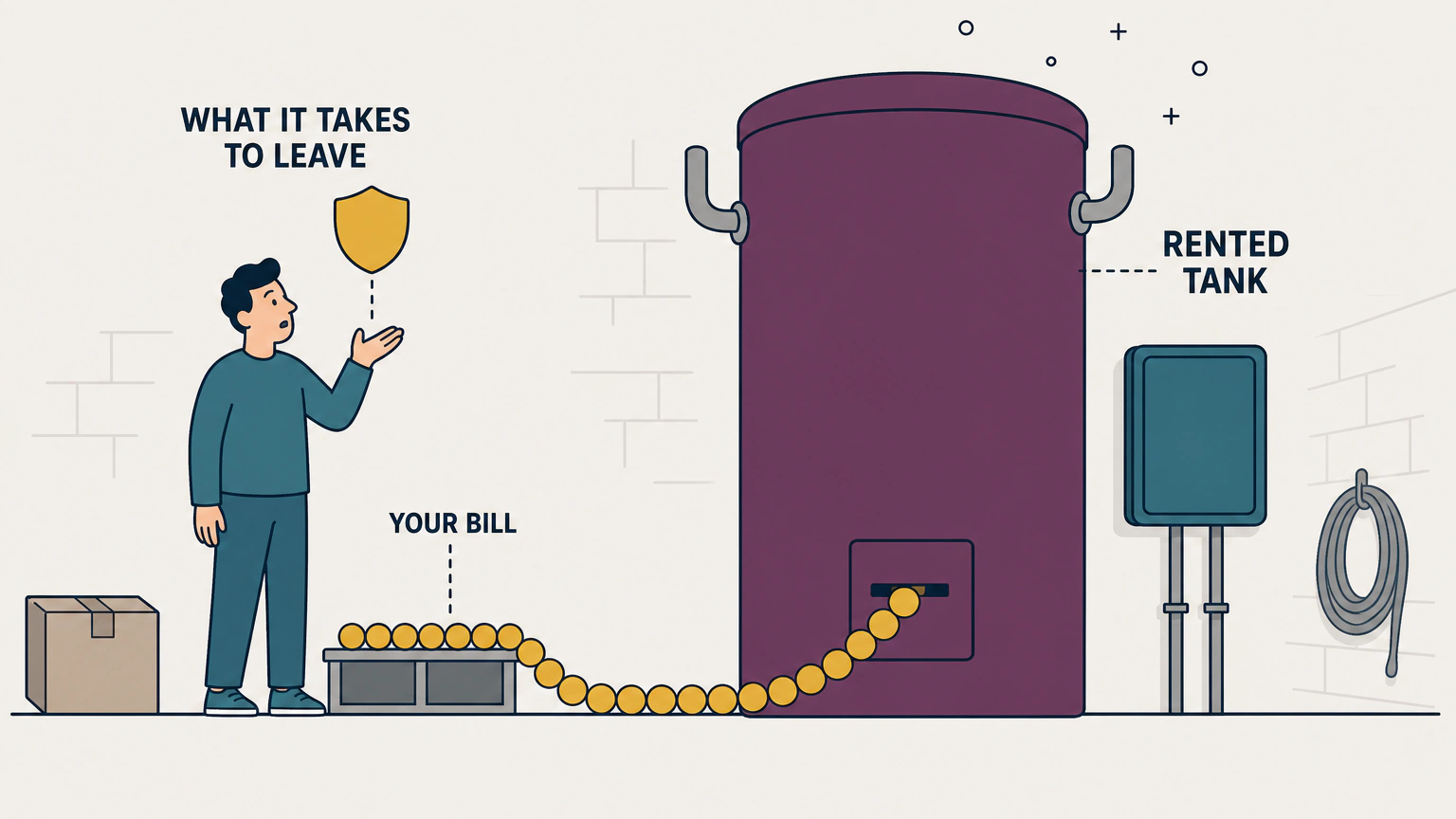
There are two prices to ask for on a rented tank. Ask for the age-reduced buyout price under your provider's schedule and any charge to end the agreement and return the tank. Whether both exits are open depends on your agreement, so get both answers in writing. A third route is the law. In Ontario, if a salesperson turned up at your door uninvited and you signed, the agreement is void, the tank counts as unsolicited goods, and you owe nothing for it.
We do not sell water heaters.
On this page
- First, work out what you're actually renting
- What leaving costs, in the provider's own numbers
- The clause that says buying is the only way out
- Four exits the buyout table doesn't mention
- The notice on your title, and why you can probably leave it there
- You bought the house and the tank came with it
- Quebec and Alberta run different rules
- Rent or own, once you're free to choose
- Your next three calls
- Frequently asked questions
First, work out what you're actually renting
Three answers matter: who owns it now, what it says, and when the tank went in. Every exit below turns on those answers.
Where the rental charge hides on your bill
The charge can be folded into a utility bill rather than arriving as its own invoice, which makes it easy to miss. Find the line naming the rental separately from the energy you actually used, and write down the account number beside it.
Then check whose name is on it, because this market has changed hands. The Competition Bureau's 2014 record traces Direct Energy's Ontario water heater rental business to EnerCare, and it cleared Reliance's acquisition of National Home Services the same month. The Bureau mapped the territories too: Direct Energy ran mainly where Enbridge distributes gas, meaning the GTA, Ottawa and Niagara, and Reliance mainly where Union Gas did, plus rural markets. The company you signed with may not be the company you're paying.
Why the install date decides your options
Enercare publishes different terms and buyout schedules by installation-date cohort, so two neighbours renting from that company can have completely different exits. It publishes three sets of rental terms, split at 15 September 2010 and 1 April 2015, and seven buyout schedules covering installations back to 2016.
The date is not a detail. It decides which document governs you.
Four places to find it: the tank's rating plate, which also carries the model and serial number; the equipment tag fixed at install; the original agreement; and the Agreement of Purchase and Sale, if the tank came with the house.
The five things to have in front of you before you phone
A retention agent's job is much easier when you're guessing. Put five things on the table first: the rental line with its account number, a photo of the rating plate, the installation date, the agreement if you have it, and the Agreement of Purchase and Sale if you inherited the tank. Then you're asking about a specific tank rather than a hypothetical one.
What leaving costs, in the provider's own numbers
One provider publishes its rate card and its buyout schedule openly, by tank model. Those are published prices, not estimates.
The monthly rate, and how much it can climb
Enercare's published 2026 residential rental rates run from $19.29 a month before HST for a 40 gallon electric tank up to $81.12 for a Polaris 50, with the common conventional gas models between $25.87 and $31.53. The same card states that unlisted residential tanks face a maximum increase of 3.93% over the 2025 rates.
That ceiling covers a single year, but run it out as arithmetic anyway: $25.87 climbing 3.93% a year for fifteen years finishes near $46. That arithmetic changes only the price. The hypothetical tank stays in the same corner, quietly getting more expensive.
The buyout schedule, and why it starts so high
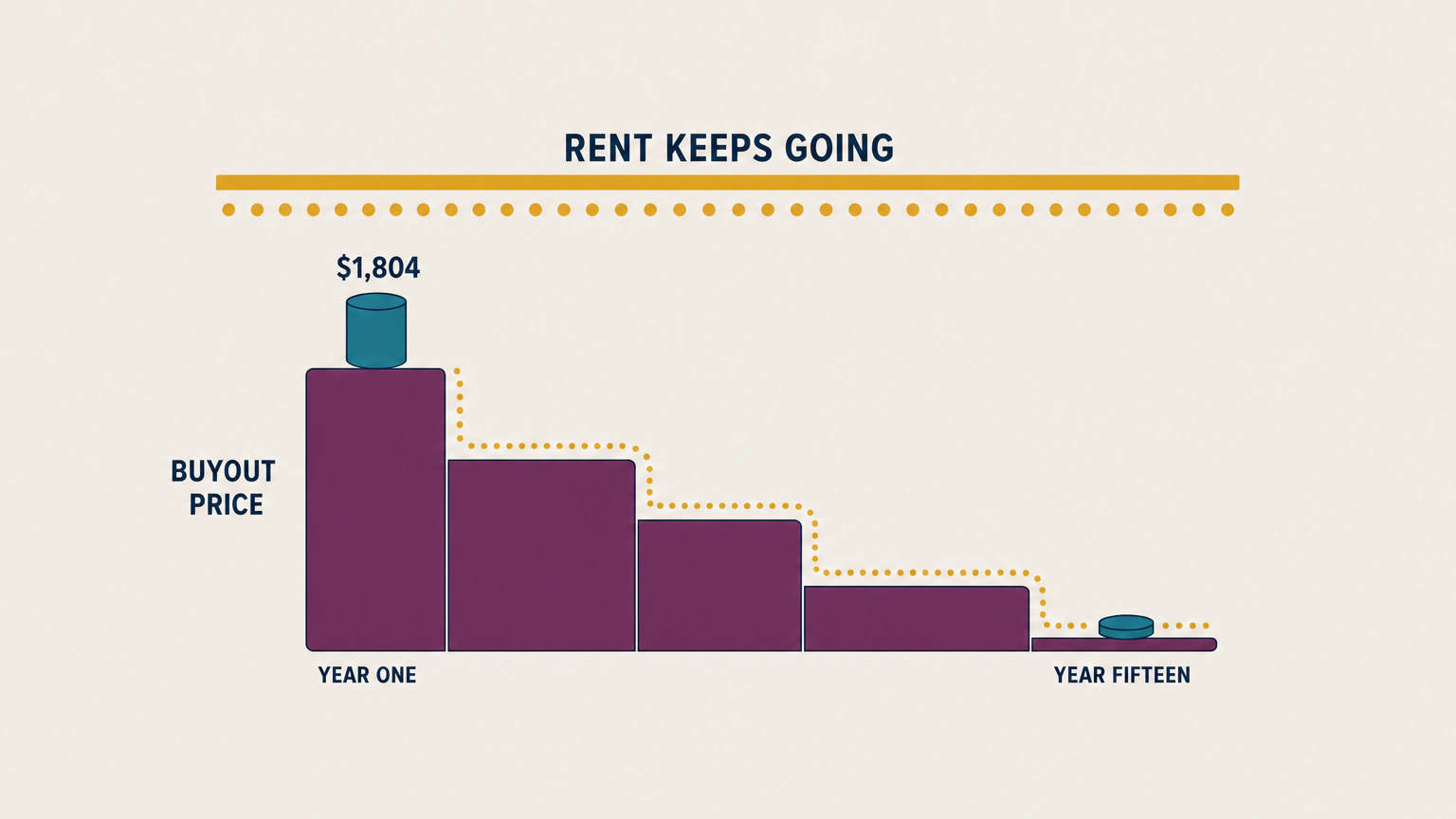
The published buyout schedule steps down as the tank ages. On Enercare's 2026 schedule, a CV40 conventional gas tank costs $1,804 to buy out in its first year, $787 between ten and eleven years, and $100 once past fifteen. Every model column bottoms out at that same $100 floor.
An older set of Enercare terms says the purchase price "reflects, among other things, the unpaid cost of the Water Heater and related installation, finance and servicing costs." That language explains why a buyout can cover more than the equipment itself.
What you take on the day the tank is yours
Buying ends the rent and starts the repair bills. In Enercare's terms for tanks installed from 15 September 2010 to 31 March 2015, you accept the water heater in "as-is" condition, subject to the balance of any transferable manufacturer's warranty, and take full responsibility for its repair and maintenance.
Enercare publishes parts-and-labour prices for customer-owned tanks, the honest other side of the ledger: $827 plus tax for a venter assembly, $526 for a gas valve, $342 for a flame sensor, $183 for a thermocouple. One bad winter can swallow a year of avoided rent. If the tank is going out as part of a larger heating job, that is a conversation for HVAC contractors, not a rental desk.
| Tank type | 2026 monthly rental rate, before HST | Buyout in year one | Buyout at ten to eleven years | Buyout once past fifteen years |
|---|---|---|---|---|
| Conventional gas, 40 gallon (CV40) | $25.87 | $1,804 | $787 | $100 |
| Power vent gas, 50 gallon (PV50) | $40.87 | $2,483 | $1,084 | $100 |
| Electric, 40 gallon (EL40) | $19.29 | $2,131 | $930 | $100 |
| Tankless gas (RX160IN) | $52.17 | $4,135 | $1,805 | $100 |
These are Enercare's published figures for tanks installed in 2026. Enercare groups some earlier installation years into combined schedules, and we did not find another provider's published schedule, so read this as one company's price list, not a national one. The range runs higher than four rows show: a Polaris 50 rents at $81.12 a month, and its year-one buyout is $8,840.
The clause that says buying is the only way out
Now the sentence that decides the whole question. In the Water Heater Rental Terms and Conditions Enercare publishes for tanks installed between 15 September 2010 and 31 March 2015, revised in October 2014, the termination section reads: "Your sole method of terminating this Agreement is to purchase your rental water heater."
The same document sets how long the agreement lasts. The term runs until you terminate it, until the company does, or "if the useful life of the Water Heater has ended," and that life ends when the company or its authorized service provider decides, weighing the tank's age against the cost of the repairs in front of it, that it is "no longer commercially reasonable to repair" it. Read plainly, that's a contract with no end date you control except the buyout.
Set it beside two published facts pointing the other way. The company publishes a list of rental return depots across Ontario, with a drop-off you pre-register by phone. And in November 2014 the Competition Bureau obtained written commitments from EnerCare that it would stop requiring an authorization number before a rented heater could be returned, would honour arrangements where a new supplier terminates a customer's account on their behalf and returns the old heater, and would open new return depots. The same fact sheet records a consent agreement with Reliance, carrying a $5 million penalty and $500,000 in costs, that bars authorization requirements before a return, unreasonable limits on when and where heaters can be returned, retention tactics and unwarranted switching fees. The Bureau was equally explicit that EnerCare was not the subject of its application about Direct Energy's practices and had not engaged in any anti-competitive behaviour.
A contract clause and a regulatory commitment can both be published and still describe different exits. Which is why you get both numbers in writing first.
Pro tip: Send one written request asking for two figures: the price to buy the tank outright today, and any charge to end the agreement and return it to a depot. Ask for the model and installation date to be confirmed in the same reply, then keep it. A written answer is a position the company has taken, and a position is much harder to walk back on the phone three weeks later.
Four exits the buyout table doesn't mention
A contract clause is not the last word in Ontario. The Consumer Protection Act, 2002 sits on top of every consumer rental agreement here, and an agreement can't waive the rights it hands you. That 2002 Act is still the one in force: its replacement passed in 2023, but the repeal waits on a proclamation that has not come.
Ten days, if you invited them in
Section 43(1) lets you cancel a direct agreement for any reason when your total potential payment obligations, excluding borrowing costs, exceed $50. The window runs from the date you entered the agreement until ten days after the written copy reaches you. No penalty, no explanation owed.
A "direct agreement" is one concluded in person somewhere other than the supplier's place of business, a marketplace, an auction, a trade fair, an agricultural fair or an exhibition. Signed at your kitchen table, then. Signed in a showroom, no. The Act also carries a transition rule naming water heaters, preserving that subsection's older wording for agreements made before the 2018 changes.
A full year, if the paperwork was wrong
This is the exit almost nobody knows about. For a direct agreement over that $50 threshold, section 43(2) gives you a full year from the day it was made to cancel if you never got a copy meeting section 42.
Section 42 says the agreement must be in writing, must be delivered to you, and must meet the prescribed requirements. For restricted products, Ontario adds a mandatory cover page setting out your rights, signed alongside the contract before any work begins, plus language clearly disclosing the overall cost and any cancellation fees. A missing cover page is not a technicality. It's a year-long cancellation right.
Nothing at all, if nobody invited them
Water heaters sit on Ontario's restricted list, alongside furnaces, air conditioners, air cleaners and purifiers, water treatment devices, purifiers, filters and softeners, and duct cleaning. Under section 43.1(1), a supplier may not solicit you at your home for any of these, or sign you up there, unless the law treats the visit as one you requested. One narrow exception covers a supplier you already have a written contract with, but only after you invite the visit and agree in advance to hear the offer.
Break that and the consequences stack. The agreement is void. Any related guarantee, security or credit agreement is void with it. The goods are deemed unsolicited, which pulls in section 13, under which a recipient of unsolicited goods "has no legal obligation in respect of their use or disposal." The supplier must reimburse charges you incur from a third party to remove or return the equipment.
If you have been paying quietly for years, one sentence matters most. Section 13(3) says a request for goods or services "shall not be inferred solely on the basis of payment, inaction or the passing of time." Payment alone is not consent. For the door-knock mechanics covering this family of products, here is what you can cancel when a home service was sold at your door.
A full year, if you were misled
Section 18(1) lets you rescind any agreement, written, oral or implied, entered into after or while a business engaged in an unfair practice. Notice goes out within a year of entering the agreement, by any means, worded any way that shows you intend to rescind and says why.
The Bureau's enforcement record names the scripts. Its November 2014 consent agreement with National Home Services barred the company from misleading consumers into believing their existing water heater is unsafe or qualifies for a no-cost upgrade, alongside $1.5 million in restitution credited to the bills of door-to-door customers acquired since July 2008, a $5 million penalty and an independent compliance monitor. If that was the pitch that got you, you are not describing a feeling. You are describing conduct a federal regulator has already acted on.
We are not your lawyer. If a company is still billing you after you have cancelled, that is the moment to get one.
The notice on your title, and why you can probably leave it there
This one surfaces at the worst possible moment, three days before a closing, when a lawyer phones to say something is registered against the property. Take a breath. In Ontario, a consumer NOSI no longer affects the land.
What changed for consumer NOSIs
A Notice of Security Interest is registered against a property's title to tell the world that someone holds a security interest in a fixture there. On 6 June 2024 the Homeowner Protection Act became law. It bans registering NOSIs for consumer goods, which Ontario defines as goods installed in a home for personal, family or household use, naming a water heater, air conditioning equipment or a furnace as its examples. It also deems every consumer NOSI already on title expired.
Expired notices keep appearing on the land title document. The land is simply no longer affected. The paper still says it. It just no longer affects the land.
How to check, and what removal involves
Ontario points homeowners at OnLand.ca, the provincial land registry, where you can search and download records for a fee. A lawyer you're already working with can confirm whether an expired consumer NOSI sits on your title.
Removal is optional, and the province says so outright: no immediate action is needed, because the land is no longer affected. If you choose to remove one during a transaction, the province says you may work with a lawyer to file an Application to Amend the Register with the fee and a law statement confirming the notice is caught by the ban. Do not confuse it with the other thing that can turn up on your title, which carries real deadlines and does demand action.
The removal offer that is itself the scam
Ontario has published a warning that a company is contacting homeowners and offering to remove NOSIs from their titles for a fee. Read that twice. It's a fee to solve a problem the province already solved, and the notice says plainly that homeowners are not required to remove these and should not feel pressured into any contract.
Be equally clear about what the ban doesn't do. It does not cancel your contract, it does not erase the business's security interest in the fixture, and the business can still go to court if you stop meeting your obligations. Suppliers may also retain repossession rights in certain circumstances.
Red flag: Nobody needs to hire a cold caller to remove an expired consumer NOSI, so an unsolicited offer to do it for a fee is the tell. Ontario's notice says to report it to your local police or call the Canadian Anti-Fraud Centre at 1-888-495-8501. Hang up first, then report. You owe a cold caller nothing, least of all a decision on the spot.
You bought the house and the tank came with it
If the tank is listed under rental items in the Agreement of Purchase and Sale, you may take on a contract you never negotiated and never read.
Enercare's terms for tanks installed from 15 September 2010 to 31 March 2015 show how one handover works. On a sale, the agreement transfers to the purchaser, provided the purchaser was notified in the agreement of purchase and sale that the water heater is rented and subject to those terms, the seller gave advance notice of the purchaser's name and intended closing date, all outstanding amounts were paid, and the purchaser agreed to rent it "in writing or by conduct."
Sit with that last phrase. The terms do not define which actions count as conduct, so "I never signed anything" does not settle whether this agreement transferred. Before you close on the next house, ask for the rental items to be itemized: provider, model, installation date, monthly charge and current buyout figure, in writing.
Quebec and Alberta run different rules
Ontario has a long history with these contracts and is where we verified the law in depth. Of the three provinces we checked, Quebec's rule is the strictest, because it does not merely hand you a cancellation window. It bars an itinerant merchant from offering the contract type.
Quebec's Consumer Protection Act defines an itinerant merchant as one who solicits or contracts with a consumer somewhere other than the merchant's own address. Section 244.7, added in 2024, says such a merchant may not, by any means, offer to enter into or enter into a credit contract or a long-term contract of lease of goods, and the Act counts any lease running four months or more as long-term. Section 60.1 separately bars an itinerant merchant from supplying the service, installation included, before your cancellation period expires.
| Province | Can they sell you one at your door? | What the law does if they do it anyway | Where a complaint goes |
|---|---|---|---|
| Ontario | Generally no. The law allows a requested visit, and a narrow exception for an existing supplier when you invite the visit and agree in advance to hear the offer. Water heaters, furnaces, air conditioners, water treatment equipment and duct cleaning are all on the restricted list. | The agreement is void, related security and credit agreements are void with it, the goods count as unsolicited, and the supplier must reimburse your removal or return charges. | Consumer Protection Ontario, at the Ministry of Public and Business Service Delivery and Procurement. |
| Quebec | An itinerant merchant may not, by any means, offer to enter into or enter into a long-term lease of goods with a consumer. A visit you expressly requested can fall outside that definition only if you were not solicited elsewhere. They also may not install anything before your cancellation window closes. | Your ten-day cancellation window becomes one full year. | The Office de la protection du consommateur. |
| Alberta | No. Unsolicited door-to-door sales of water heaters, furnaces, air conditioners, windows and energy audits have been prohibited since 1 January 2017. You can still invite a salesperson yourself. | Alberta's Consumer Protection Act covers unfair practices before, during and after the transaction. | Alberta's consumer protection line, 1-877-427-4088. |
The other seven provinces set their own rules, and the fastest route to yours is your provincial consumer affairs office. The Ontario and Quebec rules come from the statutes themselves, Alberta from the province's own consumer page, which notes well over 1,000 complaints about energy contracts before the ban.
Rent or own, once you're free to choose
Here is the trade, both sides on the table. Renting buys you covered service calls and parts under the agreement, and builds you no equity whatsoever. Owning stops the monthly charge and hands you the repair ledger, which on the provider's own price list means several hundred dollars for one failed component.
For the everyday plumbing work that follows ownership, our own category data puts the typical job at $182 to $475, based on 808 cost profiles. That is our own aggregate, not a market statistic, but it's worth holding any quote against. Start with plumbing contractors in your area.
Who should genuinely stay renting? Anyone who could not absorb a surprise replacement bill without it hurting. That is a real answer, not a consolation prize, and the service coverage is what the money buys.
And if your tank is already past fifteen years, look hard at the $100 floor. At that price, owning it costs less than six months of rent on the cheapest model on the card. The catch belongs in the same breath: once it is yours, its replacement is yours too.
Your next three calls
Three calls, in this order, and none of them commits you to anything. First, the rental company, in writing, for the buyout price and any charge to end the agreement and return the tank. Second, your lawyer or OnLand.ca, if a sale or refinance is anywhere in your plans. Third, an independent plumber, because you can't judge a buyout figure without knowing what the alternative costs. For somewhere neutral to start, we list contractors across Ontario by city.
Before you phone the rental company:
- Pull the rental line off your latest bill and copy the provider's name and your account number exactly as printed.
- Photograph the tank's rating plate so you have the model and serial number in hand, not from memory.
- Confirm the installation date from the equipment tag or the original agreement, since it decides which terms and which schedule apply to you.
- Dig out your Agreement of Purchase and Sale if the tank came with the house, and find the rental items clause.
- Find the rental contract itself, or send a written request for a copy before you discuss anything else.
- Ask, in writing, for two numbers: the price to buy the tank outright, and any charge to end the agreement and return it.
- Work out the tank's age to the year, because Enercare's published schedules step down as the tank gets older.
- Note who you spoke to, when, and what they promised, from the first call onward.
Every contractor you reach through our directory is covered by our satisfaction guarantee, which is worth knowing before you hand anyone a deposit.
Frequently asked questions
Can I just stop paying the rental?
Not safely. The agreement stays in force until it is terminated, and the provider may pursue contract remedies in court if you stop meeting your obligations. An Ontario agreement is void when it was signed at home after a visit that broke the province's restricted-product rules. Confirm that status in writing rather than deciding it by ignoring an invoice.
How much does it cost to buy out a water heater rental?
It depends on the tank's age and model. On Enercare's published 2026 schedule, a 40 gallon conventional gas tank costs $1,804 in its first year, $787 at ten to eleven years, and $100 once past fifteen. Bigger and tankless units run far higher, with a Polaris 50 starting at $8,840. Your provider's figure may differ, so ask for it in writing.
I just bought this house. Am I renting a tank without knowing?
Possibly. Check the rental items clause in your Agreement of Purchase and Sale, then look for a rental line on your utility bill and a provider tag on the tank. Enercare's published 2010-to-2015 terms transfer the agreement only if their listed conditions are met. One condition says the buyer agrees "in writing or by conduct," but the terms do not define which conduct counts.
Does the rental include repairs, and is that actually worth the money?
It covers service and parts under the agreement, real value if a major component fails. Whether it's worth it turns on arithmetic: weigh the monthly charge against the buyout price and the published parts prices for owned tanks, where a venter assembly runs $827 plus tax. Under about five years old, renting is defensible. Past fifteen, the $100 floor is hard to argue with.
There is a notice of security interest on my title. Do I have to do anything?
Usually not. Ontario's Homeowner Protection Act deemed all consumer NOSIs on land titles expired as of 6 June 2024, and the province says no immediate action is needed because the land is no longer affected. Expired notices still show on the document. You may choose to remove one through a lawyer during a sale or refinance.
Can a company sell me a water heater at my door?
Not from an uninvited seller in Ontario, Quebec or Alberta. Ontario also has a narrow exception for an existing supplier when you invite the visit and agree beforehand to hear the offer. Quebec bars an itinerant merchant from offering a long-term lease of goods, although an express-demand visit can fall outside that definition if you were not solicited elsewhere. Alberta has banned unsolicited door-to-door water heater sales since 1 January 2017.