

Neither one shows up on a square footage chart. That chart is what almost every page on this question hands you.
On this page
- What a furnace replacement costs in Canada
- Why nobody sells you the cheap furnace any more
- The venting is where the money goes
- The number that should decide your furnace size
- Who is allowed to touch the gas
- The five lines a real quote has to show
- Rebates, and the one that is not for your furnace
- Frequently asked questions
What a furnace replacement costs in Canada
Most people get here one of two ways. Either the furnace is old and you'd rather pick your moment than let January pick it for you. Or something has already gone wrong: a noise, a smell, a technician who went quiet halfway through the check. If it was the smell, what that first cold night smell actually means is worth five minutes before you spend five thousand dollars.
Either way, a single average is the wrong shape of answer. A furnace quote is four decisions bundled into one figure, and two houses on the same street can end up far apart because of one pipe. So take the range first, then take the reasons apart.
What our own cost profiles say
| Figure | Amount | What it covers |
|---|---|---|
| National average | $5,633 | Across every HVAC job in the sample |
| Typical range | $3,866 to $7,466 | Where most jobs land |
| Lowest recorded | $1,806 | Minimum in the cost panel |
| Highest recorded | $10,820 | Maximum in the cost panel |
These are our own cost profiles for HVAC work across our directory, 911 of them. That isn't a furnace-only figure, and it isn't a national market average.
Stack 911 cost profiles and you get a spread rather than a headline. We are a contractor directory, not a furnace seller. We explain what we do, and the same figures sit under HVAC contractors in your city.
What the pages selling you a furnace say
We read the pages that compete for this question in Canada. Eleven of them opened. Four hid behind bot blocks, and one was a dead link. Of the eleven, ten were written by companies that install furnaces or by their lead generation arms, and the eleventh matches you to those companies. Not one was written by anybody without a furnace to sell.
They agree on a format. Lead with a range, then a price grid by square footage, then a brand ladder. Every one of them uses the word AFUE. Not one names the standard that decides how big your furnace should be, and only one mentions heat loss at all. Several still price a "standard efficiency" tier at around $3,500, even though the 95% floor has applied to the standard model described below since 2019.
The four things that actually move your number
Four decisions sit behind the figure on your quote. Here they are in the order that matters.
First, what the new unit is allowed to be. For the standard model described below, the federal floor settles that question. Second, whether the venting changes, which can create a large swing between two quotes on one house. Third, whether anybody calculated the size or simply matched the old one. Fourth, who does the gas work and what paperwork they hold.
Get those four straight and the price stops being mysterious. It becomes a sum you can check.
Why nobody sells you the cheap furnace any more
Canada splits furnace rules down the middle, and almost nobody explains the split. How efficient the box has to be is a federal question. Who may connect it, and what permit that takes, is a provincial and municipal one. Two governments, two rulebooks, one appliance.
The federal half set a 95% floor in 2019 for the usual single-phase furnace up to 225,000 Btu/h without integrated cooling. AFUE is simply the share of the fuel that ends up as heat in your rooms rather than going up the vent. The floor for that product moved twice.
The federal minimum, and the day it changed
| Furnace manufactured | Minimum efficiency | Federal product category |
|---|---|---|
| On or after 3 February 1995 and before 31 December 2009 | At least 78% AFUE | Single-phase furnace up to 225,000 Btu/h |
| On or after 31 December 2009 and before 3 July 2019 | At least 90% AFUE | Single-phase furnace up to 225,000 Btu/h without integrated cooling |
| On or after 3 July 2019 | At least 95% AFUE | Single-phase furnace up to 225,000 Btu/h without integrated cooling |
| Other current categories | At least 78%, 80% or 90%, depending on type | Outdoor, space-constrained, three-phase, larger, relocatable and replacement non-condensing furnaces |
The current row uses the rule's own words: an "annual fuel utilization efficiency ≥ 95%" for the single-phase furnaces in that row made "on or after July 3, 2019". The shipping rule applies to equipment imported into Canada or moved between provinces for sale or lease.
A chimney-vented unit may be pre-2010, but the vent alone cannot date it. If somebody offers an "80% AFUE option", ask which furnace category it falls under.
The exceptions, and how to tell if one is yours
The lower-efficiency categories are real and named. The current table includes outdoor, space-constrained, three-phase, larger, relocatable and replacement non-condensing furnaces. The 2019 amendment described through-the-wall units at 90%, and furnaces for relocatable buildings or marked manufactured-home replacements at 80%.
If you live in a detached house, a semi or a row house, the building type alone does not settle the furnace category. Check the model and product type against the federal table before treating 95% as the only option.
One thing the federal rule doesn't do is come after the furnace you own. It governs new equipment moving into the market, not what may keep running in your basement. An older mid efficiency unit can remain in service if it is safe. The 95% row matters when you shop for a standard replacement.
The venting is where the money goes
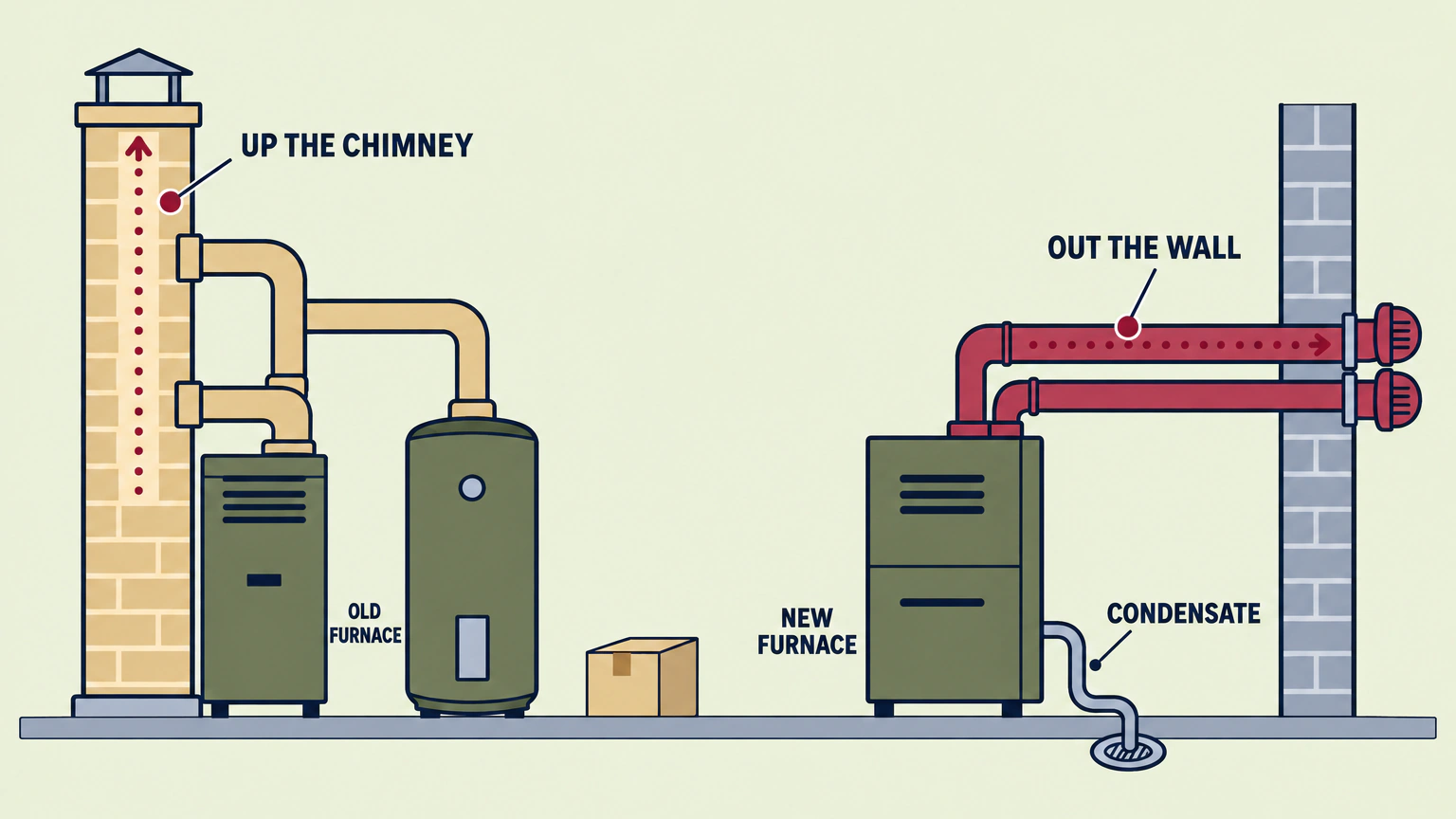
Here is the sentence that explains much of the spread. A chimney-vented older furnace pushes hot exhaust up a chimney. A condensing furnace doesn't, because it wrings so much heat out of the exhaust that what is left is too cool to climb a masonry flue.
Natural Resources Canada puts it plainly in its own gas heating booklet: "A chimney is not needed because the flue gas temperature is so low that the gases are vented out of the house through an approved plastic pipe." High efficiency units, it adds, "can generally be vented out a side wall and do not use air from the home for combustion".
So if your current furnace vents up, your new one probably vents out. That means a hole in a wall, new pipe, and a chimney with nothing much left to do. Go and look at yours before the next quote arrives.
If your old furnace vents into a chimney
Then your quote has a conversion buried in it. Somebody has to cut through an outside wall, run intake and exhaust pipe from the furnace to that opening, fit the terminal outside, and deal with the flue the furnace has left behind. Wall thickness, the pipe route through finished space and the distance from the furnace to an outside wall all move that number.
This is why two honest quotes on the same house can differ sharply and both be right. One installer has walked the pipe route and priced it. The other has priced a box.
Ask which of the two you're holding. The answer is usually visible in the quote itself. A real venting plan takes a line or two to describe, and a guess takes none.
The water heater left behind, and where the condensate goes
Two consequences turn up as surprise lines, and both are cheaper to discuss now than to find later.
The first is the water heater. Many older houses vent the furnace and a gas water heater into one chimney, so when the furnace leaves, the water heater is alone in a flue built for two appliances. Natural Resources Canada is direct about the fix. Keep venting a gas water heater through an existing chimney after the furnace goes, and "you may need to have a licensed professional install an approved metal liner". That means a double walled B-vent or a stainless steel ULC liner. NRCan adds that "this is especially important if you have a masonry chimney", because the liner narrows the flue and the gases leave faster, before they cool. Put the question to your installer. If the answer is vague, a chimney and vent specialist can settle it.
The second is water. A condensing furnace makes condensate, and it has to go somewhere. NRCan gives the normal answer in one line: "The condensate is piped to a floor drain or condensate pump." If your furnace sits nowhere near a drain, you want that pump on the quote rather than in a phone call three weeks later.
The number that should decide your furnace size
Type "what size furnace do I need" into a Canadian search box and it branches into square footage, over and over. Two thousand square feet. Twenty five hundred. Fifteen hundred with a finished basement. The query log is a room full of people asking a question that has no answer in that form.
Floor area tells you almost nothing on its own. A 1950s bungalow with original windows and a 2018 build of the same size lose heat at completely different rates. Heat loss is the thing a furnace has to replace. So two houses of one size can need furnaces a size apart, and a floor area chart can't see the difference.
There's a proper method, it has a name, and none of the eleven pages we could open mentions it.
Square footage is not a heat loss calculation
The standard is CSA F280, "Determining the required capacity of residential space heating and cooling appliances". It exists to give contractors, manufacturers and building officials "updated calculation methods for determining the output capacity" of residential heating and cooling appliances in Canadian homes. In plain terms it's a room by room accounting of heat loss and heat gain: walls, windows, insulation levels, air leakage, which way the house faces, and the design temperature for your own town.
Building codes point at it by name. The Township of Langley quotes the British Columbia rule it enforces: "The required capacity of heating and cooling appliances located in a dwelling unit and serving only that dwelling unit, shall be determined in accordance with CSA F280." That sentence is British Columbia's, read on a British Columbia building department's own bulletin. Other provinces write their codes themselves.
CSA F280 is a Canadian standard, but code requirements vary by province. Ask for it by name and see what comes back.
What to ask for, and what an oversized furnace costs you
The whole thing reduces to one question you can ask in a sentence. "Which method produced this output capacity, and can I see it?" A heat loss calculation is an answer. "Same as the old one" and "your square footage" are guesses in a confident voice, and the old one may itself have been a guess made in 1997.
Oversizing isn't the harmless safety margin it sounds like. Enbridge Gas states the consequence in its own heating guidance. A unit that's too small won't keep the house comfortable in cold weather, "while a unit that's too large will cycle on more frequently".
There is a cheaper move hiding in here too. Heat loss is a fact about your building envelope, not about your furnace. Sealing and insulating first can reduce heat loss, so talk to insulation contractors before you buy rather than after.
Who is allowed to touch the gas
The practical question isn't whether gas work is regulated. It is how you check the person standing in your basement. The places below do not use one model. Ontario has overlapping rules that need to be read together. British Columbia has a homeowner route, Quebec separates the worker's certificate from the contractor's licence, and Alberta permit rules can change by city.
| Province or city | Who may do the gas work | Who pulls the permit | Where you check them |
|---|---|---|---|
| Ontario | A certified fuel technician working for a TSSA-registered contractor. Section 6(3) allows uncertified work only in a certificate holder's presence | Varies by permit type and municipality | The TSSA and municipality |
| Quebec | A TAG-3N holder for listed work up to 120 kW, plus any other required certificate. The contractor needs the right licence | Varies by municipality and permit type | The RBQ licence holders' register |
| British Columbia | A class A or B gas fitter under a permit, or a qualifying homeowner with an installation permit | The licensed contractor or qualifying homeowner | Technical Safety BC |
| Calgary and Edmonton | A qualified contractor. Homeowner routes differ between the two cities | The contractor or a homeowner who meets the city's rules | The city |
Those are the jurisdictions we checked. Their rules do not collapse into one national pattern, so use the right authority for your address.
What three provinces and two Alberta cities require
Ontario has overlapping rules. Its Fuel Industry Certificates regulation creates G.1, G.2 and G.3 certificates. A G.2 holder may work on an appliance "that has an input of 400,000 Btuh or less". A G.3 "shall not perform the initial activation of a new appliance". Section 55 gives a qualifying owner-occupant an exemption from that rule. A certified person must approve the work before activation. But the separate Gaseous Fuels regulation prohibits uncertified installation except in a certificate holder's presence. TSSA's current consumer guidance says only registered contractors and certified fuel technicians may install furnaces.
Ontario has a second permit question that catches people out. Municipal building-permit rules differ, and Toronto's own current pages conflict. Its general permit page says replacing a furnace or boiler in a house does not need a building permit. Its stand-alone HVAC guide calls the service a building permit and lists a $214.79 furnace-replacement fee for 2026. Mississauga lists a permit trigger when the replacement is more efficient than the old furnace or the ducts change, and it publishes a Residential Furnace Replacement form. Ask your own city before work starts.
In Quebec, the TAG-3N certificate is mandatory for anyone installing approved natural gas appliances up to 120 kW (400,000 Btu/h). It covers connecting them and the initial start-up too, and working without a valid one is an offence carrying a fine. The contractor also needs an RBQ licence, and the RBQ tells consumers to look the number up in its licence holders' repertory.
British Columbia works through certificates and permits, with a homeowner exception. Its gas regulation says an individual must be authorized, and section 24 lets a qualifying homeowner apply for an installation permit on a fully detached home. Nobody may be paid to assist, and no part of the home may be rented. A class B certificate covers listed appliances up to 120 kW under an appropriate permit.
Alberta's permit route can change by municipality. Calgary says all plumbing and gas installations require permits, including renovation work, and a homeowner may apply only if they are a certified journeyman gasfitter. Edmonton also requires a gas permit for furnace work. It allows an owner-occupant to apply for renovation work in a single detached house, but not to install a new gas line.
If you are somewhere else, here is how to find your authority
If you live elsewhere, start with your province's technical safety or building authority, then check your municipality. The regulator may certify workers, license contractors, issue permits or delegate part of the job. Those roles are not interchangeable.
On the day, ask for the worker's certificate or other authorization, the contractor's licence where required, and the permit or inspection record for your address. The exact documents depend on the route your jurisdiction uses. Anyone who treats the request as an insult has told you something.
We're not your gas technician, and the rules move by province. If a salesperson and a regulator disagree, the regulator wins.
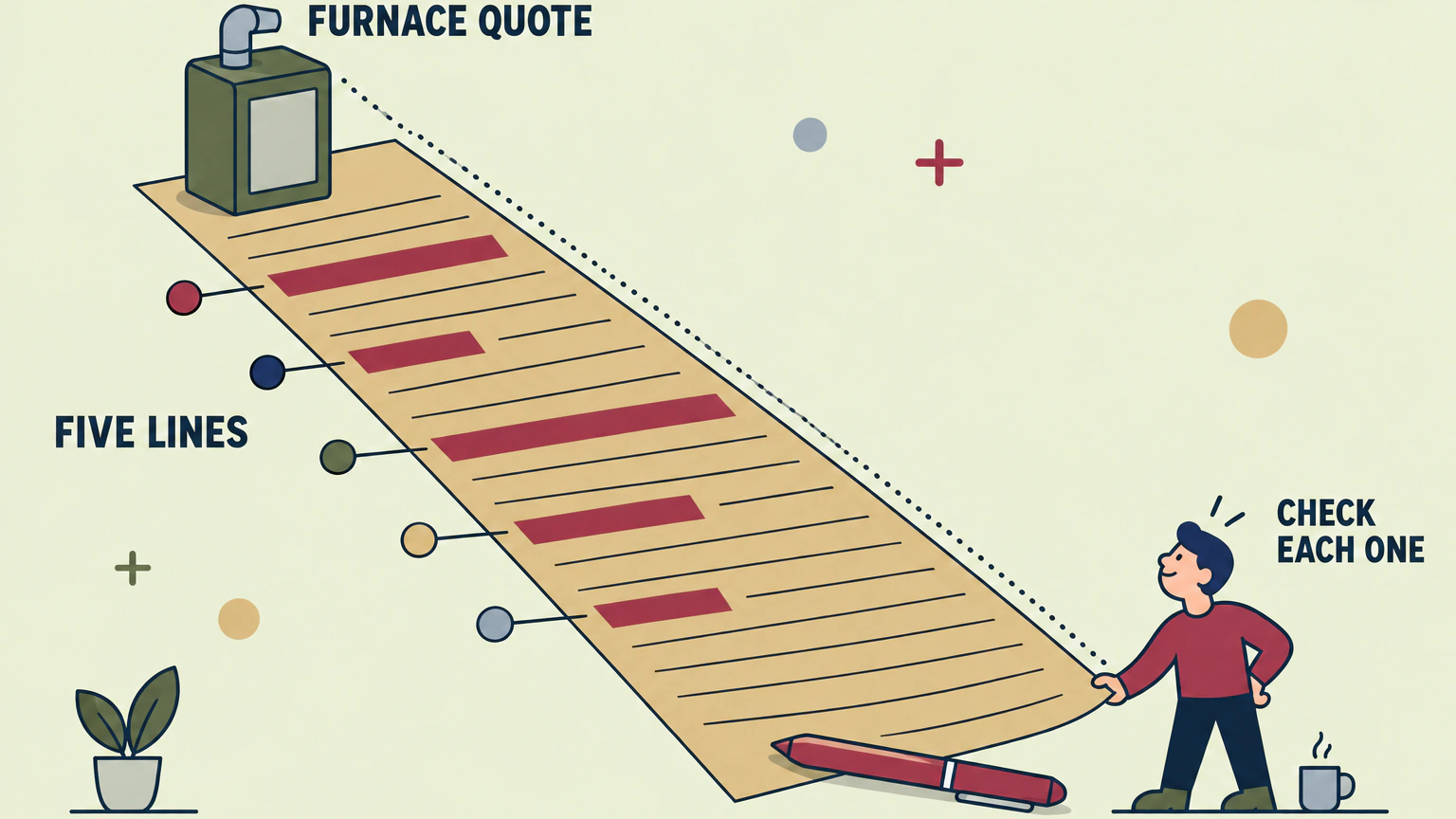
The five lines a real quote has to show
All of that turns into a short list you can hold two quotes against. Print it, screenshot it, or read it off your phone at the kitchen table.
- The exact model, and its rated efficiency. Not "high efficiency furnace" but a make, a model number and an AFUE figure you can look up. If the quote names a tier instead of a model, you cannot compare it to anything.
- The size, and where the size came from. Ask which method produced the output capacity. "Same as the old one" and "your square footage" are both guesses. A heat loss calculation is an answer.
- The venting plan. Whether the new unit reuses existing venting or needs a new sidewall vent, what happens to any other appliance on the old chimney, and where the condensate drains.
- The authorization and the permit. The worker's certificate or other authorization, the contractor's licence or registration where required, and who will apply for each permit.
- The total, and the exclusions. One all-in number including labour, disposal of the old unit, taxes and any permit fees, plus a written list of what is not included. Electrical panel work and duct modifications may be separate trades and separate lines. In Ontario, a gas technician's electrical scope stops at existing branch circuits. New wiring back to the panel needs an electrician and a line of its own.
Red flag: A quote that arrives as a monthly payment with no total. An installer who offers to skip a required permit. A price that is only good until the end of the visit. All three get the same answer: get it in writing, and get a second quote. If the pitch started at your front door, read your cancellation rights when the sale started at your door before you sign.
Rebates, and the one that is not for your furnace
Rebate figures are the numbers a salesperson reaches for first. In Ontario's current program they are attached to upgrades other than the gas furnace.
If somebody quotes you a furnace rebate
Ontario's Home Renovation Savings Program pays for a specific list, and a gas furnace isn't on it. The single upgrade stream covers a cold climate air source heat pump up to $7,500, a ground source heat pump up to $12,000, a smart thermostat at $100, solar and battery storage up to $10,000, attic insulation up to $1,250, and appliances up to $200. Bundle the work after a $600 home energy assessment and insulation goes up to $7,700, windows and doors pay $100 per rough opening, air sealing up to $250, and heat pump water heaters $500.
The word "furnace" appears on the program's page only to describe how you heat now, because that decides your heat pump amount. Homes on gas get $500 per ton up to $2,000. Homes heated by electricity, oil, propane or wood get $1,250 per ton up to $7,500. So when a large rebate number turns up beside a furnace quote, it's usually a heat pump figure that has wandered.
Other provinces run their own programs, and these figures are Ontario's. One more thing worth knowing: the program's own pages carry a warning about fake rebate websites, which tells you how much money is being made off the confusion.
When the price is a monthly payment
If the price arrives as a monthly figure with no total attached, ask what kind of contract it is. Get the total cost over the term and any buyout schedule before anything gets signed. The details are in the document if you read past the first page. A rental contract is much harder to leave than to sign.
Frequently asked questions
What size furnace do I need for a 2,000 square foot home?
Nobody can tell you from square footage alone, and anyone who does is guessing. The right input is a heat loss calculation under CSA F280, which works room by room through your walls, windows, insulation, air leakage and local design temperature. Two 2,000 square foot houses can need different furnaces depending on their age and envelope. Ask which method produced the number, and ask to see it.
Can I install my own furnace in Ontario?
Do not treat Ontario's certificate-regulation exemption as a safe yes. Section 55 describes a narrow owner-occupant exemption, with certified approval required before activation. But the separate Gaseous Fuels regulation prohibits uncertified installation except in a certificate holder's presence. TSSA's current consumer guidance says only registered contractors and certified fuel technicians may install furnaces. Use a TSSA-registered contractor and verify the technician's certificate.
Do I need a permit to replace a furnace?
Permit rules depend on where you live. Calgary and Edmonton require gas permits for furnace work, while British Columbia lets a qualifying homeowner apply for an installation permit. Toronto's current building-permit pages conflict. Check the authority for your address, then put every required permit in the quote.
Is a high efficiency furnace worth the extra cost?
For the standard model described above, it stopped being a choice on 3 July 2019, when the federal minimum went to 95% AFUE. The federal table still has lower-efficiency categories. If a quote offers an 80% model, ask for its federal product category.
How long does a gas furnace last in Canada?
Enbridge Gas puts a natural gas furnace's life expectancy at 15 to 30 years, and treats "over 15 years old" as one sign a system may be due for replacement. Where you land in that range depends on the install and the upkeep. Enbridge also warns that an oversized unit cycles more frequently.
Are there rebates for a new furnace in Ontario?
Not for the furnace itself. Ontario's Home Renovation Savings Program pays for heat pumps, insulation, windows and doors, air sealing, smart thermostats, heat pump water heaters, solar and battery storage, and some appliances. A gas furnace isn't on the list, and the program mentions furnaces only to describe how a home heats now, which sets the heat pump amount. Other provinces run their own programs.