

On this page
- The short answer
- The hot dust smell, and why it happens every autumn
- The four smells that mean stop
- How to find the gas emergency number for your home
- What a smell cannot tell you about carbon monoxide
- Who is allowed to work on your furnace
- Ten minutes before the first cold night
- Frequently asked questions
The short answer
If your furnace smells like hot dust the first time it runs this autumn, that is usually dust burning off the heat exchanger. It should clear within about an hour. If what you smell is rotten eggs, burning plastic or smoke, get everyone outside first and make the call from there.
A furnace that smells like burning on the first cold night is one of two stories. One smell is ordinary and it fades. Four of them mean you stop what you're doing. The difference usually shows itself inside an hour, so the clock matters more than how bad it seems right now.
The hot dust smell, and why it happens every autumn
It's the first properly cold evening since spring. You nudge the thermostat up, the burner catches, the fan starts, and ninety seconds later the house smells like a hair dryer someone left running. Somebody says the word "fire" out loud.
Your pulse can come down. This is the season's most common furnace complaint, and the explanation is dull. Your furnace spent four or five months idle while a summer's dust settled onto it, and the first time it fires, all of that cooks at once inside a machine built to blow air through your house.
What is actually burning
Dust, mostly. Over the summer it settles on the burner and on the heat exchanger, the metal chamber that gets hot and passes that heat to the air in your ducts. The flame never touches the air you breathe. The metal in between does, and it's the hottest surface in there, so whatever landed on it burns off first and leaves through the registers.
Carrier's troubleshooting page says the same: dust settles on the burner and heat exchanger over the summer, then burns off when the heat comes on for the first time in the season. Worth noticing who says so. Carrier builds furnaces and has no service van to fill.
A new furnace does it too, for a different reason. Trane says the coatings and lubricants on new equipment give off their own smell on the first run. A new install that smells faintly the first evening isn't automatically a defect.
The hour test, and what it means when the smell returns
The test isn't how strong the smell is. It's how long it lasts, and whether it comes back.
Note the time the burner catches. Open a window in that room. Then leave the furnace alone and check back on the hour.
Dust burn-off often fades while that first cycle runs. Carrier's page says to check the furnace after an hour, but its FAQ says the smell can last a few hours. Trane says the seasonal version should fade relatively quickly and advises starting the season with a clean filter. On a new furnace it puts the smell at about an hour, and says a persistent smell or visible smoke means you call rather than wait.
Three signals mean stop treating it as ordinary dust: it lasts for a few hours, gets stronger instead of fading, or appears well after the first start of the season. That last one is the giveaway, because a furnace that smells like burning in midwinter finished its summer dust months ago.
One thing makes the ordinary case worse and the diagnosis harder at once. A filter left in since spring holds its own load of dust and chokes the airflow that keeps the furnace cool. Change it before the first run, not after.
The four smells that mean stop
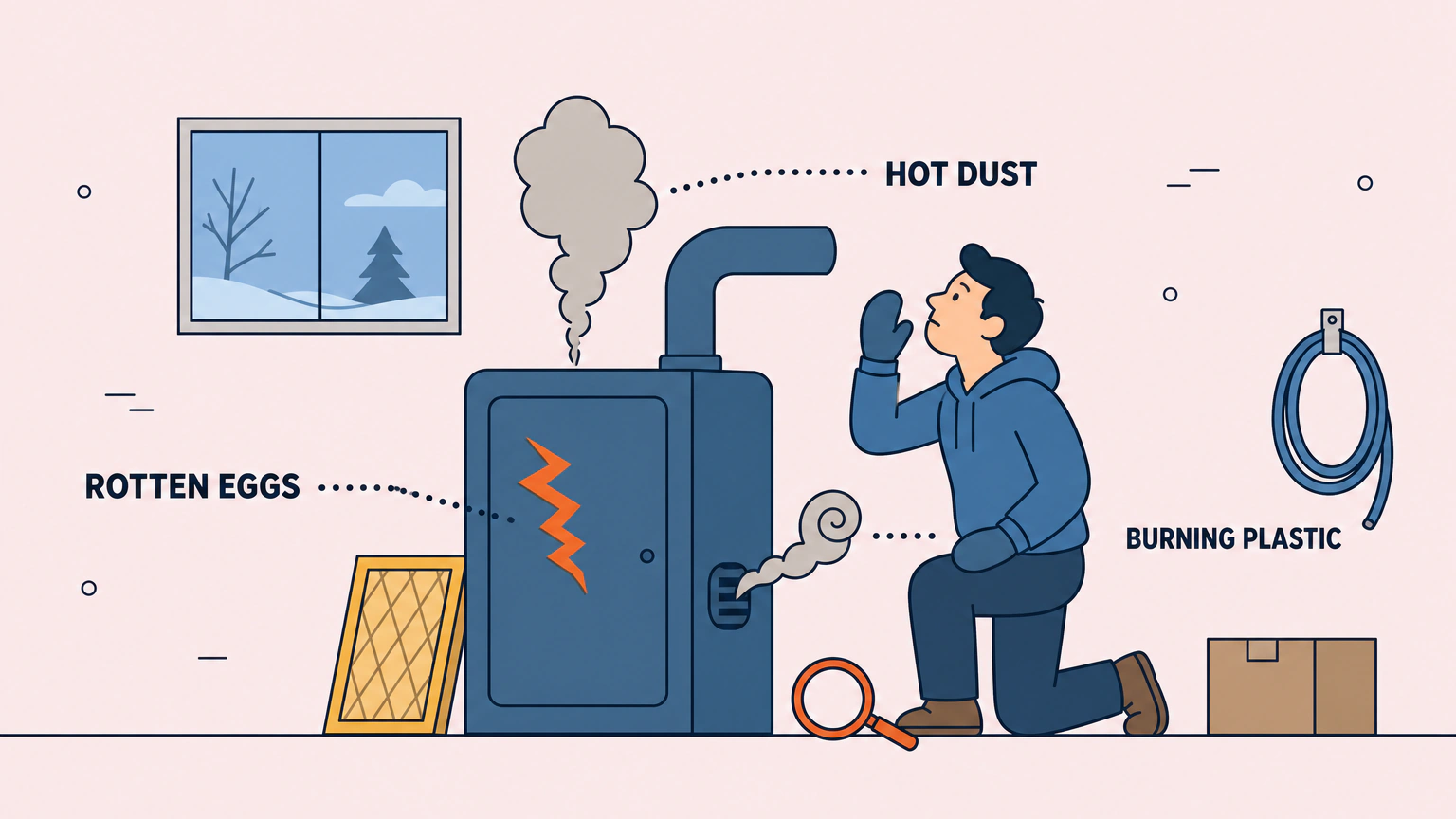
Four smells mean stop, and one means stop reading. What each is, whether the furnace stays on, and the first move:
| What you smell | What it usually is | Keep it running? | What to do first |
|---|---|---|---|
| Hot dust, faint, on the first run of the season | Dust burning off the heat exchanger and burner after a summer idle | Yes, while it fades | Open a window and check again on the hour. If it persists or gets stronger, shut it off and call |
| Rotten eggs, sulphur or skunk | Mercaptan, added to natural gas so leaks can be smelled | No | Leave the building with everyone in it, touch no switch or phone, call from outside |
| Burning plastic, or a sharp acrid smell | Overheating wiring, blower motor or control board | No | Off at the thermostat, then off at the breaker, then call |
| Burning oil, or a metallic smell, returning every cycle | An oil-furnace fault, overheating or a cracked heat exchanger | No | Shut it off and call. Check the filter and registers only after the furnace is off |
| Smoke, or anything visible | Something is actually burning, not just heating | No | Out of the house, then 9-1-1 |
| Musty or damp, arriving with the heat | Mould or mildew in the ductwork, filter or cooling coil | No, while you check the filter | Turn it off, clean or replace the filter, then call if the smell returns |
Rotten eggs, sulphur or skunk
Leave. Take everyone with you. Read the rest of this later.
Natural gas has no smell of its own. Manitoba Hydro says mercaptan is added to give it "a strong, sulphur-like or rotten egg smell that makes leaks easily detectable", and Énergir tells Quebec customers the same. That odour is there so a leak can be found by a person standing in a hallway, and it's one warning sign of a leak.
SaskEnergy describes it more broadly than most people expect: rotten eggs, sewer, or skunk. If you've spent ten minutes blaming the drains, that's the same list.
On the way out, touch nothing electrical. Not a light switch, not the garage door opener, not your phone. Énergir names the cell phone, because a switch or even static can make a spark, and the spark is the risk. Leave the doors open behind you, get clear of the building, then call from a neighbour's or from the street. And do call: SaskEnergy says not to assume the problem has been reported, or that somebody else will.
If you aren't sure whether what you can smell is gas, get out and let the utility decide. That call is free and it's answered around the clock. The alternative is not.
Burning plastic or hot wiring
Sharp, acrid, chemical. Most people tell this one from hot dust instantly, and it usually means something is running too hot, not burning. Carrier names the likely sources: an overheating blower motor, damaged wiring, or another electrical fault in the heating system. Trane's version is that the melting plastic smell may be coming off the casing on the wires inside the furnace.
Shut it down at the thermostat. Then at the breaker. Don't switch it back on to see whether it does it again, because that second run is the one you'll regret.
Then find where the smell actually is. At the furnace, it's a heating call. At the panel, an outlet or a light fixture, you want an electrician, and your furnace is innocent apart from the timing.
Burning oil, or hot metal every cycle
If your furnace burns oil, an oily smell means oil is going somewhere it shouldn't. Carrier lists the candidates: an oil leak, a burner problem, or a failing heat exchanger. None of those is a wait and see.
A metallic smell is more serious than the first-run dust smell. Trane says it can point to a cracked heat exchanger, so shut the furnace off and book a repair. Short cycling can have a different cause: the limit switch shuts off gas to the burners when the furnace overheats and runs the blower until the temperature drops. Trane lists restricted airflow among the causes and says not to bypass or reset the switch.
Once the furnace is off, your cheap checks are the filter and every supply register you closed in the spring. Furniture and curtains over the return vents count too. If you find nothing obvious, leave the rest to a technician.
The musty one, which is a different problem
A damp, wet towel sort of smell arriving with the heat is usually not the furnace at all. Trane puts it down to mould and mildew in the ductwork or on the air filter. Carrier adds the cooling coil in the airstream, which spent the summer covered in condensation. Heat comes on, air moves across all of it, and the house smells like a basement.
Treat it differently from gas or smoke. Turn the furnace off, clean or replace a dirty filter, then call if the smell returns so the moisture source can be found.
It can also trigger a duct cleaning pitch. We've written up whether a duct cleaning is worth paying for. Read that before you agree to one at the door.
Red flag: three things that are not a diagnosis.
A number without a source. We read one page on furnace smells that ranks its six causes by percentage of cases, with nothing on it to say where those percentages came from. An invented split isn't evidence, and neither is a confident round figure from somebody in your basement.
A cracked heat exchanger you were never shown. Ask to see it, and ask for the written report. Somebody who has genuinely found one will want to show you.
A duct cleaning sold to fix a smell. A musty smell has a source. Cleaning the ducts without finding it just moves your money.
How to find the gas emergency number for your home
Gas distributors serve specific franchise areas, so the phone number depends on the utility at your address. There's no national gas emergency line. There's your utility, and there's 9-1-1.
The instructions aren't identical either, which surprised us. Énergir tells its customers to call 9-1-1 and gives its own line where 9-1-1 isn't available. Enbridge Gas, ATCO Gas, SaskEnergy and FortisBC each publish a 24-hour number to call directly. Manitoba Hydro lists 9-1-1 and its own line side by side. These entries apply only where that utility serves your address. If another distributor serves you, use the number on your gas bill.
| Utility service area | Who runs the line | Emergency number | What they tell you to do |
|---|---|---|---|
| Enbridge Gas customers in Ontario | Enbridge Gas | 1-866-763-5427 | Leave the area immediately and call from a safe distance |
| ATCO Gas customers in Alberta | ATCO Gas | 1-800-511-3447 | Leave immediately, then call the emergency line |
| SaskEnergy customers in Saskatchewan | SaskEnergy | 1-888-700-0427 | Leave, then call immediately |
| Manitoba Hydro customers in Manitoba | Manitoba Hydro | 1-888-624-9376 | Leave your home immediately, then call 911 or Manitoba Hydro |
| Énergir customers in Quebec | Énergir | Call 9-1-1 first. Use 1 800 361-8003 where 9-1-1 is unavailable | Leave the building, then call |
| FortisBC customers in British Columbia | FortisBC | 1-800-663-9911 | Leave, then call FortisBC or 9-1-1 from outside |
What a smell cannot tell you about carbon monoxide
Your nose has done the work so far. Carbon monoxide is where it stops working, and most people have that backwards.
Your nose is not a detector
Carbon monoxide is, in Ontario's own words, "an invisible, tasteless and odourless gas that can be deadly". The province is equally blunt about what follows: carbon monoxide "can only be detected by a working CO alarm".
That puts a limit on the comforting answer about hot dust. A furnace can be making carbon monoxide and smell of nothing. A furnace can reek of hot dust and be perfectly safe. Smell and danger are two questions, and your nose answers one.
One check is genuinely yours, and it's visual. Manitoba Hydro says to look at the flame on your gas appliances regularly, that it should be blue, and that a yellow flame may be a sign of carbon monoxide.
The rest of the job is outdoors. Ontario's guidance is to keep the outside vents and chimneys for your furnace, dryer, stove and fireplace clear of snow and debris. A blocked vent doesn't stop exhaust being made. It stops it leaving. If yours is buried, that's work for a chimney and vent cleaner before the first real snow.
Then there's the alarm, which is law and not advice, and Ontario's rules changed on 1 January 2026: how many CO alarms Ontario now requires, and where each one has to go.
Who is allowed to work on your furnace
Anyone can own a wrench. Not everyone is allowed to open a gas appliance, and in one province that isn't guidance, it's the law.
What Ontario says in law, and what the rest of the country expects
The Technical Standards and Safety Authority, which oversees fuel safety in Ontario, puts it in one sentence: "Under Ontario law, furnaces and fuel-fired appliances must be maintained by TSSA-registered contractors." It adds that registered contractors "are required to hire certified gas technicians who have extensive training in keeping people safe in their homes."
TSSA publishes the list too, which is the part you can use tonight. Registered fuels contractors, it says, are the only businesses legally authorized to do fuels related work in Ontario, and you can search the registry by company name, by city or postal code, and by fuel type: natural gas, propane, fuel oil, chimney liner. It's updated monthly.
Ontario's rule is the one we could read as law. The others run their own fuel safety regimes and we haven't read them, so we won't tell you what they say. Ask which certification the technician holds, then check it with your own province's authority.
Pro tip: two questions before you book. Which certification will the technician who attends hold, and is the company registered with the provincial fuel safety authority? In Ontario, check the answer yourself against TSSA's Authorized Heating Fuel Contractors lookup before anyone knocks. A registered company won't mind being asked.
What the first visit buys, and how to compare a replacement quote
A diagnostic call is a fee for somebody's time and travel, and it buys a diagnosis, not a repair. Ask what it costs before the van leaves, whether it comes off the bill if you go ahead, and what evenings and weekends cost. A scheduled tune-up is a different product with a published price in some provinces: SaskEnergy posts its network home heating tune-up at $149.95 plus taxes, with parts and labour for any repairs on top.
Then there's the sentence nobody wants on a cold night. Your heat exchanger is cracked, and the furnace has to be condemned.
Our own HVAC cost panel reports a $3,866 to $7,466 range and a $5,633 average from 911 profiles. It does not identify those profiles as furnace replacements, so it cannot support a replacement-price benchmark. Get the scope in writing and compare at least one more quote before you sign.
A cracked heat exchanger is a real finding and a dangerous one. It can also lead to a replacement quote, which is why a second opinion matters here.
Ten minutes before the first cold night
Ten minutes once a year can catch simple problems before the first cold night. It doesn't replace an annual professional inspection or a service call.
- Change a dirty furnace filter before the first run so the system starts with clear airflow.
- Open every supply register you closed off in the spring, including the ones behind furniture.
- Move anything stored against or on top of the furnace, especially cardboard, paint tins and cleaning products.
- Vacuum the visible dust off the furnace cabinet and off the return grille.
- Set the thermostat above room temperature and let one full cycle run.
- Open a window in that room for the first cycle, and note the time the burner started.
- Go back on the hour. If the smell is fading, keep watching. If it persists or gets stronger, shut the furnace off and book a look.
- Step outside and check the vent and chimney outlets are clear, then check again after the first snowfall.
Frequently asked questions
Is it normal for a furnace to smell like burning when you first turn it on?
Usually, yes. On the first run of the season that smell is dust burning off the heat exchanger and burner after a summer of sitting still, and it should fade as the cycle runs. Open a window and let it finish. If what you smell is sharp, chemical or eggy rather than dusty, that's a different answer entirely.
How long should the burning dust smell last?
Carrier says to check the furnace if the smell lasts more than an hour. Its FAQ says it can last from 30 minutes to a few hours. Trane says the seasonal smell should fade relatively quickly. If it persists or returns later in the season, shut the furnace off and call.
My furnace smells like rotten eggs. What do I do first?
Get everyone out of the building, pets included, before anything else. Touch no light switch, no garage door opener and no phone on the way, because a spark is the risk. Call your gas utility or 9-1-1 from outside, from a neighbour's or from the street. As SaskEnergy puts it, don't assume somebody else has already called.
Why does my furnace smell musty when the heat comes on?
Trane points to mould or mildew in the ductwork or on the filter, and Carrier adds the cooling coil. Turn the furnace off, clean or replace a dirty filter, then call if the smell returns so the moisture source can be found.
Can a carbon monoxide alarm detect a natural gas leak?
No, and Enbridge Gas says so outright: a CO alarm detects unsafe amounts of carbon monoxide in your home, and it won't detect a natural gas leak. Two different gases, two different warning systems. Carbon monoxide needs the alarm because it has no smell. A gas leak carries mercaptan precisely so your nose can do that job.
Do I need a certified technician to look at my furnace, or can a handyman do it?
In Ontario, hire a TSSA-registered contractor that sends a certified gas technician. The regulation has a narrow exception for people servicing an appliance in a detached home they own and occupy. Elsewhere in Canada, check the rules with your provincial fuel safety authority before work starts.
Ontario's own advice is to have fuel-burning appliances, chimneys and vents inspected every year before cold weather sets in. Book it from the list of HVAC contractors in your area rather than at midnight in October with the heat off.