

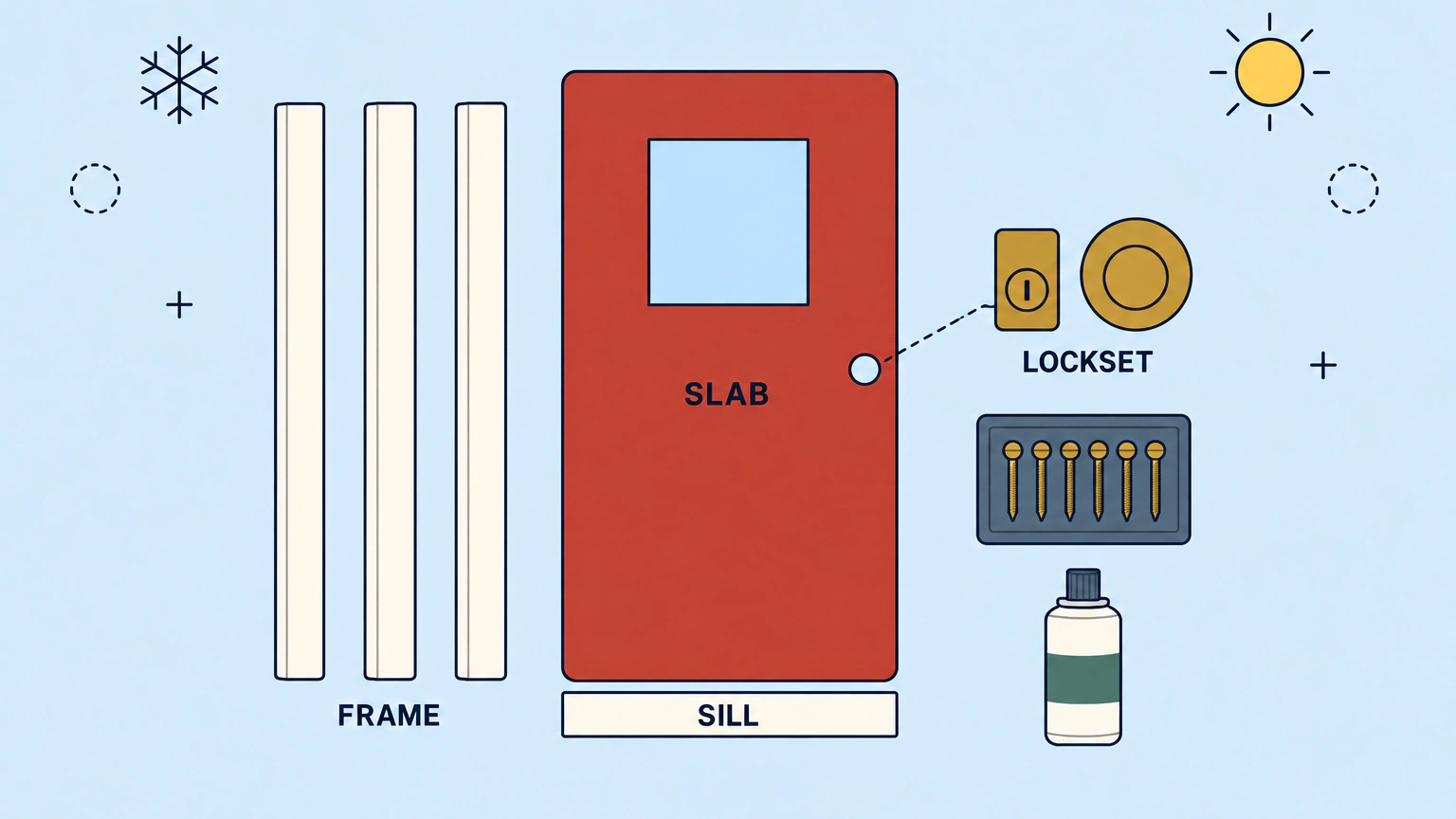
The spread makes more sense once you know why quotes differ, what to get in writing, and which winter details decide whether the new door lasts.
On this page
What a new front door costs in Canada
Home Depot Canada prints exterior door installation cost ranges for six provinces, and the page says what the money buys. Each price covers a pre-hung door system, labour, interior casing, and removal and disposal of your old door. Single doors come primed only, while the sidelight units come painted on at least the outside. None of it includes tax. The Atlantic provinces aren't on its list, and these are one retailer's program prices, not a market average.
Home Depot Canada's installed price ranges, by province
| Province | Single door | With one sidelight | With two sidelights | Double door |
|---|---|---|---|---|
| Ontario | $1,750 to $4,000+ | $3,000 to $6,500+ | $5,000 to $8,500+ | $4,300 to $7,500+ |
| Alberta | $1,900 to $3,000+ | $3,000 to $6,500+ | $5,000 to $8,500+ | $3,900 to $6,500+ |
| British Columbia | $2,500 to $3,300+ | $4,000 to $5,150+ | $5,600 to $7,250+ | $3,900 to $6,500+ |
| Manitoba | $1,500 to $3,000+ | $3,000 to $5,000+ | $4,000 to $6,000+ | $3,000 to $5,000+ |
| Quebec | $2,000 to $3,000+ | $2,500 to $4,500+ | $4,000 to $6,500+ | $3,500 to $7,000 |
| Saskatchewan | $1,500 to $4,000+ | $3,000 to $6,500+ | $4,000 to $8,500+ | $3,900 to $6,500 |
Pre-hung door systems installed through Home Depot Canada's program, before tax, with labour, interior casing and removal of the old door included. Single doors come primed only, so painting is extra. The program lists no Atlantic province.
For a single door, the lowest band starts at $1,500 in Manitoba and Saskatchewan, and the highest top end is $4,000 or more in Ontario and Saskatchewan. Saskatchewan manages both, which tells you how wide these bands run. Treat them as rough. The same page also shows Ontario's single door at $2,500 to $3,300+ in a second table, and that plus sign means nobody's promising a ceiling.
The Toronto installer's ladder further down is before tax, too. Sales tax gets its own short section near the end.
Why two quotes for the same door can be thousands apart
Nobody's necessarily padding anything. Installix, a Toronto installer, puts it this way: "The quotes are pricing different jobs." A $900 quote and a $6,000 quote can both be honest, because one may cover a door and the other a whole new entrance.
Its price list shows how the job changes at each step. The cheapest line is a slab hung in the frame you already have. Next comes a pre-hung steel unit, then fibreglass with glass. Sidelights (many installers spell it sidelites) are the fixed glass panels beside the door. They share its frame, so they widen the opening. A transom is the same idea above the door, and going taller means moving the header, the beam over the opening. That taller opening has to be framed to suit, so look up standard door sizes before you fall for one. A double door sits at the top of the ladder.
One Toronto installer's price ladder, before HST
| What you're buying | What comes with it | Installed price |
|---|---|---|
| Slab only | A new door hung in your existing frame, hardware moved over | $700 to $1,600 |
| Pre-hung steel, no glass | Door, frame, threshold, weatherstripping and basic hardware | $2,200 to $3,600 |
| Pre-hung fibreglass with glass | Door, frame, threshold and a decorative or clear insert | $3,000 to $5,000 |
| Fibreglass with two sidelights | One frame with two fixed glass sidelights | $4,800 to $8,000 |
| Two sidelights and a transom | The full system, with header work and a taller opening | $6,500 to $11,000 |
| Double door | Two working doors and heavier hardware | $6,000 to $12,000 |
Installix Windows & Doors, Toronto, as published on its own price guide. One company's list, there to show how the job changes, not what your door costs.
Two other installers' own front door cost tiers show the same pattern. EcoChoice, in the Toronto area, lists a standard steel door at $1,850 to $2,800 installed, and a standard fibreglass door at $3,000 to $4,500. Elegant Entry Doors, in Vancouver, lists a steel front door at $3,000 to $5,000, and a standard fibreglass door at $4,000 to $8,000. Compare two quotes only after both name the same configuration: the same door, the same frame, the same glass.
Steel or fibreglass, in dollars and in winter
EcoChoice's list puts fibreglass about $1,150 above steel at the low end and $1,700 above it at the high end. Whether that's worth paying depends partly on your winter.
Steel is less forgiving of temperature. Home Depot Canada's own comparison says steel "Absorbs heat, which can make steel doors hot or cold to the touch", and that fibreglass "won't expand and contract with temperature changes". The National Building Code of Canada 2020 cares about this too. It requires a thermal break in metal door frames, meaning a layer that stops cold running straight through the metal. It also wants doors built to minimize condensation on their warm side.
A door that latches in one season and not the other is telling you something. If it's twisted in its frame, it was probably set while the framing sat differently, and the house has since shifted back. If it only refuses to latch in summer, suspect a sun-facing door warping in the heat. That same summer sun is why storm doors get their own section further down.
What a front door quote should spell out
Novatech, a Quebec door maker that sells through dealers, has told those dealers what a good quote looks like, and it's a fair standard to hold yours against. A quote should state what's included: "measurements, manufacturing, delivery, installation, removal of the old door, and interior and exterior finishes." It should list the exclusions and give the "total price, taxes, payment terms, required deposit and payment schedule", plus lead times and the warranties that apply "to the door itself, as well as to the installation." Who does the work matters too. In Toronto, every renovation business needs a city Building Renovator licence, and in Quebec, construction work for someone else generally needs a licence from the Régie du bâtiment du Québec. The detail is in our window replacement guide.
Before you sign, make sure the quote names each of these in writing.
- The door itself: the maker, the material, the size and the glass, by name.
- Whether you're getting a pre-hung unit or a slab, and whether the old frame and sill come out.
- A new sill and threshold, with a sill pan or flashing under it to send water back outside.
- A set price for rot, per sill or per foot of framing, if the crew finds it when the old door comes out.
- Low-expansion foam between the frame and the house framing, and sealant along the sill.
- Which deadbolt goes in, with long screws through the strike plate and hinges into the house framing, and solid blocking at lock height.
- Interior casing and exterior brickmould or aluminum capping, and who paints the door by what date.
- Removal and disposal of the old door and frame.
- Taxes, the deposit, the payment schedule, the lead time, and both warranties: the maker's on the door and the installer's on the work.
That last line is where your leverage lives, because a paid deposit is money you can't hold back later. Before you agree to a schedule, read what to hold back from each payment.
The rot nobody can price until the old frame is out
A door that stops closing properly is often rotted underneath. The damage starts at the sill and can reach the subfloor below it, and sometimes the rim joist, the board that runs around the edge of the floor framing. It's rarely anyone's fault you could name today. Older installations usually put nothing under the sill to send water back out, so rain that got past the door simply sat in the wood.
On a front door replacement, nobody can see any of this until the frame comes out. By then the old door's on the lawn, the new one's leaning against the wall, and your front hall is open to January. That's a poor moment to start negotiating.
So get the price before anyone picks up a pry bar. Two Ontario installers publish their own lines for it. Custom Contracting lists frame repair or replacement at $200 to $800, and Canadian Choice lists framing or structural repairs at $250 to $600, "Revealed during removal". That's the gap between the exterior door replacement cost you signed and the one you pay. Ask for a set price per sill or per foot of framing, written in before work starts. Ask for a sill pan or flashing too. A sill pan is a shallow tray under the sill that sends any leak back outside, and without one, rot and mould can show up under a door.
The cheap route doesn't dodge any of this. In Installix's words, a slab hung in a rotted frame "inherits the old leak".
The lock and the frame: what Canada's building code asks for
The National Building Code of Canada 2020 says doors must, "where required, resist forced entry", and then turns that into millimetres. It's a model code. Most provinces adopt it or a variant. It has no legal force until one does, so where your house sits matters.
In the 2020 national code, the detailed rules sit under doors assembled on site. Factory-made doors are held to the North American standard for windows and doors, plus its Canadian supplement. And a door, frame and hardware tested to Grade 10 of ASTM F476, a security test for door assemblies, can skip the door, lock, hinge and strike rules. British Columbia's 2024 building code applies the same numbers to every swinging entrance door into a home, although the City of Vancouver has its own by-law. Ontario's code says main entrance doors must "resist forced entry".
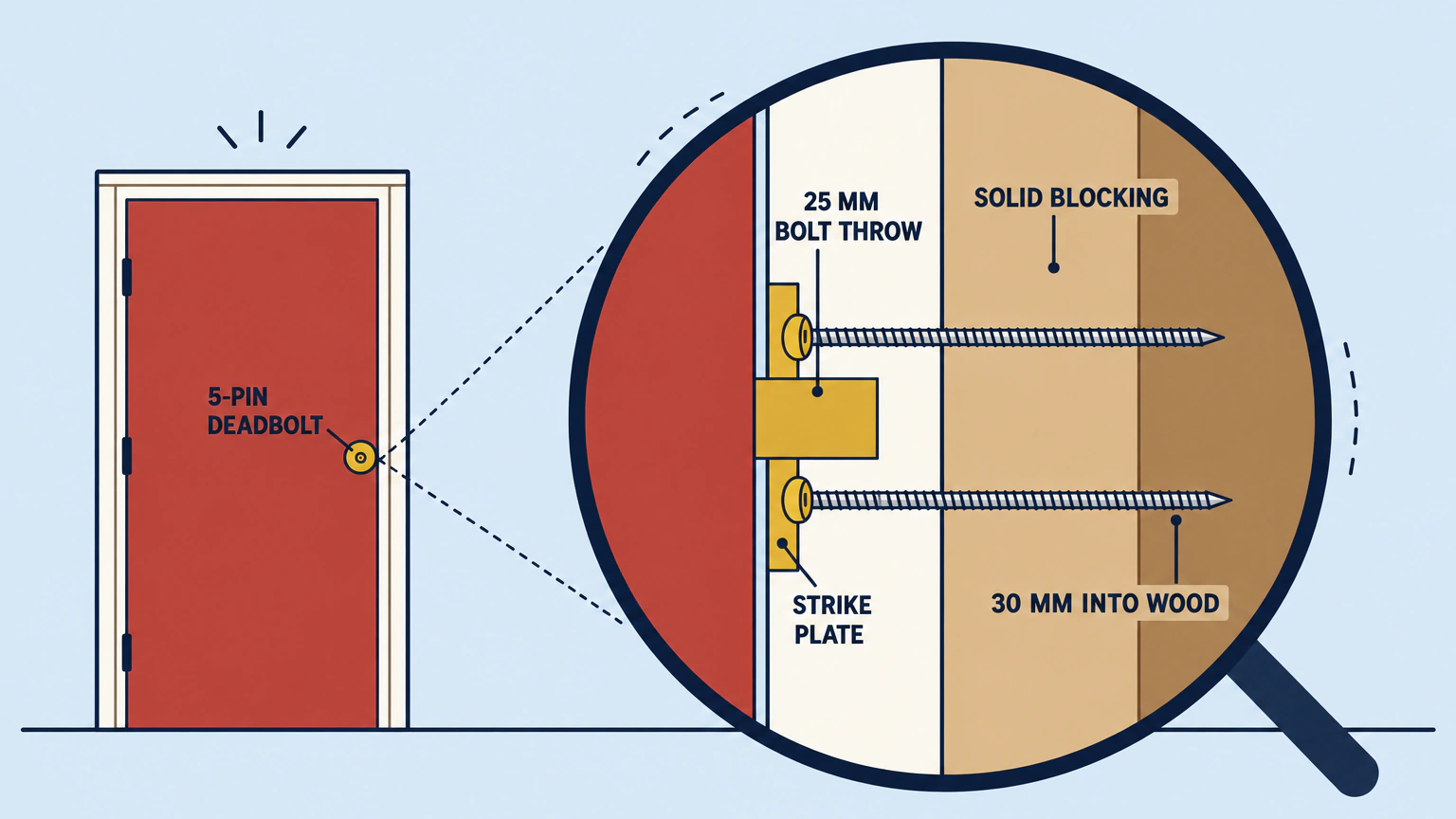
So a factory-made door may sit outside the letter of those numbers in your province. We'd ask for them anyway, because they're the clearest minimum anyone publishes. A front door replacement is also your one chance, since the blocking at lock height can only go in while the old frame is out. The strike plate is the metal plate on the frame that the bolt slides into, and if short screws hold it, it's holding only the jamb, the board lining the opening, and not the house. A straight swap often needs no permit either, so nobody from the city is likely to check. The glass counts too. The code's own note says, "It is, however, a common method of forced entry to break glass in doors and sidelights to gain access to door hardware and unlock the door from the inside". It doesn't require special glass for security, but it suggests considering laminated glass in doors and the sidelights beside them. Your city's building department has the final word on what applies to your house.
The building code's forced-entry minimums for an entrance door
| Part | The code's minimum |
|---|---|
| Wood door | Solid core or stile-and-rail, at least 45 mm thick |
| Deadbolt | A cylinder with at least 5 pins and a bolt that throws at least 25 mm, with a hardened ring or bevelled housing around the cylinder |
| Second leaf of a double door | Heavy-duty bolts at the top and bottom, engaging at least 15 mm |
| Hinges, wood frame | At least 2 screws per hinge reaching 30 mm into solid wood |
| Strike plate, wood frame | Screws reaching at least 30 mm into solid wood |
| Door that swings outward | Hinges or pins that keep the door from being removed while it's closed |
| Behind the jambs | Solid blocking on both sides at lock height, between the jambs and the house framing |
From Article 9.7.5.2 of the National Building Code of Canada 2020, which British Columbia's 2024 code applies to every swinging entrance door to a home. A door, frame and hardware tested to Grade 10 of ASTM F476 is exempt from the first five rows. The last two still apply.
What a better deadbolt costs
Our own locksmiths category puts a planning budget on this. Replacing a standard deadbolt runs $100 to $400 per installed lock, with ordinary hardware and local attendance included. Fitting a smart lock you've already bought runs $150 to $375, and that's labour only. Rekeying one cylinder, so your old keys stop working, runs $100 to $140. Those are planning budgets drawn from published Canadian prices and cost guides, not an average. As we put it on that page, "New holes, frame repair and premium security hardware need separate pricing."
Most of this is cheaper on the day the door goes in, because the door's being prepared anyway. Ask for the lock on the same quote.
Storm doors, dark paint and your door's warranty
Picture a glass storm door over a new front door on a south-facing step in July. It looks tidy. It also traps heat against your door, and door makers take that seriously enough to write it into their warranties.
A storm door can look like a small line on your front door replacement cost. These three makers each treat it differently, so know your maker's rule before you order.
What three door makers say about a storm door
| Maker | What the warranty says |
|---|---|
| Novatech, steel doors sold in Canada | An unventilated storm door voids the warranty. Ventilated means a screen covering at least half the door's height, and a venting unit doesn't count. |
| Masonite | A vented storm door is fine on steel and fibreglass doors, but not on a door painted or stained a dark colour, or in high heat or strong sun. On Masonite wood doors, a storm door voids the warranty. |
| Therma-Tru | A properly installed, properly vented storm door doesn't void the warranty. Damage the storm door causes to your door isn't covered. |
From each maker's own warranty document or support page. Your dealer is the first stop for a claim.
Masonite's warranty has one more line for anyone who likes a dark door. It excludes damage from "excessive heat due to being finished a dark color", so a black door on a sunny wall can be a warranty problem with no storm door in sight.
Then there's the paint clock, which bites when a primed door sits unpainted through winter. Masonite wants unfinished doors and frames finished "within 45 days of original purchase", and another clause in the same warranty counts those days from the date Masonite shipped. Therma-Tru wants steel doors finished "within several days" of installation, and fibreglass within 6 months. A door waiting for a warm weekend in May can outlast its coverage.
So decide on the storm door and the colour before you place the order. Ask the dealer which maker built the slab, because the name on your quote may not be the name on the warranty. Get "who paints it and by when" on the quote. And keep the paperwork, since Novatech's FAQ says an issue starts with "the retailer who sold you the product".
Rebates and sales tax
Ontario's Home Renovation Savings Program pays "$100 per rough opening" for an ENERGY STAR certified door, and one door meets its minimum. The catch is everything around that $100. You need a home energy assessment before any work starts, and you have to finish at least two upgrades from its list. Doors and windows together count as one, so a door on its own earns nothing. A slab earns nothing either, because the program's terms exclude a door without a frame. And the clock's nearly out: those terms want your follow-up assessment booked by November 30, 2026, and done by December 31, 2026.
The federal Canada Greener Homes Grant and Loan are both closed, and the grant's own page says so outright. Several 2026 door price guides still list them, so treat any quote that counts on that money as out of date.
The Home Depot and Installix prices are before tax. Front door replacement cost in Ontario picks up 13% HST from any HST-registered installer, so a $3,000 quote becomes $3,390. Other provinces' rates, rebate programs and the permit table are in our window replacement guide.
Questions people ask about replacing a front door
How long does it take to install a new front door?
About half a day for a straightforward swap of a pre-hung door in a wood-framed opening. One Toronto installer puts it at "four to six hours including tear-out, shimming, foaming, and trim". A full system with two sidelights and a transom in a brick opening takes a full day and sometimes two. The longer wait is the door itself. ALDA Windows says most custom orders run 8 to 14 weeks from deposit to delivery, so order well before you need it.
Can you replace a front door without replacing the frame?
Yes, if the frame, sill and threshold are sound, square and dry. A slab hung in an existing frame is the cheapest line on an installer's price list. But a frame that's rotted or racked (pushed out of square) passes its old drafts and leaks straight to the new slab. One installer's words: the new slab "inherits the old leak". Have someone check the sill before you choose the cheap route.
Can you replace a front door in the winter?
Yes. The swap itself takes hours, not days. One Ontario installer says costs may drop in late fall or winter because demand is lower. The limit is the sealing foam. Common window-and-door foams are rated for use from about 4 or 5°C. GE tells crews in cold conditions to store the can above 5°C for at least 12 hours first. On a frigid day, ask what the crew will use to seal the frame.
Why is there frost on the inside of my front door?
Usually it's indoor humidity meeting a cold surface. Natural Resources Canada notes that new windows can make condensation worse because the old, leaky ones were letting moisture out. Its fix starts with lowering humidity and improving ventilation. Novatech adds two checks: keep the threshold's drainage channel clear, and treat frost that keeps coming back as a sign the door may no longer be performing as it once did.
Do I need a permit to replace a front door?
Usually not for a straight swap in the same opening. The City of Toronto, for example, needs no permit to replace a door in a house with one dwelling unit, as long as the opening keeps its size and location, its structural support isn't touched, and no new exit is created. Widening or moving the opening, which adding sidelights or a transom can mean, needs one. Rules differ by city, and our window replacement guide compares five.
How long does a front door last?
One Toronto installer's estimates run about 15 to 25 years for steel and 25 to 40 for fibreglass, and wood anywhere from 20 to 50 years if you keep up with it. A warranty tells you what the maker will stand behind, and it varies by line. Masonite covers its named fibreglass doors for as long as the original owner lives in the house, and its Sta-Tru steel doors for 20 years. That warranty doesn't pass to the next owner.
Once two quotes describe the same door, the same sill and the same lock, the comparison takes a minute. When you're ready, find window and door installers near you and ask each one for those lines in writing.