

On this page
- What replacement windows cost in Canada
- Insert or full frame: the choice behind most of the price gap
- What a window quote should spell out
- Window rebates in 2026, and the rules that decide what you get back
- Permits, licences, and the price quoted at your kitchen table
- Questions people ask about replacing windows
What replacement windows cost in Canada
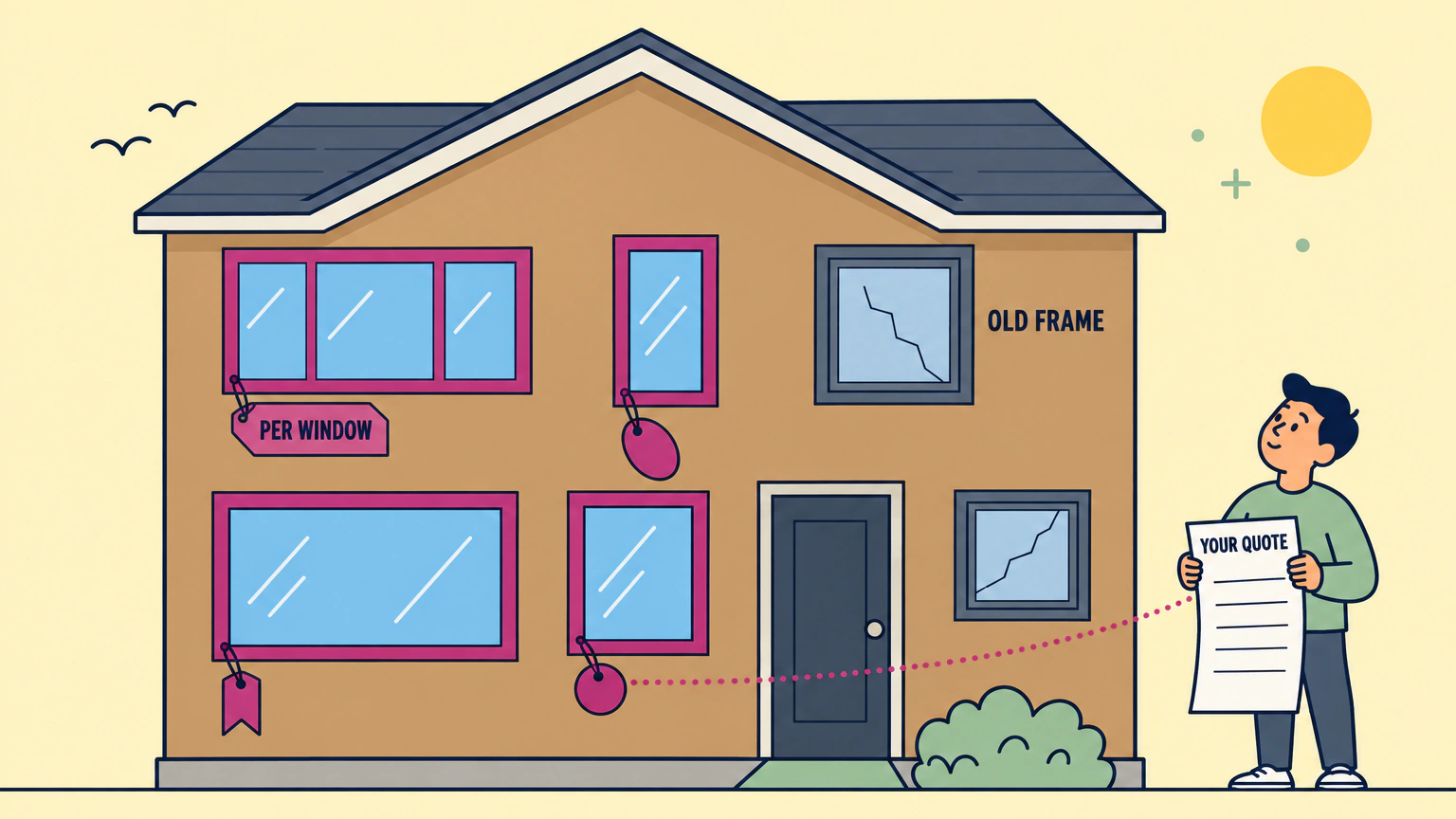
Two quotes for the same eight openings, four thousand dollars apart. One of them was written up at your kitchen counter by the person who measured. Neither page tells you which one is padded. So start by sorting out what each number counts.
| Where the number comes from | What it prices | What it says |
|---|---|---|
| Our cost profiles for window installers | A whole job with an unstated number of openings | Fair price range $3,125 to $8,943, national average $5,685 |
| One window company's 2026 price guide | One replacement window | About $400 to $2,100 per window |
| Two other guides, on full frame versus insert | The extra for tearing out the old frame | From 10 per cent more to $600 more per window, depending on the guide |
Those guide figures are sellers' own asking ranges. They show the spread across the market, not what your installer will charge.
Why one opening gets quoted $500 and another $1,500
Install method can move the number substantially. Keeping the old frame or tearing it out changes the labour and it changes what has to be rebuilt around the hole.
Glass matters too. Triple glazing sits above double in every guide that prices both, and in Manitoba the rebate only pays on triple-pane units. Pane count isn't the whole rating, so compare each model's U-factor instead.
Then look at how the window opens. NRCan says non-operable windows may leak less air than ones that open, so not every opening in a house has to open. A floor level with a bedroom is the exception, and that exception has teeth.
Size and shape move the window installation cost on their own lines. Bays and bows are several units in one opening, and every guide we read prices them separately. Frame material shifts the number again.
Last, and the quietest of the lot: what sits inside the price, and what's been left outside it. On the exterior, that means capping or new brickmould. On the interior, it's casing, jamb extensions and paint. Then there's hauling the old windows away, the permit and the tax. Two quotes only become comparable once both of them answer the same ten questions.
What our cost profiles for window installers can tell you
Our own cost profiles for window installers put the fair price range at $3,125 to $8,943, with a national average of $5,685. The smallest job in there ran $356 and the largest $20,683.
Read the scope before you use those numbers. There's no honest way to turn them into a price per window. Use them as a sanity check instead. A quote that lands well past the top of that range deserves a line-by-line answer, opening by opening. One that lands well under the bottom earns the same question in reverse. A cheap number is often a smaller scope.
Insert or full frame: the choice behind most of the price gap
Natural Resources Canada describes exactly two ways to put a new window into a house that already has one. The difference is physical, and it's permanent. The price gap between the two is the one number the window guides can't agree on.
What an insert keeps
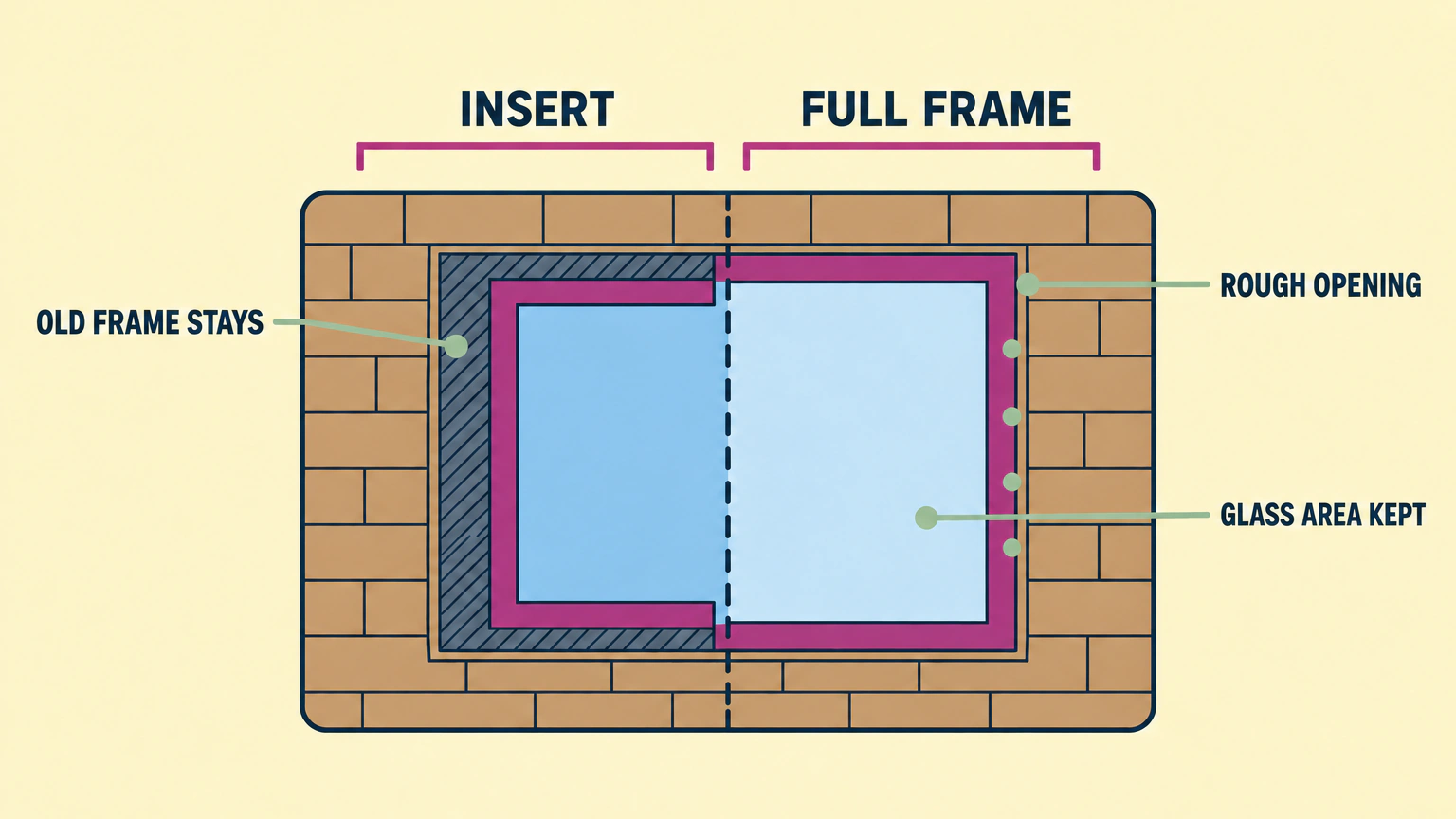
Here's NRCan's definition: "An insert retrofit involves installing a new window or door into the frame of the existing window or door that is being replaced." Your old frame stays in the wall. The new window sits inside it.
That's a fair way to work, with one condition NRCan states plainly: "an insert should be done only if the existing frame has not deteriorated and is properly sealed and insulated." Where the old frame is sound, an insert costs less and leaves your inside trim and the wall around the opening alone.
Before you order an insert, ask what happens to the gap between the old frame and the wall. NRCan says the crew should seal and insulate that gap from inside before it finishes the exterior. Ask whether the inside casing will come off first.
Ontario's rebate draws the same line. A complete new window and frame set into your old frame counts. New glass or a new sash on its own doesn't.
What a full frame replacement buys you
A full frame job, which NRCan calls a complete tear out, removes "the old window, door or skylight, including the frame". That's what the extra money buys. A tear out "allows the installer to make an airtight insulated seal between the product and the rough opening", and the glass area "is usually retained or enlarged".
A full frame quote also needs different measurements. JELD-WEN's checklist says to measure the narrowest brick-to-brick or siding-to-siding width and height outside. The old frame dimensions and your brickmould choice belong on the quote too.
The premium is where the sellers stop agreeing. Ecoline's price guide says full frame runs 15 to 20 per cent more than a retrofit, then says 10 to 15 per cent further down the same page. RenoQuotes prices the same step at $400 to $600 a window. We'd stop trying to square those figures and ask for both methods priced on one quote, opening by opening. The reply is useful either way.
Replacing your windows is also a reason to think about radon. Health Canada lists new windows among the energy retrofits after which to test for radon again.
The bedroom's escape window still has to let someone out
A floor level with a bedroom needs an egress window or door. Ottawa's building code services, applying Ontario's 2024 Building Code, spell out what the required egress window must do. Fully open, it has to give an unobstructed opening of at least 0.35 square metres, with no dimension under 380 mm. It has to open from the inside without tools. Outside a basement, the sill can sit no higher than 1,000 mm above the floor.
Calgary ties the same standard to its permit rule. A swap that keeps the size of the opening and the type of window needs no permit. At least one window in a bedroom still has to meet the egress rules in the National Building Code (Alberta Edition). Calgary's own guidance rules out two styles for that egress window: a picture window, because it doesn't open, and a hopper, because getting out means crawling over the glass. In Montréal, Anjou borough wants a permit to replace any window that fails the standard, and it gives bedroom egress as the example.
Two things shrink an opening without anyone noticing. An insert sits inside the old frame, so the glass area comes down. And a switch to a different opening style changes how much of the window opens.
Ask the installer to confirm the clear opening of any bedroom window that will serve as egress before the order goes in.
What a window quote should spell out
A window replacement quote describes work as much as it names a price. The cheaper of the two on your counter may be a better deal. It may also be less work in the same number of words. These ten lines are how you tell them apart.
Ten things a window quote should say
- Whether each opening gets an insert or a full frame installation
- The model of each window, with its NRCan reference number or proof it's ENERGY STAR certified
- Each model's U-factor or Energy Rating, and whether it's double or triple glazed
- How many rough openings the job covers, with a bay window counted as one
- What goes on the outside: new brickmould, aluminum capping over the old frame, or siding repairs
- What happens inside: new casing, jamb extensions, and whether painting is included
- Removal and disposal of the old windows
- Whether GST or HST is included in the price or added on top
- Who applies for the permit, if the job needs one
- How long the workmanship warranty runs, and who stands behind it
The tax line most price guides skip
The Canada Revenue Agency puts this one on the business, not on you. A contractor has to tell you whether the GST or HST is "included in the price or added separately", and has to show the rate that applies, on the invoice or in the contract.
None of the 2026 guides we measured says whether its prices include tax. So in Ontario a guide's range and a real quote can look like the same number, while one of them is quietly missing 13 per cent.
| Where you live | Tax on the job | Added to a $10,000 quote |
|---|---|---|
| Ontario | 13% HST | $1,300 |
| Nova Scotia | 14% HST | $1,400 |
| New Brunswick, Newfoundland and Labrador, Prince Edward Island | 15% HST | $1,500 |
| Alberta, British Columbia, Manitoba, Quebec, Saskatchewan | 5% GST, plus any provincial sales tax your province applies to the job | $500 in GST |
On a $10,000 Ontario job the HST comes to $1,300. That's most of another window. In provinces outside the HST system, whether provincial sales tax lands on an installed-window contract depends on that province's rules for contractors. So ask for the tax written out on its own line.
The sticker on the glass is part of the paperwork
ENERGY STAR certified windows sold in Canada carry temporary energy labels, though the exact fields depend on who certified the model. For models certified by a Canadian certification body, NRCan requires the ENERGY STAR mark and "Do Not Remove" text. The label also lists four performance values: U-factor, solar heat gain coefficient, Energy Rating and visible transmittance. The frame and glazing description and the model code or NRCan Reference Number appear there too. It's the one place where a promise in your quote becomes checkable.
Canada now runs one national criterion, in force since January 1, 2020: a U-factor of 1.22 W/m²·K or lower, or an Energy Rating of 34 or higher. Version 5.0 of the rules "supersedes all previous versions". So a page that still sorts ENERGY STAR windows into climate zones is describing an older edition. NRCan's searchable product list lets you check a model code before you sign.
Two rebate programs care about those stickers as much as you should. Ontario's program tells you to keep the labels on until after the follow-up assessment, and Efficiency Manitoba wants them left on until your rebate arrives. Manitoba also wants the NRCan reference number for each unit written on the invoice.
Which means the crew doesn't get to peel them off on install day.
Window rebates in 2026, and the rules that decide what you get back
The Canada Greener Homes Grant stopped taking documents on December 31, 2025. The loan stopped taking applications on October 1, 2025. Both are closed. Several window guides still point readers at one or the other, which is reason enough to ask any salesperson who mentions "the rebate" which program they mean.
Ontario's Home Renovation Savings Program
Ontario pays $100 per rough opening on windows. Every other rule in the program decides whether you see that money.
| The program's rule | What it means for your windows |
|---|---|
| A home energy assessment comes before any work starts | Windows installed before that first visit don't qualify. |
| At least two upgrades from the program's list | Windows and doors count as one upgrade, so windows on their own earn nothing. Insulation, air sealing or a heat pump water heater can be the second. |
| At least three window rough openings | One or two windows earn $0. A bay made of several sections in one opening counts once. |
| $100 per rough opening | Eight windows in eight openings bring $800. |
| ENERGY STAR certified, installed by a professional contractor | Keep the ENERGY STAR labels on until the follow-up assessment. A new window and frame set into your old frame counts. New glass or a new sash alone doesn't. |
| Follow-up assessment within 180 days of the first, or by December 31, 2026 | Whichever comes first. It has to be booked by November 30, 2026. |
| Proof of the work | Invoices for the upgrades and both assessments, plus your property tax bill. |
| $600 back for the two assessments | Paid only after you complete the program. |
Start with who qualifies. You own the home. It's a detached, semi-detached, row or town house, or a mobile home on a permanent foundation, and stacked townhomes are out. You heat with Enbridge natural gas, or with electricity, propane, oil or wood while connected to Ontario's grid.
Then the math. Eight new windows in eight openings, plus attic insulation, brings $800 back on the windows. The same eight windows on their own bring nothing, because windows and doors together count as one upgrade and the program wants two. A third upgrade adds a $500 bonus, and insulation can count as another upgrade.
The calendar is the tight part this autumn. Your follow-up assessment has to be booked by November 30, 2026, and done within 180 days of the first one or by December 31, 2026, whichever comes first.
One more thing, and the program says it first: scammers are building fake rebate websites and posing as contractors who take part in the program. Start from the program's own site, never from a flyer.
Manitoba pays per window, if it's triple pane
Efficiency Manitoba runs the plainer version. It pays $100 on each ENERGY STAR certified window and door with at least triple-pane glass, counted by rough opening, so a bay window in one opening counts once. Windows going into new openings don't qualify at all.
You apply within 90 days of the install and payment in full, with the NRCan reference number for each unit on your invoice. Leave the stickers on until the rebate arrives, because they may ask for photos.
Set against Ontario, the trade is clear. No energy assessment, and no second upgrade to line up. But in Manitoba, double glazing earns nothing, however well it performs.
Everywhere else, start with your province's own program
British Columbia can't be answered with a number. Better Homes BC sorts its rebates by the kind of home you live in, your household income, how many people live there, where you are and how you heat. The honest answer is the site's questionnaire, not a figure we could print.
For the rest of the country, check your provincial or utility efficiency program before you sign, and ask the installer which program and which rule they're counting on.
In Ontario and Manitoba the money moves one way. You apply, and the program pays you once its rules are met. So when a quote in either province has already taken "the rebate" off the total, we'd read that line as money nobody has approved yet, and ask for the price without it.
Permits, licences, and the price quoted at your kitchen table
A same-size window swap is the easy case in four of the five cities we checked. It's the work around the swap, a bigger opening or a different style of window, where the cities stop agreeing.
Do you need a permit to replace windows?
Here's what five cities say on their own permit pages.
| City | Same-size replacement in a house | What changes the answer |
|---|---|---|
| Toronto | No permit for a detached, semi-detached or row house with one dwelling unit, if the opening keeps its size and location, its structure isn't touched, and no new exit is created. | New or enlarged openings, and replacing windows in any other kind of building. |
| Calgary | No permit if the size of the opening and the type or operation of the window stay the same. | Adding or enlarging a window, or changing how it opens. A new bedroom window has to meet egress rules. |
| Winnipeg | No permit for replacing doors and windows with the same size. | You still have to follow the building code and zoning, so ask the city before changing an opening. |
| Halifax | No permit when the size and location don't change. | Changes to exterior walls or structure. The city says changes to bedroom windows should consider egress. |
| Montréal | Depends on the borough. Most require a permit even for a same-size replacement, while Anjou and Saint-Laurent generally don't. | Many boroughs require the new windows to keep the building's original shape and appearance, and heritage areas add more. |
Those are five cities whose permit pages we read ourselves. Anywhere else, phone the building department before the order goes in, because each city writes its own rule.
Four of the five run the same way. Toronto, Calgary, Winnipeg and Halifax all let a same-size replacement in a house go ahead without a permit. Montréal is the outlier, where most boroughs want a permit even for an identical swap. A new or bigger opening needs a permit in Toronto and in Calgary.
Winnipeg adds the reminder that matters most. No permit still means the building code and the zoning rules apply. Enlarging an opening can mean structural work around the header, which is a job for a general contractor as much as for a window installer.
Who's allowed to do the work
Two places put a licence between you and the crew. Toronto requires a Building Renovator licence for every business that repairs or renovates buildings, and for any business that merely advertises renovation work. In Quebec, anyone who does construction work for someone else needs an RBQ licence, unless the law exempts them.
Beyond those rules, there's one voluntary program NRCan itself points to: Window Wise, run by the Siding and Window Dealers Association of Canada. It says it audits and certifies window makers and installers, inspects jobs at random, registers your job and carries a five-year transferable guarantee. That's a trade group describing its own program, not a licence.
Ask for the licence number wherever one exists. Then go and check it.
If the price was written up in your living room
Window sales still happen at kitchen tables, and Ontario's Consumer Protection Act, 2002 treats that room differently from a showroom. Buy something costing more than $50 from a salesperson at your door or in your home, and you get a 10-day cooling-off period. It starts the day you receive your written copy of the agreement. You don't need a reason. If the contract leaves out information the Act requires, or the salesperson said something false or misleading about it, you have a year.
Windows aren't on Ontario's list of products that can't be sold door to door. That list covers furnaces, water heaters, air conditioners, duct cleaning and a few more. A window salesperson can still knock, and the rest of the Act's rules apply when they do. Alberta went further. It has banned unsolicited door-to-door selling of windows since January 1, 2017, though you can still invite someone in yourself.
Our duct cleaning guide compares cancellation rights in other provinces for contracts signed at home. Check how your province applies those rules to windows.
We aren't lawyers. If a cancellation turns into a fight over money, Consumer Protection Ontario or a lawyer is the next call.
Questions people ask about replacing windows
How much does it cost to replace 10 windows in Canada?
At the broadest guide range we found, ten windows come to roughly $4,000 to $21,000. Our own cost profiles put the fair whole-job range at $3,125 to $8,943. Compare two quotes opening by opening rather than by their totals.
Is full frame window replacement worth the extra cost?
It is when the old frames are rotting, leaking or poorly sealed, because NRCan says an insert should only go into a frame that hasn't deteriorated and is properly sealed and insulated. A tear out also lets the installer seal the new window to the rough opening, and it usually keeps your glass area. Over sound, well-sealed frames, an insert is a fair saving.
Do I need a permit to replace my windows?
Toronto, Calgary, Winnipeg and Halifax exempt same-size house swaps. In Montréal, most boroughs want a permit anyway. Enlarging an opening or adding a new one needs a permit in Toronto and Calgary. Calgary's exemption only holds if the new window opens the same way the old one did.
Does the Ontario Home Renovation Savings Program cover windows?
Yes, at $100 per rough opening, but only in the stream that starts with a home energy assessment before any work. You need at least three window openings and a second upgrade such as insulation. The windows have to be ENERGY STAR certified and put in by a professional contractor, and your follow-up assessment has to be booked by November 30, 2026.
Why do my new windows have condensation on the inside?
Usually because the house is tighter than it used to be. NRCan points out that old, leaky windows helped keep indoor humidity down, so new ones can make the problem worse until you lower the humidity or add ventilation. Condensation between the panes is a different fault: the seal has failed, the glazing unit needs replacing, and the warranty is the first thing to check.
How do I check that a window is ENERGY STAR certified?
Look for the temporary energy label on the new window. It shows the U-factor and Energy Rating. Use the label to match the window to NRCan's product list. In Canada a window qualifies with a U-factor of 1.22 or lower, or an Energy Rating of 34 or higher.
When both quotes answer all ten of those lines, you can compare them as prices instead of guesses. If you're still a quote short, find window installers near you and ask for the same ten lines.