

On this page
What a whole-house renovation costs per square foot
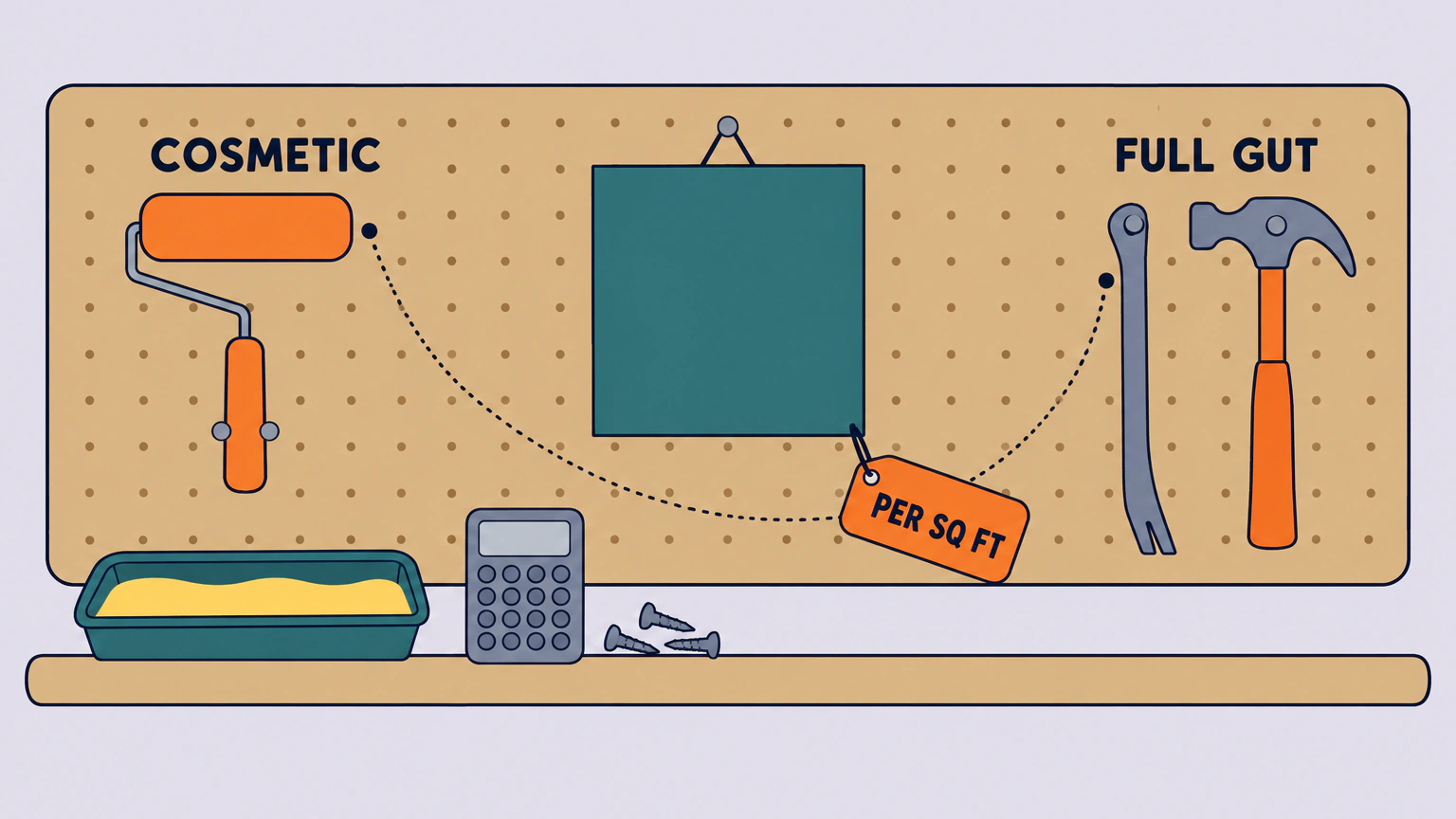
A whole-house job is priced on the floor area it touches, and the scope decides the rate. Our general contractors page gives these four planning budgets, each with what it covers and what it leaves for you to budget on top.
| Job | Our planning budget | What it covers | Budget for separately |
|---|---|---|---|
| Cosmetic interior renovation | C$30 to C$100 per square foot of renovated floor area | Paint, flooring and fixture refresh in the rooms you name, with the layout and major services left as they are | Major plumbing or electrical upgrades, and structural work |
| Full interior gut renovation | C$250 to C$450 per square foot of renovated floor area | The interior stripped and rebuilt inside the existing structure, with the building services and finishes written into the specification | Structural defects nobody has found yet, and exterior work that isn't listed |
| Ground-floor addition | C$350 to C$600 per square foot of new floor area | A new foundation, the roof connection, services and interior finishes | Land, and design or municipal charges that aren't listed |
| Cost-plus contractor fee | 15% to 25% of the eligible direct construction costs | The contractor's management fee on a cost-plus contract, not the project total | The direct project costs themselves |
These are our own planning budgets for general contractors. The square-foot rates use only the floor area the job actually touches.
Cosmetic refresh or full gut: price the job you're actually doing
Start with the floor area, and count only the rooms being renovated. That's our own instruction on those budgets, and it matters more than it sounds. If the basement and one bedroom are staying as they are, leave them out of the sum.
A cosmetic job refreshes paint, flooring and fixtures and leaves the layout and the major services alone. Add a new kitchen, a new bathroom or a changed layout and it's no longer cosmetic. A gut strips the interior and rebuilds it inside the existing structure, with the building services and finishes written into the specification. Our budget says to confirm structural work, kitchens and bathrooms in that written specification, and we'd insist on it.
On 1,600 square feet, that puts the whole house renovation cost at $48,000 to $160,000 for the cosmetic tier and $400,000 to $720,000 for the gut. The gap between the two rates is roughly the gap between painting a wall and removing it.
An addition is priced per square foot of new floor, not renovated floor, and a second-storey addition is a different project again. A basement on its own has its own row in our budgets and its own guide to finishing a basement.
Why four price guides give you four different answers
Put our gut range beside three published guides to home renovation cost and the spread is wide enough to make anyone nervous.
| Who publishes it | Lighter scope, in their words | Full gut, in their words | What the figure covers |
|---|---|---|---|
| Our planning budgets | C$30 to C$100 (cosmetic interior renovation) | C$250 to C$450 | Per square foot of renovated floor area, with the scope written out |
| RenoQuotes price-per-square-foot guide | $10 to $45 (light, cosmetic) | $150 to $260 and up | National averages for 2026, before taxes |
| HomeStars guide to the cost of renovating a house | $100 to $300 (whole-house renovation) | $200 to $500 | Averages across Canada, on a page that also opens with $100 to $200 for a full renovation |
| Andare Homes, a Toronto design-build firm | $100 to $175 (cosmetic whole-home update) | $175 to $350 (comprehensive), $350 to $500 and up (structural or high-end) | Toronto planning ranges for 2026 |
Three things explain most of the gap. First, "gut" means different jobs. RenoQuotes' full gut lists structure, insulation, electrical, plumbing and finishes. Ours lists building services and finishes, and leaves structural defects nobody has found yet as a separate line. Second, a national average isn't a Toronto design-build firm's planning range, and neither one is a quote for your street. Third, HomeStars can't agree with itself: the same guide gives $100 to $200 in its opening line and $100 to $300 further down.
So compare scope sheets, never headline rates. A $150 gut and a $450 gut can both be honest prices for two different jobs.
What the square-foot price leaves out
Tax, permits and design can sit on top of the per-foot number, along with whatever an older house is hiding. Statistics Canada says it plainly about the renovation prices it tracks: they exclude sales tax and the cost of design.
Sales tax, which depends on your province
RenoQuotes prints its per-foot figures before tax. Where your house sits decides what lands on top.
| Where the house is | What can go on top of the contract price |
|---|---|
| Ontario | 13% HST |
| Nova Scotia | 14% HST |
| New Brunswick, Newfoundland and Labrador, Prince Edward Island | 15% HST |
| Quebec | 5% GST plus 9.975% QST |
| Alberta, Yukon, Northwest Territories, Nunavut | 5% GST |
| British Columbia | 5% GST. The contractor pays the 7% PST on materials and doesn't charge PST on the work itself |
| Manitoba, Saskatchewan | 5% GST, with provincial sales tax of 7% in Manitoba and 6% in Saskatchewan applied under each province's own rules for contractors |
Rates are the ones the Canada Revenue Agency publishes for each province. Ask your contractor to show the tax as its own line.
In the HST provinces, the tax is charged on the price of the work. Nova Scotia's rate dropped to 14 per cent in April 2025, so an older quote there may still show 15. In Quebec, Revenu Québec's rule is that GST and QST apply to most goods and services, and a renovation contract isn't on its list of exemptions.
British Columbia is the useful surprise. The contractor pays PST on the materials and doesn't charge PST on the work, so your invoice shows 5 per cent GST. Manitoba and Saskatchewan apply their own contractor rules, so ask how PST is being handled before you compare two bids.
The amounts aren't small. On a $400,000 job, the tax is $20,000 at 5 per cent, $52,000 at 13 and $60,000 at 15.
Permits and design fees
Your own city sets these, so treat Toronto as a worked example rather than the rule. Toronto requires a building permit to add or remove walls, to install or change heating or plumbing systems, and to demolish all or part of a building. It doesn't require one for new cabinets and millwork, replacement plumbing fixtures, added insulation or a replacement furnace in a house.
The fee is charged by floor area. Toronto's 2026 schedule sets $11.53 a square metre for interior alterations in a house, and $13.41 for residential alterations with floor replacement. On 150 square metres (about 1,615 square feet), that's roughly $1,730 to $2,010, against a $214.79 minimum. Plumbing fixtures ($23.20 each) and heating, ventilation and air conditioning ($270.64) are permitted separately. Start work without a permit and Toronto adds 50 per cent of the permit fee or $214.79, whichever is more, up to $29,456.99.
Design is the bigger line. Our planning budget for a full service from an architect is 6 to 18 per cent of the construction cost, which is $24,000 to $72,000 on a $400,000 gut. Permit drawings on their own are priced by scope, so ask what's in the package.
What a house built before 1990 can hide, and how much to set aside
A gut is the moment an older house shows you what's behind its walls. Health Canada says asbestos was commonly used before 1990, in insulation, exterior siding, ceiling and floor tiles, cement and plaster. It suggests having a professional test suspect materials before you renovate, and hiring a qualified removal specialist to take out any asbestos before work starts. Our guide to testing for asbestos covers what that involves. Homes built before 1991 may also have lead paint.
Before the walls come down in a house built before 1990:
- Have materials you suspect contain asbestos tested, and budget for a qualified removal company if a test comes back positive.
- Have old paint tested for lead if the house was built before 1991.
- Run a long-term radon test now, so a fix can go in while the walls and floors are open.
- Ask the electrician and the plumber, in writing, what they'll do if they open a wall and find old wiring or worn-out pipes.
Radon belongs on the list because Health Canada says a high level is best reduced before or during renovations, and a long-term radon test runs for three months. Trades add their own worries: knob and tube wiring, and supply pipes that are near the end of their life.
Then there's the reserve. Published advice runs from 10 to 30 per cent. Leedway Group calls 10 to 15 per cent "the minimum prudent buffer", Andare Homes suggests 10 to 20 for older homes, RenoQuotes' budget formula uses 15, and Builders Ontario says 20 to 30. We'd set yours after the electrician and plumber have put their answers in writing. The right number follows what they find.
How much renovation prices have moved in your city
A renovation cost per square foot from a neighbour's 2019 job, or from an older price guide, is out of date by roughly what prices in your city have risen since. Statistics Canada's Residential Renovation Price Index tracks what renovation contractors charge in 15 cities, before sales tax and design.
| City | Change over the past year | Change since the second quarter of 2019 |
|---|---|---|
| Composite index | +2.3% | +59.2% |
| St. John's | +2.8% | +56.7% |
| Halifax | +4.8% | +51.9% |
| Moncton | +1.7% | +35.1% |
| Quebec City | +7.1% | Not tracked before 2023 |
| Montréal | +5.9% | +47.7% |
| Ottawa | +3.5% | +47.2% |
| Toronto | +1.0% | +79.7% |
| London | +4.1% | Not tracked before 2023 |
| Winnipeg | +2.9% | +44.3% |
| Regina | +5.0% | Not tracked before 2023 |
| Saskatoon | +3.3% | +44.0% |
| Calgary | +0.9% | +55.1% |
| Edmonton | +2.2% | +49.9% |
| Vancouver | -0.1% | +41.8% |
| Victoria | +5.3% | Not tracked before 2023 |
Statistics Canada's Residential Renovation Price Index for the second quarter of 2026, compared with a year earlier and with the second quarter of 2019. It tracks what renovation contractors charge, before sales tax and design costs.
The composite index is up about 59 per cent since 2019 and just over 2 per cent in the past year. Four cities joined the series in 2023. Toronto shows why you need both numbers: up about 80 per cent since 2019, but only 1 per cent over the last year. Vancouver was flat. Quebec City rose fastest, about 7 per cent in a year.
One caution comes from Statistics Canada itself. The index reflects the prices contractors report, which may not match the bids people finally accept. Use it to age an old number, not to judge a fresh quote.
When a gut renovation gets its GST or HST back
The GST/HST new housing rebate is normally about new houses, but the CRA treats a substantially renovated house as a newly built one. Three things decide whether you see any money: whether the work passes the 90 per cent test, which rebate you fit, and in Ontario, when the work starts.
The 90 per cent test that makes an old house count as new
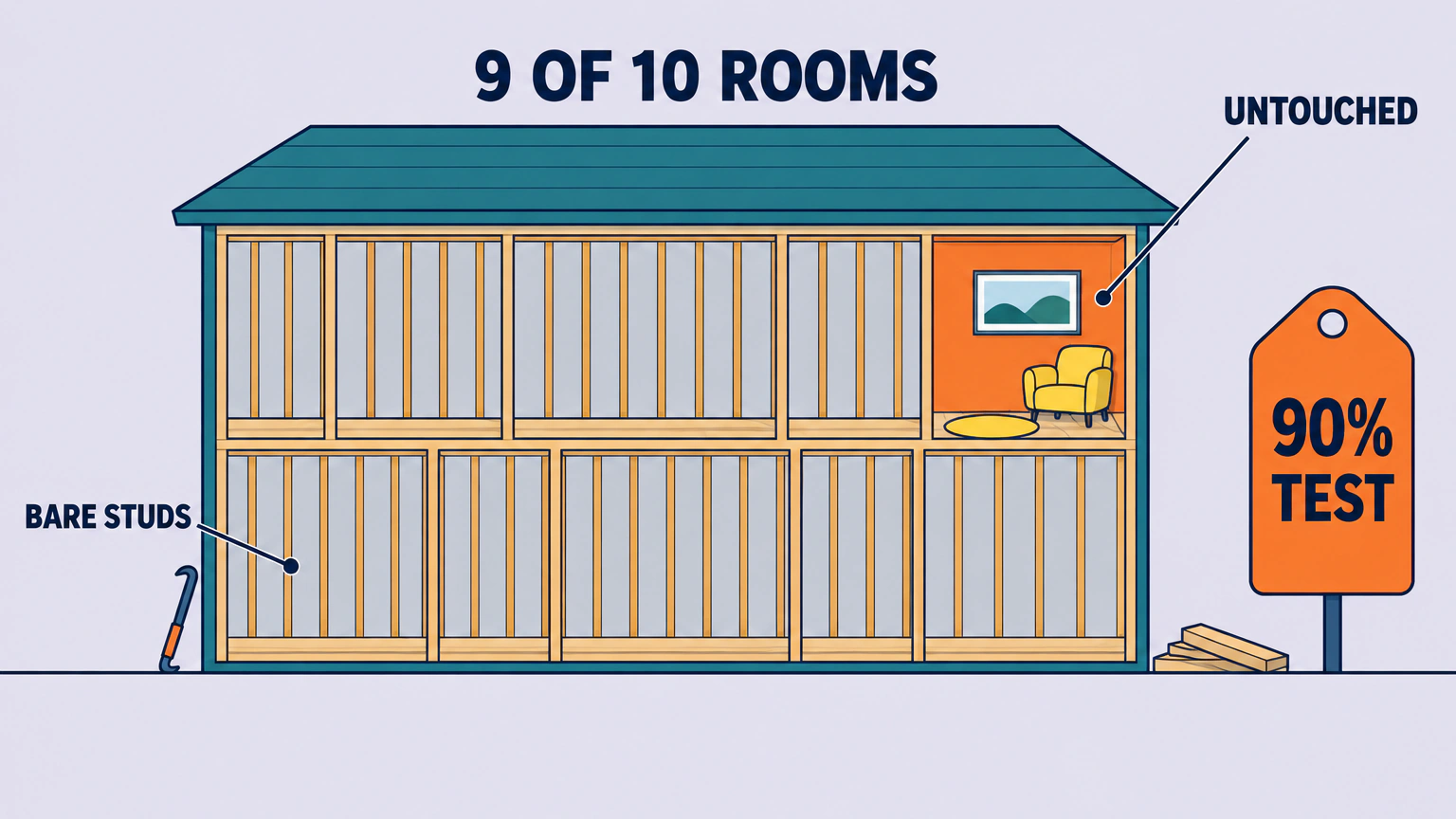
The CRA's rule is that at least 90 per cent of the interior that existed before the renovation has to be removed or replaced. The foundation, the exterior and interior supporting walls, the roof, the floors and the staircases don't have to go. Only livable areas count. Finished basements and attics are in, while garages and crawl spaces are out. A basement renovation, a garage or a deck on its own never qualifies, and an addition doesn't count toward the test.
The CRA's bulletin on substantial renovations spells out the minimum. Interior walls are "stripped to the studs and refinished and replaced with drywall", together with the ceilings or floors, across 90 per cent of the house. Older plaster walls can be covered with new drywall instead. In a kitchen, removing the cabinetry plus the ceiling or floor and the remaining walls is generally enough. In a bathroom, it's the walls and the fixtures. Repairs don't count, so patching drywall, painting or sanding a floor adds nothing.
Any fair and reasonable way of measuring works: floor area, floor-plus-wall area, or rooms, where nine renovated rooms out of ten passes as long as the tenth isn't a big share of the house. Our cosmetic tier can't pass, because it leaves the walls in place. Our gut tier describes the job the test has in mind, but the work actually done decides whether it passes.
The rebates, and who each one is for
Five rebates can reach a gut renovation, and each has its own value limit and timing.
| Rebate | Who can claim it for a gut renovation | Home value limit | What it pays back | When the work has to happen |
|---|---|---|---|---|
| GST/HST new housing rebate | An individual who substantially renovates a home they own, or hires someone to, as their own or a relative's main home | Under $450,000 for the house and land, with the rebate shrinking above $350,000 | 36% of the GST or federal part of the HST, up to $6,300 | No start window |
| First-time home buyers' GST/HST rebate | A first-time buyer who substantially renovates their own main home and is the first to live in it after work begins | Under $1.5 million, with the full rebate up to $1 million | The GST or federal part of the HST, up to $50,000 in total with the regular federal rebate | Work begins on or after March 20, 2025 and before 2031. The work must be substantially complete, and the buyer must move in, before 2036. |
| Ontario new housing rebate | An Ontario owner who substantially renovates their own or a relative's main home | No value limit | 75% of the 8% provincial part of the HST, up to $16,080 when no HST was paid on the land | No start window |
| Ontario first-time home buyers' rebate | A first-time buyer who substantially renovates their own main home in Ontario and is the first to live in it after work begins | Under $1.5 million, with full relief up to $1 million | Up to $80,000 of the 8% provincial part of the HST, including the regular Ontario rebate | Work begins on or after March 20, 2025 and before 2031. The work must be substantially complete, and the buyer must move in, before 2036. |
| Ontario enhanced new housing rebate, with the Ontario new home affordability payment | An Ontario owner who substantially renovates their own or a relative's main home | Under $1.85 million, with full relief up to $1 million | Up to the full 13% HST, capped at $80,000 of the 8% part and $50,000 of the 5% part | Work begins between April 1, 2026 and March 31, 2027, and is substantially complete before 2030 |
In Quebec, Revenu Québec runs the federal rebates. Nova Scotia's provincial rebate doesn't cover a substantial renovation.
The regular federal rebate needs the finished house and land to be worth under $450,000, and it starts shrinking above $350,000.
The first-time home buyers' rebate fits the buyer who guts an older house before moving in, and it has its own first-time test. You must be at least 18 and a Canadian citizen or permanent resident. The test applies when you first occupy the home or substantially finish the work, whichever comes first. You can't have lived in a home you or your spouse or common-law partner owned as your main home that year or in the four years before it. You also can't have received this rebate before. So a homeowner gutting the house they've lived in for a decade doesn't qualify. The work has to begin on or after March 20, 2025 and before 2031.
Ontario's regular rebate has no value limit. It pays up to $16,080 if you didn't pay HST on the land, or $24,000 if you did. If you keep the house, you or a relative must be the first to live there after work starts, as your main home. For the first-time buyer rebates, it must be you.
We're not tax advisers, and whether your renovation qualifies is the CRA's call, made on your own paperwork. Read Guide RC4028 or call the CRA before you put the rebate in your budget.
Ontario's temporary top-up for gut renovations
Ontario has added two layers for a limited window. The Ontario enhanced new housing rebate, run by the CRA, and the Ontario new home affordability payment, run by the province, apply to an owner's substantial renovation that begins between April 1, 2026 and March 31, 2027. The work has to be substantially complete before 2030, and the home has to be worth less than $1.85 million when it's done.
Together they can return up to the full 13 per cent HST on a home worth up to $1 million. The provincial rebate is capped at $80,000 of the 8 per cent part, and the payment at $50,000 of the 5 per cent federal part. Neither returns more than the tax you paid. Between $1 million and $1.5 million the caps apply as flat amounts, and between $1.5 million and $1.85 million the relief is partial. The payment is reduced by any federal rebate you get. There's no separate Ontario application: you give your consent on the CRA form.
Here's what the window does to a real budget if you aren't a first-time buyer and paid no HST on the land. A $400,000 gut on a house worth $900,000 afterward, started in January 2027, pays $52,000 in HST. Up to all of it can come back. Start the same job after March 31, 2027 and the Ontario rebate tops out at $16,080. That's $35,920 less, for the same walls and the same drywall.
If a spring 2027 gut is on the table, we'd ask the CRA what counts as the start date before picking one, and keep the paper that proves it.
The paperwork that keeps your claim alive
Fill out Form GST191-WS first, then Form GST191 and, in Ontario, Form RC7191-ON. Send them together if you apply by mail. If you move in after the work is finished, you have two years from substantial completion to claim. The CRA accepts only original invoices in your name or a co-owner's, and it doesn't accept quotes, estimates, card slips or account statements. Where a supplier charged no GST or HST, you send that invoice in with your worksheet.
Keep these for the rebate
- Original invoices in your name for materials and contractor work, with the GST or HST shown.
- Paperwork that shows when the renovation began, such as the permit and the first invoice.
- The date the work was substantially complete, and the date you moved in.
- A professional appraisal of the finished house if its value sits close to a rebate limit.
- A copy of every form you file, kept with the invoices for six years.
An audit can add up to six months to the wait for payment. And the plain consequence of the invoice rule: a cash job with no invoice is tax you paid and can't claim back.
Reading a whole-house quote before you sign
The quote is where the scope, the tax line and the rebate paperwork either exist or don't. Two choices shape the rest: how the contractor gets paid, and what's been left out.
Fixed price or cost-plus
On a cost-plus contract you pay the actual costs plus a fee. Our planning budget for that fee is 15 to 25 per cent of the eligible direct construction costs, so $100,000 of direct costs adds $15,000 to $25,000, for $115,000 to $125,000 before tax. Don't add the fee to a fixed-price quote that already includes overhead and profit. Cost-plus also needs the cost base, the markups and the approval limits in writing.
The two models feel different once work starts. On a cost-plus job, agree what itemized invoices the contractor will provide. Get the manufacturer's warranty papers for products such as the water heater, along with the contractor's workmanship warranty. On a fixed price, a change order is simply a price for extra work, which you accept or refuse. Anything not clearly written into the contract can become one. Those itemized invoices also feed the rebate paperwork.
Allowances, exclusions and what to hold back
Our general contractors page puts it simply: "Get a written scope that lists what's left out." An allowance is a placeholder price for something you haven't chosen yet, such as flooring or tile. Andare Homes points out that a flooring allowance may omit levelling, which is exactly the kind of gap that turns into a change order. Exclusions are the "budget for separately" items from our planning budgets, written into your contract. Payments should follow finished stages, not dates. Our lien guide explains what you can hold back from each payment in your province.
Eight things a whole-house quote should spell out
- The floor area being renovated, room by room.
- Whether the price is fixed or cost-plus, and on a cost-plus job, the fee and what it's charged on.
- Every allowance, with the amount and what happens if you choose something pricier.
- A written list of what's excluded.
- How a structural surprise will be priced before anyone fixes it.
- Who applies for the building and trade permits, and who pays the fees.
- The sales tax as its own line, at your province's rate.
- A payment schedule tied to finished stages, not to dates.
Questions people ask about whole-house renovation costs
How much does it cost to gut a house to the studs?
On our planning budgets, a full interior gut runs C$250 to C$450 per square foot of the floor you renovate. For 1,600 square feet, that's $400,000 to $720,000. Other guides print lower ranges, starting around $150 a square foot, and they don't all mean the same job by "gut". Compare what each price includes before you compare the prices.
Does a renovation qualify for the HST new housing rebate?
Only a substantial renovation does. The CRA's test is that at least 90 per cent of the interior is removed or replaced, which in practice means walls stripped to the studs plus new ceilings or floors almost everywhere. A basement, garage or addition on its own never counts. The house also has to be your own or a relative's main home.
Can I live in the house while it's being gutted?
Living there doesn't cancel the regular new housing rebate by itself. If you move in before the work is substantially complete, though, your two-year filing clock can start earlier. Tax that becomes payable more than two years after you first moved in can't be claimed. On the practical side, Andare Homes is blunt: for a full gut, "moving out is usually safer and faster".
How much contingency should I set aside?
Published advice runs from 10 to 30 per cent of the construction price. Andare Homes suggests 10 to 20 per cent for full renovations of older homes, and Builders Ontario says 20 to 30. We'd set yours after the electrician and plumber have looked behind a few walls, because the right number depends on what they find.
Do I need a permit to renovate the inside of my house?
Usually, if you're moving walls, changing plumbing or heating, or demolishing part of the house. Toronto requires a permit for all three, while new cabinets, replacement plumbing fixtures, added insulation and a replacement furnace don't need one there. Permits are municipal, so check with your own building department before demolition starts.
Is it cheaper to renovate or tear down and rebuild?
Not reliably. Our planning budget for a standard custom house from a design-build firm is C$350 to C$450 per finished square foot above ground, foundation included, before land, servicing, design, the garage and basement finishing. Tearing the old house down isn't in that figure. A gut runs C$250 to C$450. A new house you build on your own lot can qualify for the same rebates as a substantial renovation.
Write one scope sheet that lists the rooms, the square footage and what's coming out. Then ask two or three general contractors in your area to price that same sheet.