


On this page
- What a winter of snow removal costs in seven Canadian cities
- How often your city gets enough snow to plow
- What the contract should say before you pay anything
- The sidewalk, the street and the windrow: what stays your job
- Snow clearing help for seniors and people with a disability
- Questions Canadians ask about snow removal costs
What a winter of snow removal costs in seven Canadian cities
Snow companies post their prices one neighbourhood at a time, and no two price quite the same thing. We put seven current price cards, one per city, on a season basis so they can sit side by side. If you're lining up fall contractors anyway, booking the autumn eavestrough cleaning in the same week saves a second round of calls.
What seven companies post for a season of driveway clearing
| City | Who posts it | What the price covers | Posted price | Season total on that basis |
|---|---|---|---|---|
| Toronto (North York, Scarborough, Markham) | The Blizzard Wizard | Two-car driveway, 2 cm trigger, cleared an estimated 6 to 10 hours after the snow stops | $650 for the season, or $110 a month over six payments, before tax | $650, or $660 paid monthly |
| Ottawa | Tremblay Contracting | Double driveway, two cars wide and two deep, driveway only | $579 plus HST | $579 |
| Montreal (centre and east) | Déneigement Ice | Double parking space cleared by machine after each snowfall over 5 cm, first snow to last | $755 before taxes | $755 |
| Winnipeg | Super Value Home Services | Up to a four-car driveway plus front steps and sidewalk, 5 cm trigger measured at the airport, cleared within 24 hours | $999.75 for November 1 to March 31, or $199.95 a month, plus 5% GST | $999.75 |
| Calgary | Landgraf Lawn Care | Double driveway, all snowfall above a trace, cleared within 24 hours | $160 a month on a November 1 to March 31 contract, $200 a month with no contract, or $50 a visit | $800 on the contract, $1,000 month to month |
| Edmonton | Serene Landscaping | Double driveway, unlimited visits, sent out for every snowfall over 1 cm | From $249 a month, November to March | From $1,245 |
| Halifax region | Doucet Landscaping | Every snowfall November through April, no visit cap | From $1,000 for the season | From $1,000 |
Each row is one company's own published price for its own service area, and none is a quote for your driveway or an average for the city. Monthly prices are multiplied over the months each company names, and the Calgary, Edmonton and Halifax cards don't say whether tax is included.
The season totals run from Ottawa's $579, for the driveway only, to Edmonton's "from $1,245", and five of the seven sit between $650 and $1,000. Billing splits along the map. The three Prairie cards price the winter by the month over November to March, though Winnipeg's also posts a season figure. Toronto's sets the month and the season side by side. Triggers run from 1 cm in Edmonton and 2 cm in Toronto to 5 cm in Montreal and Winnipeg. Calgary's crew clears anything above a trace, which it puts at about 1 cm. Only Halifax's card names April, and Montreal's runs from the first snow to the last. Four cards quote before tax, and three don't say. Winnipeg's covers the most ground: up to a four-car driveway, plus the front steps and the sidewalk.
By the season, by the month or by the push
You can buy a winter three ways. Toronto's Blizzard Wizard charges $650 for the season on a two-car driveway, or $110 a month over six payments, which comes to $660. Pay by October 31, 2026, and its Thanksgiving prepay price drops to $585. So monthly is the dearest way to buy the same winter: $10 more than the season price and $75 more than the prepay. Winnipeg's Super Value charges the same either way, $999.75 for November 1 to March 31 or $199.95 a month for those five months.
Paying per push, one visit billed when it happens, is the third way. Calgary's Landgraf Lawn Care charges $50 a visit for a double driveway. Edmonton's Serene Landscaping starts at $79, and Winnipeg's one-time clearing is $129.95 for the first person-hour plus $25 for each extra 15 minutes of labour.
A per-push price buys a visit when you call, not a place on the route. Serene says its contract clients are cleared first, before one-off requests, which matters most on the morning after a big storm. Book early, too. Doucet in Halifax asks for bookings by October.
Why two driveways the same size get different prices
The trigger matters most, because a plow sent out at 1 cm shows up far more often than one that waits for 5 cm. Speed costs money too. The Toronto card charges $650 for a crew that finishes an estimated 6 to 10 hours after the snow stops, and $725 for 4 to 6 hours.
Then there's what "the driveway" means. Ottawa's Tremblay price is "for driveway only". Toronto's package "can include" the front walk, the sidewalk frontage and the windrow "where it is accessible from the serviced driveway", and that little word "can" deserves a question. Ice gets priced three ways. Toronto lists salt or de-icing "when appropriate", Calgary sells ice chipping at $65 an hour, and Montreal prices salt de-icing as its own line. And the calendar differs. Halifax's season runs into April, while three Prairie cards stop on March 31.
Four of the seven cards come from firms that also offer lawn care or landscaping, so ask the lawn care companies near you whether they plow. And a trigger only means something once you know how often your city gets that much snow.
How often your city gets enough snow to plow
Environment and Climate Change Canada publishes airport climate normals for the 1991 to 2020 reference period. Some stations use fewer than 30 years of observations. The normals count the days a year when 5 cm or more of new snow falls. That's a useful yardstick for the Montreal and Winnipeg contracts.
How often a normal winter brings 5 cm of snow or more
| City (weather station) | Normal snowfall in a year | Days a year with 5 cm or more of new snow | Of those days, how many fall outside November to March |
|---|---|---|---|
| Toronto (Pearson airport) | 114.5 cm | 7.2 | 0.3 |
| Ottawa (airport) | 231.9 cm | 16.0 | 0.9 |
| Montreal (Trudeau airport) | 216.6 cm | 13.3 | 1.0 |
| Halifax (Stanfield airport) | 215.2 cm | 13.4 | 0.9 |
| Winnipeg (Richardson airport) | 126.2 cm | 7.4 | 1.4 |
| Regina (airport) | 104.6 cm | 5.0 | 1.3 |
| Saskatoon (Diefenbaker airport) | 91.0 cm | 4.1 | 0.9 |
| Calgary (airport) | 138.7 cm | 7.7 | 2.6 |
| Edmonton (airport) | 126.7 cm | 6.6 | 1.8 |
From Environment and Climate Change Canada's 1991 to 2020 climate normals for each city's main airport station. A day counts only when 5 cm or more of new snow fell that day, so a storm spread over two days can count once or not at all.
Ottawa gets the most 5 cm days of the nine, at 16.0 a year, and Saskatoon the fewest, at 4.1. Ottawa, Montreal and Halifax each get roughly twice Toronto's count. Toronto's Pearson station records 114.5 cm of snow in a normal year, against 231.9 cm at Ottawa's airport. A 10 cm day is rarer still, with Toronto averaging 2.2 a year and Ottawa 5.9. A slow storm that never drops 5 cm in a single day doesn't appear in the count. These are weather averages, not a forecast of visits.
Why the trigger changes how often the crew comes
The trigger matters too. A contract that clears at 1 or 2 cm, or "all snowfall other than trace amounts", brings the plow far more often. Calgary's airport records measurable snow, 0.2 cm or more, on 39.8 days between November and March in a normal winter. Only about 5 of those days bring 5 cm or more. Landgraf puts its trace at about 1 cm, so its real visit count can't be read directly from either count.
Now the break-even sum, worked on Landgraf's own card. The $800 season divided by $50 a visit is 16 visits. That sits between about 5 days with at least 5 cm and roughly 40 with any measurable snowfall. Which side you land on depends on how much you'd happily shovel yourself. Calgary adds a catch. Its 24-hour sidewalk rule applies after every snowfall, big or small, so a per-push customer still has to get the sidewalk done.
Pro tip: Do the break-even sum before you sign. Divide the season price by the per-visit price. That's how many visits the contract has to make to pay off. Winnipeg's Super Value posts $999.75 for November to March and $129.95 for a one-time clearing's first person-hour. At one person-hour per visit, the season pays off at the eighth visit. It pays off sooner if visits need more labour. Its trigger is 5 cm measured at Richardson airport, where a normal winter brings about six 5 cm days in those five months. If you'd only call for the big ones, paying per visit can win. A long storm or a heavy winter tips it back.
On the Prairies, the snow that falls before and after the contract season
Of Calgary's 7.7 days a year with 5 cm or more, 2.6 fall outside November to March, about a third. About 46 cm of the airport's 139 cm a year falls in September, October, April and May. Edmonton has 1.8 of its 6.6 days in those shoulder months, more than a quarter. Regina has 1.3 of 5.0, about a quarter, Saskatoon 0.9 of 4.1, more than a fifth, and Winnipeg 1.4 of 7.4, nearly a fifth. In Toronto, Ottawa, Montreal and Halifax, fewer than one in ten falls outside those months.
Set the contracts beside that. Calgary's, Winnipeg's and Edmonton's all run November to March, so an October dump or an April storm sits outside what you paid for. Before you sign, ask two plain questions. What does a visit cost in October and April? Can the season be extended? Calgary's 24-hour sidewalk clock follows the snow, not your contract dates.
Halifax shows what a season that fits its city looks like. Doucet's card covers every snowfall November through April, which takes in most of the little snow Halifax gets outside the core months.
What the contract should say before you pay anything
Quebec's consumer regulator, the Office de la protection du consommateur (OPC), publishes a snow contract checklist you can use anywhere.
Ten lines to find in a snow removal contract
- The first and last dates of the season, and what a visit costs outside them.
- The snow depth that brings the plow, in centimetres, and where it's measured.
- How many hours after the snow stops your driveway will be cleared.
- Every area included: driveway, front walk, steps, the city sidewalk and the windrow at the end of the driveway.
- Whether salt or ice treatment is included or billed by the visit.
- Any cap on visits or on total snowfall, and the price of each visit after it.
- Whether the price can change during the season, and on what condition.
- The payment dates, and what you get back if you cancel or the company stops coming.
- Who pays when the plow damages your lawn, curb or driveway, and how the edges are staked. If a plow already has, driveway paving contractors can price the repair.
- The company's liability insurance, and in Ottawa or Montreal its City licence or borough permit.
Red flag: Three snow contract pitches worth a pause
- "Pay the whole season now to hold your spot." The OPC advises avoiding a pre-service deposit, or keeping it very small. In Quebec, the OPC says an uninvited door-to-door seller can't take an advance for 10 days after signing. Don't trust a company that gives you only a phone number. Get an address before you pay.
- An uninvited seller asks you to sign at your front door. In Quebec, you can cancel within 10 days of receiving the written contract. The seller needs an OPC licence. Elsewhere, check your province's door-to-door rules before you sign.
- A fuel or "heavy winter" surcharge clause. In Quebec, a contractor can't use it to change a season price on its own. Anywhere else, ask for it struck.
Caps, storm charges and a price that rises mid-winter
A cap turns a flat price into a count. Find the season dates, any cap on cleanings or total snowfall, and the price of each visit after the cap. Even "unlimited" needs reading. Calgary's Landgraf calls its visits unlimited, then explains that means one visit per 24 hours, with extra visits billed. Toronto's card promises "unlimited qualifying visits", and "qualifying" is doing some quiet work there.
In Quebec, the price itself is locked. The OPC says the contractor on a fixed-term contract, like one for a whole season, "cannot unilaterally change any essential elements of the contract, such as the price of the services." That holds "even if the contractor has included such a provision in the contract", and the OPC gives a fuel-price clause as its example. If the price goes up anyway, negotiate first. Then pay "under protest" by writing those words on the cheque, and send a formal notice to claim the money back.
Outside Quebec, the rules vary by province. Read the surcharge line before you sign, and ask for it struck.
Deposits, payment dates and getting out of the contract
The company that vanishes in January is mostly a payment-schedule problem. The OPC's advice is to avoid a down payment before service starts, or keep it very small. It notes that most companies take two post-dated cheques, for example one dated November 15 and one dated February 15. That keeps part of your money in hand until midwinter.
The cards vary. Montreal's Déneigement Ice takes payment at the start of the season, or in two instalments on request, with the second on February 1. Calgary's Landgraf bills its monthly plan at the start of each month and wants 30 days' written notice to cancel. Winnipeg's Super Value charges a $99.95 administration fee on a contract cancelled before its first month starts, and gives no refund for a month already under way.
Getting out is harder than most people think. In Quebec, the OPC says there's no general 10-day right to cancel. The exception is an itinerant merchant, such as a seller who came to your door uninvited. The seller needs an OPC licence. You can cancel within 10 days after receiving the written contract, even if clearing has already started. If day 10 falls on a weekend or holiday, the deadline moves to the next business day. Outside Quebec, our duct cleaning guide sets out your door-to-door cancellation rights province by province.
Insurance, and who answers when someone slips on your driveway
Ottawa requires at least $2 million in liability coverage for each plow. The type of insurance depends on whether the vehicle needs a road licence. Montreal boroughs can ask for proof of liability insurance before issuing a plow permit. Ask for proof wherever you live. A landscaper's policy may not cover winter plowing unless the insurer added it, so get a certificate that names snow removal.
Ontario's Occupiers' Liability Act shows why choosing and checking the contractor matters. An occupier, usually the owner or tenant, can avoid liability for a contractor's negligence if hiring them was reasonable. They must also take reasonable steps to check the contractor's competence and work, and it must have been reasonable to undertake the work. Checking the licence and insurance helps, but doesn't replace checking the work. Duties the law won't let you hand over still stay with you.
Since 2021, the Act has also put a clock on snow and ice claims. Someone hurt by snow or ice must give written notice within 60 days of the injury, in person or by registered mail, to an occupier or the snow contractor. It must name the date, time and location. If you get one, send a copy the same way to the other occupiers and your snow contractor from when the injury happened. Missing notice doesn't bar a claim if the person died from the injury. A judge can also excuse missing or incomplete notice if there's a reasonable excuse and the defence isn't harmed.
A fall on your property is a legal question as much as a snow one. If you get a notice, call your home insurer before you call anyone else.
The sidewalk, the street and the windrow: what stays your job
The contract covers what you pay for, and the city decides the rest. Calgary and Edmonton normally require you to clear the public sidewalk after every snowfall. Toronto leaves lighter snowfalls to you.
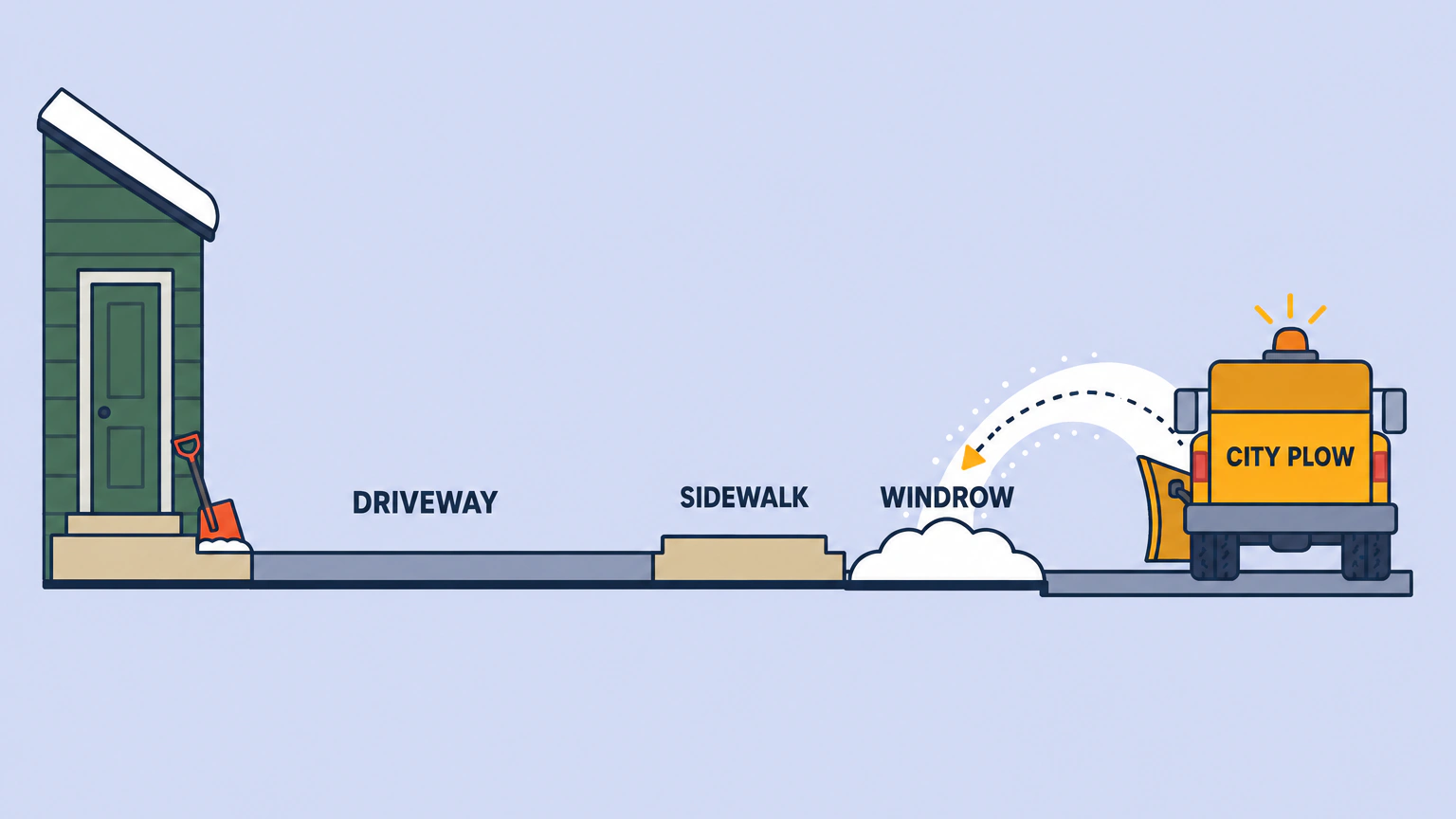
The windrow is the ridge of snow a city plow leaves across the mouth of your driveway, often after your contractor has gone. Unless the contract says the crew comes back for it, you're the one who digs out. Calgary makes the wider point for landlords in so many words: owners stay responsible for the sidewalk "regardless of who does the work." Calgary exempts a sidewalk separated from your lot by a developer-built retaining wall. It also exempts one behind a developer-built community screening fence at least 1.75 m high. A developer-built or City-built sound barrier qualifies too. And if a plow pile ends up banked against the house, checking your furnace vents after the first snowfall is worth the walk around.
Who clears what, in seven cities
| City | The public sidewalk out front | Pushing driveway snow onto the road or sidewalk | The windrow at the end of your driveway |
|---|---|---|---|
| Toronto | City crews clear it once 2 cm has fallen. For a lighter snowfall, you have 12 hours after it stops. | Not allowed. The City lists a $500 fine plus a $110 victim surcharge. | City crews open eligible residential driveways. On eligible collector and arterial roads, they clear openings when the ridge exceeds 25 cm. Other windrows are yours. |
| Ottawa | City crews plow residential sidewalks once 5 cm has fallen. | Not allowed, for you or your plow contractor. | Yours to clear. |
| Montreal | The City clears sidewalks, starting at 2.5 cm. | Not allowed in most boroughs. Pile it on your own lot. | Yours to clear when the City's plow blocks your entrance. |
| Halifax | The municipality clears all public sidewalks. | Not allowed. Tickets start at $100. | Yours, including snow plowed into your driveway. |
| Winnipeg | The City plows sidewalks, residential streets included. | Not allowed. Report it to 311. | Sidewalk and back-lane ridges are normally yours. City crews can help in back lanes with no front access. Report missed street-plow ridges over 20 cm to 311. |
| Calgary | Yours unless a wall, fence or sound barrier exemption applies. Clear to bare pavement "within 24 hours after the ice and snow has been deposited." Fines run $250, $500 and $750 within 12 months. | Not allowed. Keep driveway snow on your property. | The City doesn't clear windrows. You don't have to clear them, but can for access. |
| Edmonton | Yours, as soon as possible. There's no set deadline, and the fine is $100 plus the City's clearing cost. | Not allowed. The fine is $250. | Ask 311. The City's sidewalk page doesn't say. |
From each city's own pages and bylaws. Where the sidewalk is yours, the bylaw still names you after you hire someone, so put the sidewalk in the contract.
Driveway snow can't go onto the road or sidewalk in any of the seven cities, though Montreal's rule covers most boroughs rather than all of them. Toronto puts a number on it: a $500 fine plus a $110 victim surcharge. Calgary and Edmonton normally make owners clear the public sidewalk after every snowfall. Toronto leaves them lighter snowfalls. Ottawa, Montreal and Halifax leave the windrow to you, and Calgary doesn't clear windrows at all. Toronto's crews open eligible driveway windrows, and in Winnipeg the answer depends on which plow left the ridge.
In Ottawa and Montreal, check the plow's licence
Two of the seven cities let you check a plow before it touches your driveway. Ottawa licenses snow plow contractors, and its SNOW KNOWledge leaflet tells you what to look for. Ask for proof of the City's business licence, and look the company up at ottawa.ca/consumerawareness. The plow should carry an orange plate with a valid annual sticker, and the truck should show the company's name and phone number on both sides.
Rules in force since October 16, 2024 require $2 million in insurance. The City's bylaw text, saved in an August 2025 archive, says contractors must remove illegally dumped snow as soon as they discover it. It also sets four hours after a licence inspector's request. It requires a copy of the rules or a link for clients. The City's 2024 announcement says to provide the rules annually. Driveway markers must sit at least 1.5 m (5 feet) from the sidewalk. Where there's no sidewalk, the minimum is 2.1 m (7 feet) from the travelled part of the street. Markers can stay up from October 20 to April 30. Report an unlicensed plow to 3-1-1.
Montreal requires a permit for each vehicle a private snow contractor uses, displayed inside it. Some boroughs also require an identification post with the contractor's name and phone number. Ask your borough which rule applies to your lot. In other cities, ask 311 whether plows need a licence.
Snow clearing help for seniors and people with a disability
Several cities help older residents and people with a disability pay for snow removal, or do some of the clearing themselves, and most sign-ups happen in the fall.
- Ottawa: Snow Go matches older adults and people with disabilities with contractors at affordable rates. Snow Go Assist repays up to 50% of the cost for low-income residents 60 or older, or adults with a physical disability, when no one at home can shovel. The seasonal maximum differs for urban and rural homes. Applications go out each October, close in early December and need a signed contract or proof of payment.
- Oakville: a paid windrow program runs December 1, 2026 to March 31, 2027, at $215 with HST, for up to 1,100 households. Priority sign-up in early October went to residents 65 or older, residents with a disability or medical condition, and homes with no able-bodied person under 65. Anyone can register until November 7, or until it fills.
- Toronto: there's no separate program, because the City clears about 98% of sidewalks and opens windrows on eligible residential streets.
- Winnipeg: the City clears a path across the boulevard for owners who can't shovel, have no one else at home who can, and can't afford to pay someone. It takes a medical certificate, and homes with front driveways don't qualify.
- Edmonton: Hello Seniors refers seniors to vetted snow-clearing providers.
- Calgary: the City asks neighbours to be Snow Angels for someone who's away or has trouble shovelling.
Questions Canadians ask about snow removal costs
Short answers, for when you're pricing a winter in a hurry.
How much does snow removal cost for a season in Canada?
At the 2026 to 2027 prices seven companies post, a season runs from about $580 to about $1,250, with five of the seven between $650 and $1,000. The cheapest is a driveway-only Ottawa price. The dearest is an Edmonton plan that sends a crew for every snowfall over 1 cm. Compare season totals on the same areas and the same trigger, not the headline price.
Is it cheaper to pay per push or sign a seasonal contract?
Per push can win if you'd only call for the big snowfalls. Divide the season price by the per-push price to see where the line falls. In Calgary, one company's $800 season equals 16 visits at $50. Between November and March, that city's airport averages about 5 days with 5 cm or more and about 40 with any measurable snow.
Does a snow removal contract include the windrow at the end of the driveway?
Only if it says so. The windrow is the ridge a city plow leaves across your driveway, and it can arrive after your contractor has gone. Ottawa, Montreal and Halifax leave it to the owner, and Calgary doesn't clear windrows. Toronto clears eligible residential openings. It also clears eligible collector and arterial openings when the ridge exceeds 25 cm. Ask whether the crew comes back for it and whether that counts as a visit.
Do I still have to clear the city sidewalk if I hire a snow removal company?
In Calgary and Edmonton, normally yes. Hiring a crew doesn't transfer your duty, so put the sidewalk in your contract. Calgary gives you 24 hours after snow and ice is deposited. It exempts sidewalks separated from your lot by a developer-built retaining wall. A developer-built community screening fence at least 1.75 m high also qualifies, as does a developer-built or City-built sound barrier. Edmonton expects clearing as quickly as possible. Ottawa, Montreal, Halifax and Winnipeg clear residential sidewalks themselves. Toronto clears them once 2 cm falls and leaves you lighter snowfalls, with 12 hours after the snow stops to clear them.
Can a snow removal company charge extra after a heavy winter?
Quebec bans a contractor from changing a season contract's price on its own, even through a fuel clause. Elsewhere, extra charges depend on your contract and provincial law. Read the visit cap, snowfall cap and surcharge lines before you sign.
Who is responsible if someone slips after the snow company has been?
It can be you, the contractor or both. In Ontario, hiring a contractor doesn't automatically release you from liability. Hiring them must have been reasonable, and it must have been reasonable to undertake the work. You must have taken reasonable steps to check their competence and that the work was properly done. Duties you can't legally delegate stay with you. Snow and ice claims generally need written notice within 60 days of injury, served personally or by registered mail on an occupier or snow contractor. Include the date, time and location. Death from the injury removes the notice barrier. A judge can excuse missing or incomplete notice if there's a reasonable excuse and the defence isn't harmed. An occupier receiving notice must forward it the same way to the other occupiers and snow contractor from when the injury happened.
Is there free snow removal for seniors in Canada?
Several cities offer help. Ottawa's Snow Go Assist repays up to half the cost for eligible low-income residents 60 or older or adults with a physical disability. Oakville runs a paid windrow program that gave seniors first sign-up, and Winnipeg clears a boulevard path for owners who can't shovel or pay. Calgary encourages Snow Angels, and Edmonton refers seniors through Hello Seniors.
Get two quotes that name the same trigger, the same months and the same areas, then compare the season totals with tax. Our directory lists landscaping companies near you, so ask each one whether it plows in winter.