


The ladder is the dangerous part of this job, not the leaves. If you feel wrong three rungs up, hire it out.
On this page
- What eavestrough cleaning costs in Canada right now
- When to book: the Canadian window nobody spells out
- What actually happens when the trough stays packed
- Who you're letting up a ladder, and how to check them
- Do it yourself, or hire it out?
- Gutter guards, screens and covers: what they change
- Booking checklist: what to do this month
- Frequently asked questions
What eavestrough cleaning costs in Canada right now
Two things decide where your house sits in that range: how far off the ground the work is, and how much roofline it covers.
The national picture: $123-$235, average $164
Our cost panel on the eavestrough and gutter cleaning companies page puts the national average at $164, with a typical range of $123 to $235 and outer bounds of $80 to $365. The method behind it sits on the same page, under "Learn how we score".
It is labelled a national average rather than a province-by-province one, so treat it as a sanity check, not a quote for your address. It's also the one figure in this market that no company chasing the job owns.
| House type | Typical range | What drives it | Source |
|---|---|---|---|
| One-storey bungalow | $150 to $175 | One storey | Toronto rate card |
| Two-storey semi-detached | $175 to $275 | Two storeys | Toronto rate card |
| Two-storey detached | $185 to $300 | Two storeys, detached | Toronto rate card |
| Four-storey or custom estate | $350 to $500+ | Height and property complexity | Toronto rate card |
| National reference | $123 to $235 (average $164) | Platform aggregate | IndustryOversight.ca, 822 profiles |
The first four rows come from one Toronto company's published price list: marketing, not measured market data. Only the last row is our own aggregate.
Why your quote may be higher than the national average
Seven things move the number: storeys, roofline length, roof pitch, ground access, debris load, time since the last visit, and additions or a detached garage that each need their own ladder set-ups.
So a Toronto company quoting $150 to $350 isn't contradicting a $164 average. The rate card and the aggregate describe different scopes and different sources. Use the average as a sanity check, never as a ceiling.
Minimum charges, and why the first hour costs the most
Almost everything in the first hour is fixed. Travel, unloading, footing the ladder and moving it, bagging debris, clearing up. Only the scooping scales with your house, which is why a bungalow doesn't cost half what a two-storey costs, and why an eavestrough cleaning price in Calgary carries the same fixed hour as one in Mississauga.
One Toronto company sets its minimum service charge at $150. Published per-foot rates run from about $0.50 to $2.50, with no stated basis.
That fixed hour is also the argument for bundling: a window clean on the same visit means paying for the truck once, not twice. And a quote well under the $80 floor earns a scope question, not a celebration.
When to book: the Canadian window nobody spells out
Twice a year is the baseline, and it isn't the cleaner saying so
Of course a cleaning company says twice a year.
The City of Toronto tells property owners to "clean eavestroughs at least twice a year, and check all elbows and outlets for debris to prevent clogging". The Insurance Bureau of Canada sets its floor at once a year. Neither one earns a dollar when you book.
The autumn deadline: after the last leaves, before the freeze
The autumn visit is bounded at both ends, which makes it a different job here than in a milder climate. Go too early, before local leaf drop is finished, and the trough refills behind the crew. Wait too long and frozen debris becomes harder to remove, while ice and snow create additional ladder hazards.
Natural Resources Canada adds a free diagnostic at the same point in the season. In Keeping the Heat In it advises that "one way to find areas prone to ice dams is to look at the roof after the first heavy frost in fall or light snow".
Regional timing, and what to do about the trees you don't own
| Region | Autumn window | What ends it | Spring visit |
|---|---|---|---|
| Southern Ontario and the GTA | Once the oaks and maples are bare | First frost near 16 October (Toronto Pearson) | After the maple keys drop |
| Ottawa Valley and Quebec | As soon as the canopy is bare | Near 7 October (Ottawa), 12 October (Montreal) | After snowmelt, once the ground is firm |
| Prairies (Winnipeg, Saskatoon, Calgary, Edmonton) | Tightest: leaf drop and frost overlap | Near 16 September (Calgary), 18 (Saskatoon), 22 (Winnipeg, Edmonton) | After melt, when grit washes down |
| BC South Coast | Longest, set by rain rather than frost | Near 10 November (Vancouver); heavy rain, not ice, exposes a blockage | After bloom and needle drop |
| Atlantic Canada | After leaf drop and the autumn storms | Near 31 October (Halifax), 17 October (St John's) | After winter debris and grit |
Book by what you can see, not by a date. The frost figures are Environment and Climate Change Canada's mean date of first fall frost at each named station, from the 1981-2010 normals, and a mean is not a forecast.
Where an overhanging limb is the cause, tree services companies treat the cause rather than the symptom.
What actually happens when the trough stays packed
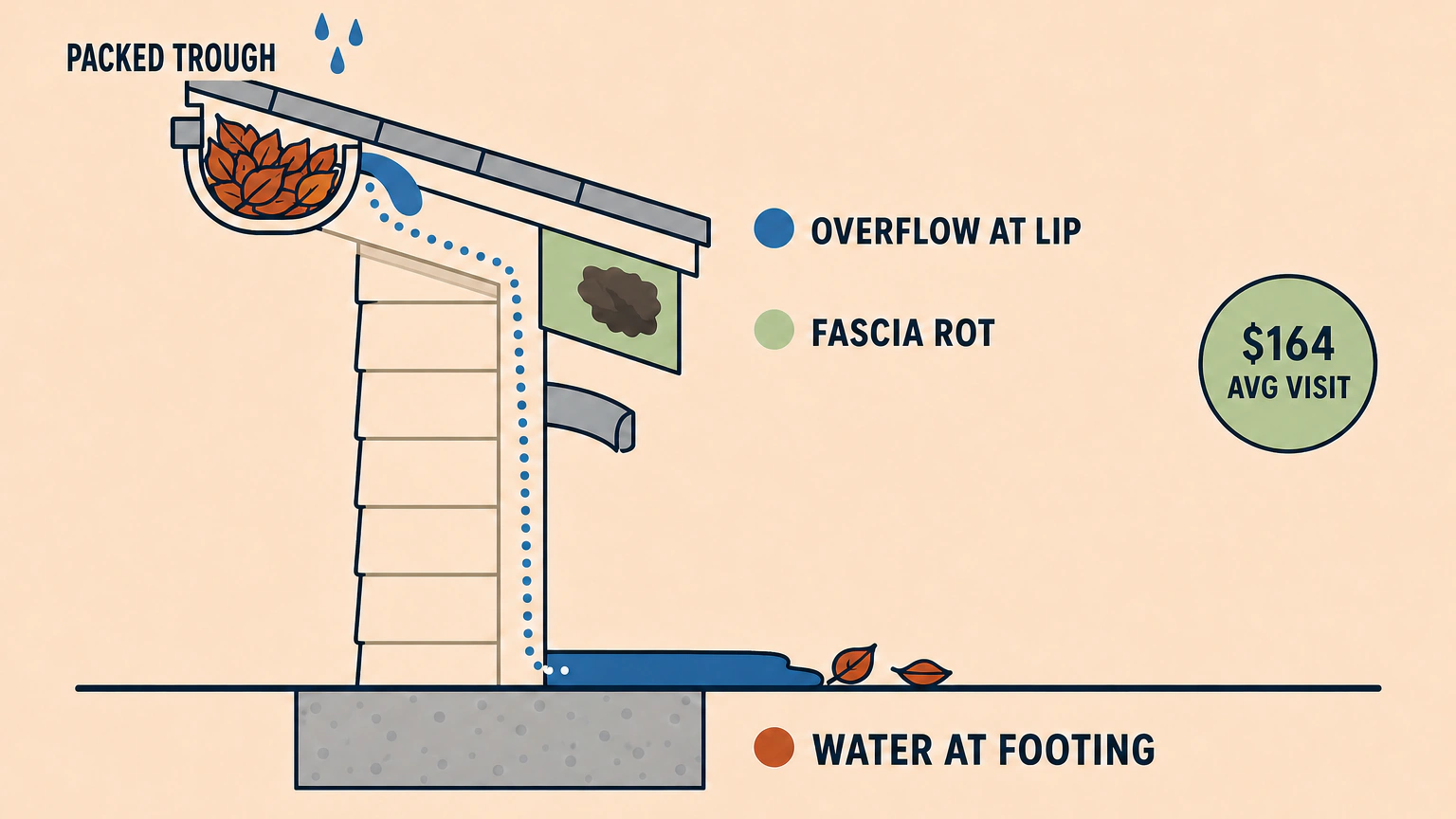
A blocked eavestrough doesn't fail in one place. It fails in three, and each one arrives as a different trade with a different invoice.
At the ground: water at the footing
Overflow doesn't sprinkle. It drops a roof's worth of water in one line against the wall and saturates the soil at the footing. That leaves your weeping tile to cope: the perforated pipe buried around the foundation that collects groundwater and carries it to a sump or drain. Repeat that season after season and basement-water risk climbs, which can end with a quote from basement waterproofing contractors.
Where the water lands matters. In Toronto it is mandatory for all property owners to keep downspouts disconnected from the City sewer, and the City's guidance is that water must flow away from the foundation and must not run onto a neighbour's property, a driveway or a City sidewalk. It recommends a splash pad. It warns that the flow may freeze in winter and that you must not create dangerous conditions. It says to take rain barrels off over winter and fit a downspout extension instead. The Insurance Bureau of Canada wants that extension carrying water at least six feet (1.8 metres) out.
At the edge: fascia, soffit and the trough itself
Wet packed debris is heavy, and nobody designed the trough to hold it. You can see most of it from the driveway: the eavestrough sagging between brackets, spikes pulling out of the fascia board, staining down the fascia, dark patches on the soffit.
A full trough needs cleaning. Sagging or loose brackets need assessment and may need repair. Rotted fascia, staining behind the trough or a soft soffit are repairs, and they belong to roofing contractors.
In winter: what clean eavestroughs do and do not prevent
You will see the autumn clean marketed as ice-dam prevention, and that needs correcting.
Ice does collect at the roof edge. Natural Resources Canada describes ice dams as "large masses of ice that collect typically on the lower edge of a roof and in the gutters". But it is blunt about the cause: "if the attic temperature is above freezing, it warms the roof sheathing, which melts the layer of snow that is in direct contact with the roof". It adds that "uninsulated attics usually do not have ice dams" and that "a well-sealed and insulated attic results in a cool roof and generally will also not have ice dams", so the problem lives in the badly sealed middle. Its conclusion runs to one sentence: "the best prevention for ice damming is to seal all attic air leaks and insulate thoroughly."
Clean your troughs because water needs somewhere to go. Fix ice dams in the attic, with insulation contractors.
Who you're letting up a ladder, and how to check them
Liability insurance: what it covers and what to ask for
Ask for the certificate of insurance, not the reassurance.
The policy period has to cover your booking date, and the named insured has to be the business on your quote. A certificate in another company's name protects another company. Commercial general liability covers damage to your property and injury to third parties. It does not cover the crew's own injuries, and those run on a separate system.
Workers' compensation clearance: free, public, and a five-minute check
This is the check homeowners skip, and it's the one with your name on it. WorkSafeBC has told homeowners that if a contractor is not registered or is behind on payments, "the homeowner could be liable for insurance premiums owing in connection with the work or service being performed on their behalf". WCB-Alberta puts timing on it: get a clearance before you hire, and again before you release payment.
| Province | Board | Ask for | How to check | What it will not tell you |
|---|---|---|---|---|
| Ontario | WSIB | A clearance: the number showing a business is registered and current on premiums | Quick-access clearances online, no log-in; valid up to 90 days | Anything about workmanship |
| British Columbia | WorkSafeBC | A clearance letter confirming registration and premium payment | Requestable online, free, 24 hours a day | It "does not rate the contractor's health and safety record" |
| Alberta | WCB-Alberta | A clearance letter stating whether coverage exists and the account is in good standing | Through myWCB, or without an account, emailed or printed | Whether the work will be any good |
Workers' compensation is provincial. If your board isn't listed, search its name plus "clearance" and ask the company for the equivalent document.
When "no clearance number" is not a red flag
Sometimes there is genuinely nothing to show you. WSIB says independent operators, meaning businesses with no employees other than the registered owner, "outside of construction might not be obligated to register with the WSIB, and therefore would not be eligible for a clearance certificate". Inside construction, coverage is compulsory with or without employees, subject to exceptions.
Which side a routine cleaning falls on is the board's call, not ours. So ask the question that works under either answer: which of the two are you, and what document goes with it? Then ask to see it.
Ladder practice and working at heights
You can judge a lot from the driveway. A competent crew uses a stand-off so the ladder does not rest on the eavestrough, sets it on firm level ground and secures it against movement.
Training is fair to ask about too. Ontario requires workers on construction projects who use fall protection to take a working-at-heights program the province has approved. A routine house visit may not be a construction project, so treat the training as a question rather than a demand.
Red flag: a price quoted before anyone has seen the house. Ask what it assumes and what triggers an extra charge.
Red flag: pressure to decide at the door, or "today only" pricing. Take the name and call back; unsolicited sales may be subject to provincial consumer-protection rules. Same judgement as how to judge whether a cleaning service is worth it.
Red flag: no proof of insurance when you ask for it. That ends it, whatever the price.
Red flag: the ladder resting on the eavestrough with no stand-off. Stop the job, because that is the crew bending the thing they were hired to protect.
Put the scope in writing before anyone climbs
You don't need a contract. You need an email the crew answers yes to:
- Troughs cleared by hand or vacuum, not flushed into the downspout.
- Every downspout flushed and water-tested, not just those at the front.
- Debris bagged and removed from the property.
- Elbows and outlets checked, because that is where clogs form.
- Brackets, seams and spikes inspected, and any looseness reported.
- Before-and-after photos of each elevation.
- Any repair quoted in writing and approved before it is done.
- The price quoted is the price invoiced.
Item seven is the one that turns a small job into an argument. Somebody up a ladder decides a bracket needs replacing, replaces it, and invoices at a rate nobody agreed to. That is how homeowners end up learning what happens when a small job turns into a paid repair.
Do it yourself, or hire it out?
The answer is about your house, not about the gutter. A single-storey home with firm level ground all round, no overhead service wires near the ladder and a partner available to assist may be a DIY option for someone who can use an extension ladder safely. Two storeys, a steep pitch, a walkout lot where one side drops a full extra storey, wet leaves, or any hesitation about the ladder is not.
Then count the real cost. An extension ladder and a stand-off is a purchase, and the job takes a careful morning. Against a $164 average, what you save is smaller than it looks.
Pro tip: after the first frost or light snow, stand in the driveway and note where the snow on your roof melts first. Natural Resources Canada uses exactly this to find the heat-loss spots prone to ice damming. It costs nothing, needs no ladder, and helps identify roof areas affected by attic heat loss.
Gutter guards, screens and covers: what they change
The people selling guards have a stake in your answer, so weigh it from both ends. Government of Canada guidance lists gutter guards as an optional way to keep debris out. Independent testing and expert review land somewhere narrower: guards can reduce maintenance but do not eliminate it. They still need inspection and clearing, and the downspouts still need checking.
Then do the arithmetic against the $164 average. Two visits a year cost about $328. If guards take you down to one visit, the annual cleaning-cost saving is about $164. Divide the installed quote by that saving to estimate a simple payback, before financing, maintenance and repair costs. Ice and snow may also affect how guards perform, so ask how the product is designed for your winter.
Booking checklist: what to do this month
Type "eavestrough cleaning services near me" into a search box and you get names. These items turn names into quotes you can compare. We'd get two, not one.
- Measure or pace the roofline so you can describe the job in metres, or feet if that is how quotes come.
- Count storeys and note what a ladder cannot easily reach: additions, walkouts, sunrooms, a detached garage.
- Note the last cleaning date and what came out.
- Photograph any sagging, staining or overflow marks before you call.
- Ask for a total price for the whole property, not a per-hour rate.
- Ask what happens if they find a repair once they are up there.
- Ask for proof of liability insurance and a workers' compensation clearance, and check both.
- Book the autumn visit for after leaf drop, with a reminder set for the week the leaves come down.
Booking early buys a slot, not an early clean. Ask for the appointment after leaf drop, because the queue behind the first snowfall is where missed windows come from. Make the call this week. The leaves won't wait for you.
Frequently asked questions
How much does it cost to clean eavestroughs in Canada?
Budget $123 to $235 per visit, with a national average near $164, which is our own aggregate rather than a market survey. Toronto companies publishing their own rate cards quote $150 to $350 for a standard home, rising to $350 to $500 or more once the property is tall or complicated.
How often should eavestroughs be cleaned?
Twice a year for most homes, and it isn't the cleaner saying so. The City of Toronto tells property owners to clean eavestroughs at least twice a year and check all elbows and outlets for debris. The Insurance Bureau of Canada's floor is at least once a year. Inspect more often when storms, heavy rain or high winds add debris.
What month is best for eavestrough cleaning?
There is no best month, only a window: once the trees over your roof are bare and before the first hard freeze. Environment and Climate Change Canada's normals put the mean first fall frost near mid-September on the Prairies and near 10 November at Vancouver, so the window is regional.
Can eavestroughs be cleaned in winter?
It gets harder once debris freezes, and a ladder on ice, snow or any other slippery surface needs its footing secured. If you missed the window, keep the discharge point at ground level clear, watch for overflow during a thaw, and rebook for spring.
Does the price include cleaning the downspouts?
Ask, because it is the most useful scope question you can put. A trough scooped clean still overflows if the downspout under it is plugged. Ask for a visit that clears the trough by hand or vacuum, then flushes and water-tests every downspout rather than pushing debris downhill into the pipe.
Does home insurance cover water damage from clogged eavestroughs?
It depends on the loss and the policy. The Insurance Bureau of Canada says insurance is meant to cover sudden and accidental loss, while roof damage due to wear and tear or poor maintenance is not covered. Confirm with your own insurer, and keep your cleaning invoices and photos.
Is DIY eavestrough cleaning safe?
It depends on the house, not the gutter. A single-storey home with firm level ground, no overhead wires and a partner available to assist may be a DIY option for someone who can use an extension ladder safely. Two storeys, a steep pitch, a walkout lot or wet leaves are not. The ladder is the risk.