

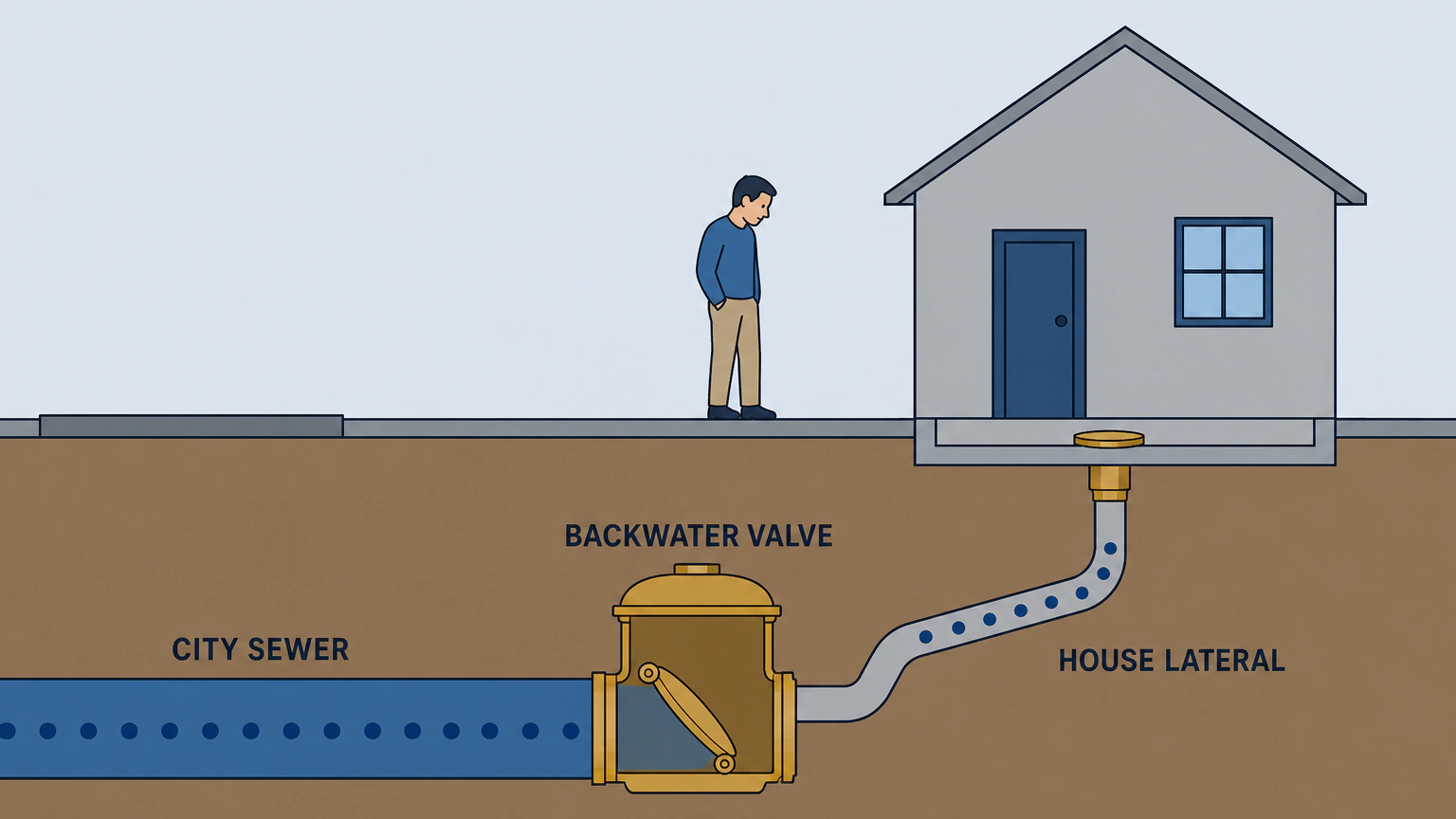
A backwater valve is a one way device in a drain line. A mainline model stays open for wastewater and closes against sewer backflow. The published installation prices we found start at four figures. The City of Hamilton publishes what its five pre qualified plumbers charge for an assessment plus a mainline valve, and the five prices are $1,292, $1,444, $1,523, $1,554 and $1,562, each plus HST, with a $291 building permit on top. The programs here offer up to $800 in Edmonton, $1,600 per valve in Toronto and up to $2,000 across eligible work in Hamilton. The rules depend on the program, including when to apply and who may do the work.
On this page
- What a backwater valve costs, and what comes off the top
- What six Canadian programs pay, and what they want in return
- The order that decides whether you see the money
- Who is allowed to do the work
- How the valve works, and the one thing not to do when it shuts
- A valve is not the whole basement
- Finding the valve you may already have, and keeping it working
- Before you sign the quote
- Frequently asked questions
What a backwater valve costs, and what comes off the top
Nobody comparison shops a backwater valve the way they shop for a dishwasher. You get one quote, maybe two, from a plumber who has just been standing in your basement explaining what happens next time it rains hard. Four figures sounds steep until you hear what breaking and repouring a concrete floor costs. So start with a price that isn't a sales pitch, then work out what your municipality takes off the top.
If your drain is backing up tonight, that's a different and much smaller call. Our own cost profiles put a typical visit at $139 to $310 across 654 jobs, and drain cleaning companies are who you phone while the water is on the floor. The valve is the fix you arrange once things are dry.
The one price list a government publishes
Hamilton publishes the prices. Five contractors are pre qualified for the City's Protective Plumbing Program, and the City prints what each one charges for an assessment plus a mainline backwater valve. The permit and the per downspout price sit beside it. Those are rates for one defined scope, not estimates gathered from a market.
That's what makes the spread readable. Same job, same city, same program, five rows. Compare it with what Toronto companies advertise for backwater valve installation cost. That's roughly $1,800 to $3,500 up through the basement floor, and $2,400 to $4,800 dug in from the yard. Those are sellers' numbers for a whole market. Hamilton's are a rate card.
What one city says the same job costs. For an assessment plus a mainline backwater valve, Hamilton's five pre qualified contractors charge $1,292, $1,444, $1,523, $1,554 and $1,562, each plus HST. The permit is $291 and downspout disconnection is $75 plus HST each, identical across all five. So the priciest firm is about 21 per cent above the cheapest, for work the City has defined down to the line item. Switch to the Adapt-a-valve version, which needs City pre approval, and the same five spread from $1,292 to $2,505. One charges the same either way. Another rises by about 60 per cent. Ask which valve you're being quoted for before you compare two prices at all.
What the quote leaves out
Quotes also account for labour and access work. The permit, the inspection, cutting the slab, digging down to the lateral and putting the concrete back are where a quote grows. An exterior valve dug in from the yard costs more, because the hole is bigger. An alarm can tell you the flap has shut. Toronto folds that alarm into the valve amount, which says plenty about what the City thinks of it.
Mississauga leaves two costly categories out of its rebate. The City won't pay for interior finishes such as drywall, paint or flooring. It won't pay for outside repairs either, such as landscaping, sod, porches, concrete or asphalt. If the trench crosses your interlock, that one is yours.
What six Canadian programs pay, and what they want in return
Six programs, across Ontario, Quebec and Alberta. It's a sample, not a national inventory, and the money is only half of what each one tells you. The other half is the sequence and the conditions, which is where people actually lose the cheque.
| Program | What it pays toward a backwater valve | When you apply | Who may do the work | Also worth knowing |
|---|---|---|---|---|
| City of Toronto, Basement Flooding Protection Subsidy Program | 80 per cent of the invoiced cost to a maximum of $1,600 per device, up to two devices | After the work, within two years of installation. Work completed before 12 November 2025 falls under the older $1,250 single device cap with a one year window | A contractor holding a valid City of Toronto business licence: Plumbing Contractor T94, Plumbing and Heating Contractor T92 or Drain Contractor T87. Building Renovator T85 may not do the valve | Building permit and inspection required, and the valve must not be covered before the inspection. Downspouts must be disconnected or exempted. First come, first served against the annual budget Council approves. Up to 10 weeks to be paid. Property maximum $6,650 across all measures |
| Peel Region, sanitary backwater valve rebate, covering Brampton, Mississauga and Caledon | 60 per cent of the invoiced amount to a maximum of $1,500 including tax | After the work, and only for a valve on the sanitary lateral | A qualified, licensed contractor. The applicant must be an individual and not a corporation | Building permit from the local municipality first, then a municipal building inspection. The valve may serve only one dwelling unit, so a basement apartment needs its own. One rebate per residence every 10 years. Valve must have been installed after 16 July 2024 |
| City of Mississauga, Basement Flooding Prevention Rebate Program | Up to $1,500 for a valve on the storm lateral, and only where the downspouts are also disconnected. The sanitary valve is Peel Region's rebate, not the City's | Pre approval before installation, mandatory since 12 February 2025. Final approval within six months of pre approval | A contractor qualified and licensed in their skilled trade in Ontario, named with their licence number in the pre approval quote | Building permit required for the storm lateral valve and for pipe capping. Program maximum $7,500 across all measures, with sump pump up to $6,000. Paid in order of complete applications until funding runs out. 8 to 10 weeks for the cheque. One measure per residence every 10 years |
| City of Hamilton, Protective Plumbing Program | Up to $2,000 across the valve, downspout disconnection and a sump pump installed with the valve. Only $500 toward the valve if the contractor is not on the City's list | After the assessment and the work, with the completed package. Permit is pulled by the contractor before work begins | One of the City's five pre qualified contractors if you want the full grant. Anyone else drops you to the $500 maximum | Home must have a basement, be connected to City sewers and have been built before 1 January 2012, with property taxes up to date. The permit cost is reimbursed on top of the grant. A separate City loan of up to $2,000 at 4 per cent is available for costs above the grant |
| Ville de Montréal, Rénoplex | $90 for a normally closed valve, $600 per valve installed under an existing slab, and $1,600 for a retention pit and pump system | Apply before work and wait for approval, which the City says may take 3 to 4 months. Complete the work within 18 months of conditional approval | A plumbing contractor who is a member of the CMMTQ, per the City's own guidance, who gives you a certificate of conformity with the invoice | A different device from the Ontario mainline valve: Montreal's rule puts valves on each basement fixture drain, they have been required in all new buildings since 2011, and they are mandatory after a backup under by law 11-010. Houses and buildings of five dwellings or fewer, with a property value of $3,860 per square metre or less |
| Edmonton, EPCOR Backwater Valve Subsidy | Up to $800 for an interior or exterior valve, paid by cheque to the homeowner | After the work. The pre approval inspection with EPCOR's flood prevention team is suspended until further notice, and every other requirement still applies | A professional plumber, with a City of Edmonton business licence or GST number visible on the paid invoice | Only five named valve models qualify. EPCOR targets homes built before 1989, homes that have flooded from sanitary sewer backup, and areas with previous neighbourhood flooding. You must have no existing valve, no previous subsidy at that address, and a separately serviced home. Needs the City's green sticker with the permit number |
Check your city's current program page before you book the work.
If your city isn't there, you can build the same picture yourself in about twenty minutes. Search your city's site for "backwater valve" and for "basement flooding". Then search your regional government and your water utility separately. The money often sits there instead of at city hall. Peel Region pays the sanitary rebate for three cities that don't pay it themselves, and EPCOR pays Edmonton's. Read the eligibility list before the dollar amount. Build year, taxes owing and prior claims rule people out long before the arithmetic matters. Then settle three things before you call anyone. Whether the application comes before or after the work, who is allowed to hold the tools, and who pulls the permit. Four of the six here are Ontario programs.
The order that decides whether you see the money
Every one of those six programs is a sequence, and the money attaches to the order you do things in, not to the valve. Do the right work in the wrong order and the device still functions perfectly while the cheque never arrives. That mistake can cost the entire subsidy.
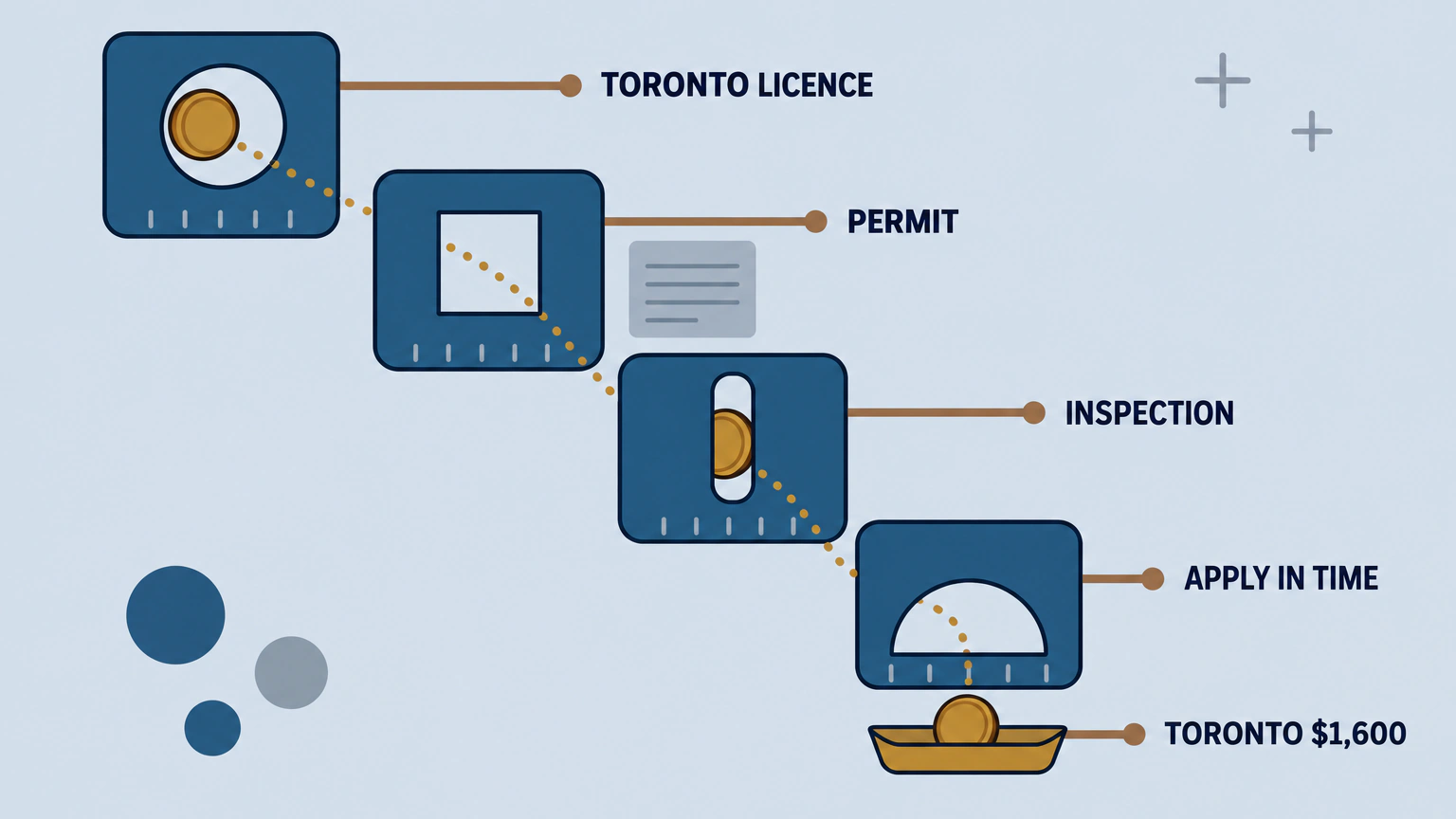
The permit can do more than satisfy a bylaw. Where a building permit is required, it leads to the municipal inspection and can decide whether the money is released. If you've never pulled one, how municipal building permits actually work is worth ten minutes before you sign anything.
Toronto pays after the work, and gives you two years
Toronto's Basement Flooding Protection Subsidy Program runs backwards from Mississauga's. You do the job first, then apply. Before work starts, check your contractor and any subcontractors on the City's Business Licence Lookup, because the City says outright that you'll be denied funding for work done by an unlicensed one. Pull the permit, and once the valve is in, request the inspection. Don't let anyone enclose or cover that valve before it's done. Keep the original electronic invoice with an itemized breakdown and the words "paid in full".
You then have two years from installation to apply, and the City takes up to 10 weeks to pay. Subsidies depend on the funding Council approves each year, so early in a budget year beats late. The expanded amounts reach back to work completed on or after 12 November 2025, so a valve you paid for last autumn under the old $1,250 cap may now be worth $1,600.
In Mississauga, nobody digs before the City approves
Mississauga runs the opposite way, and this is where its backwater valve rebate trips people up. Since 12 February 2025, every measure has to be pre approved before it's installed. Start the work first and you've already lost it. Pre approval wants your tax bill, an itemized quote naming the contractor and their licence number, and a sketch showing where the valve, the capping and the disconnections go. Final approval follows within six months of the pre approval email, then 8 to 10 weeks for a cheque, paid in order until the funding is gone.
The second trap has nothing to do with timing. Mississauga's rebate covers a valve on the storm lateral, up to $1,500, and only if you disconnect the downspouts too. The sanitary lateral valve is Peel Region's rebate. Two governments, two applications, two sets of rules. Find out which pipe the quote covers before you fill in either form.
Edmonton pays for five valve models and no others
EPCOR's subsidy is up to $800, paid by cheque to the homeowner, and it's the fussiest of the six about hardware. Only five valves qualify: the Adapt-a-valve, the Branch Line, the Fullport, the Retrofit and the Top Check Fullport. Your invoice has to name the model that went in, carry the plumber's City of Edmonton business licence or GST number, and show it's paid. You also send a copy of the City's green sticker carrying the permit number.
The blogs haven't caught up with this. EPCOR's pre approval inspection with its flood prevention team is suspended until further notice, and every other requirement stays.
Who is allowed to do the work
Treat this as a money question rather than a credential hunt. A contractor's authority to install a valve is separate from whether that contractor qualifies under a rebate program. Getting the program rule wrong can leave otherwise eligible work unfunded. So the useful version of who can install a backwater valve is who your program will pay for.
The licence category matters, not just the licence
Toronto publishes a table of which licence classes may perform which subsidized work, and it isn't decorative. A Plumbing Contractor (T94), a Plumbing and Heating Contractor (T92) and a Drain Contractor (T87) may all do the plumbing assessment, the backwater valve, the sump pump and the pipe severance and capping. A Building Renovator (T85) may do the sump pump and the capping only. No assessment, no valve.
So a renovator you've used happily for years, holding a real and valid City licence, can leave you with an unfunded valve. The City's sentence is blunt: if your contractor doesn't hold a valid City of Toronto licence, you'll be denied funding for the work completed. Check the class, on the City's own lookup, before the truck arrives.
Hamilton's short list, and what going off it costs
Hamilton attaches $1,500 to a list. Choose one of the City's five pre qualified contractors and the grant runs up to $2,000 across the valve, downspout disconnection and a sump pump installed alongside it. Choose anyone else and you're capped at $500 for the valve. Same house, same valve, same inspection.
One line on that page is worth reading twice. Hamilton is clear there's no contract between it and the contractor, and that any agreement is private between you and the firm you hired. Pre qualified means the City checked them and published their prices. It doesn't mean the City is standing behind the work if something goes wrong, and it tells you exactly where a dispute lands.
How the valve works, and the one thing not to do when it shuts
The mainline valve Peel Region describes is simpler than the paperwork. Under normal conditions its flap hangs open, so wastewater from your toilets, showers and sinks flows out to the sewer freely. When the sewer is overloaded by heavy rain, or blocked by the things people flush that they shouldn't, water starts moving back toward your house. The flap swings shut against it and seals the line. Then the surcharge passes and it reopens.
Toronto and Peel Region both publish this warning. While that flap is closed, do not use any plumbing fixture. No toilets, no shower, no dishwasher, no washing machine. Your own wastewater has nowhere to go while the line is sealed, so it backs up into your basement, and the device that just saved you is what's holding it there. That's the argument for an alarm: it can warn you that the valve has shut.
How to tell if you already have one. Go to the lowest floor and look for a round access cap set flush into the concrete. It usually sits near where the water and sanitary lines come into the house, often beside the main cleanout. A removable access cap is a good sign because it leaves the valve accessible for service. Montreal names the two failures worth knowing about: valves nobody can reach, because a floor was laid over them, and valves too worn to seal any more. If your basement has been finished since the house was built, find out what's under that floor before a storm finds out for you.
A valve is not the whole basement
A backwater valve solves one kind of problem: sewage travelling backward through a protected drain. It does nothing about rain through a window well, nothing about water pushing through a foundation crack, and nothing about a failing weeping tile. Peel Region says so on the same page where it offers you the rebate, which is unusually honest for a page selling a solution.
That matters for the budget, because the other problems are the expensive ones. Across 637 jobs, our own cost profiles put full basement waterproofing at an average price range of $2,062 to $6,698, on a national average of $4,431. Weighing a valve against sealing a foundation puts two unrelated jobs side by side, and basement waterproofing contractors are a different trade from the one pulling your plumbing permit.
The sump pump, the weeping tile and the downspouts
This is why the programs bundle. A sump pump handles the groundwater your weeping tile collects around the footings, a different water source from the sewer entirely. Toronto pays up to $2,250 for one and another $300 for a battery backup, on top of the valve money. Mississauga pays up to $6,000.
Capping is the third piece. Toronto pays up to $400 to sever your foundation drain from the City's sewer and cap it. In Mississauga it's up to $1,000. Once the weeping tile stops draining into the city system, the sump pump has to take that water instead. Downspouts follow the same logic, and both cities make disconnecting them a condition rather than a bonus. Mississauga pays $125 per downspout, up to $500. Keeping the eavestroughs clear is the cheap half of the same problem, since a downspout dumping at the foundation undoes a lot of expensive work below it.
Your policy probably does not cover sewer backup
The Insurance Bureau of Canada doesn't hedge. Water damage in a basement due to a sewer backup is only covered if you have purchased specific, optional sewer backup coverage. It isn't part of a standard home policy. Pull out your declarations page and look for that endorsement by name. "Water damage" alone doesn't answer the question. Neither does overland flood coverage, which is a separate add on for different water.
You'll see it suggested that a valve earns you a premium discount. We went looking and found no Canadian insurer figure we'd be willing to print. Install the valve because a finished basement full of sewage is a catastrophe, not for a line on next year's renewal.
Finding the valve you may already have, and keeping it working
Some homes already have one, including homes where a previous owner installed one. The access cap sits flush in the lowest concrete floor near where the main drain exits the home. Look for a removable cap that leaves the valve accessible. If records show a valve but you cannot find the access cap, flooring may cover it. A valve you can't open is a valve nobody can clean, and Montreal lists exactly that among the problems it sees.
The upkeep advice splits by city. Montreal says check it twice a year. Peel Region says inspect and clean it at least once a year, or before forecast heavy rain. Toronto tells you to follow the maker's directions, and puts no fixed annual duty on its own program page, whatever the plumbing blogs say. Backwater valve maintenance cost is a small number: Toronto firms selling the service advertise roughly $100 to $200 for a yearly check. Opening the cap and looking is free.
Before you sign the quote
You've got the number, the program and the sequence. What's left is the conversation with the person holding the quote, and the goal there is narrow: make the paperwork the contractor's job, in writing, before any concrete gets cut. If you're still choosing, plumbing contractors near you is the place to start a shortlist, and your city's own licence lookup is how you confirm the class once you have names.
Five things to settle before anyone breaks the floor
- Which pipe the valve is going on, sanitary or storm. In Peel that single fact decides which government pays you, and they're two applications with two sets of rules.
- Whether your municipality wants the application before or after the work, and the date the deadline runs from. Toronto runs from installation. Mississauga runs from your pre approval email.
- The contractor's licence, in the class your program names, checked on the city's own lookup before work starts rather than after. In Toronto, a valid licence in the wrong class can leave the work unfunded.
- Who pulls the building permit and when the inspection happens, plus a written promise that nothing gets covered until it passes. Put it in the quote, not in a text message.
- An itemized quote separating the valve, the labour, the concrete work and the permit. Toronto and Mississauga require cost breakdowns, and Hamilton asks for a detailed final invoice.
Four things worth a second question. Anyone at your door offering flood protection on behalf of the city or the region. Peel Region states outright that it does not conduct door to door sales of any kind and does not sell, partner with or endorse any contractor, product or service. Mississauga says the same about its own program. Close the door and phone the number printed on the city's page. A quote that folds the permit into a lump sum with no line for it. Ask for it separately. Hamilton reimburses the permit on top of the grant, so you'll need that line. "We can skip the inspection, it's only a small job." Toronto, Peel, Mississauga, Hamilton and Edmonton all require inspection evidence before payment. Toronto also warns you not to cover the valve before inspection. A contractor who promises you the full grant without asking which program you're in. In Hamilton that answer is worth $1,500 in either direction depending on whether they're on the City's list, and they know perfectly well whether they are.
Frequently asked questions
How much does it cost to install a backwater valve?
Hamilton's five pre qualified contractors charge $1,292 to $1,562 plus HST for an assessment and a mainline valve, with a $291 permit on top. Toronto area plumbing companies advertise roughly $1,800 to $3,500 through the basement floor and $2,400 to $4,800 for an exterior dig. After a Toronto subsidy of up to $1,600 per device, a typical interior job lands close to the Hamilton range.
Do I need a backwater valve?
Whether you need one depends on your plumbing and the rules that apply to your address. Montreal is different: valves have been required in all new buildings since 2011, and after a sewer backup the city's bylaw 11-010 makes them mandatory on basement fixtures. Ask your municipality what applies where you live.
How do I know if I already have one?
Look at the lowest concrete floor for a round access cap set flush into the slab near where the main drain exits the home. A removable access cap may mark the valve. If the basement was finished after the house was built, the cap may be buried under the flooring, which is worth knowing before a storm tells you.
Can I install a backwater valve myself?
Usually not if you want the rebate. Hamilton is the exception: it allows homeowner work, but caps an off-list installation at $500. Mississauga says plainly that owner labour, done to cut contractor costs, will not be paid back. Toronto denies funding outright when the contractor lacks a valid City licence. Peel Region calls this a job for a pro, not a home improvement project.
Does a backwater valve affect my home insurance?
It doesn't create coverage. The Insurance Bureau of Canada says water damage in a basement due to a sewer backup is only covered if you've purchased specific, optional sewer backup coverage. Check your declarations page for that endorsement by name. Tell your broker the valve is in and ask how your policy treats it.
What is the difference between a backwater valve and a sump pump?
They handle different water. A backwater valve blocks sewage travelling back through a drain toward the house. A sump pump sits in a pit and pushes out groundwater that the weeping tile collects around your foundation. Toronto funds them separately, up to $1,600 per valve and up to $2,250 for a pump.
How often does a backwater valve need to be cleaned?
The cities disagree, so take the strictest one that applies to you. Montreal recommends checking twice a year. Peel Region wants it checked and cleaned at least once a year, or ahead of forecast heavy rainfall. Toronto points you to the manufacturer's directions. If the access cap is removable, inspect the valve for debris as its maker directs.