

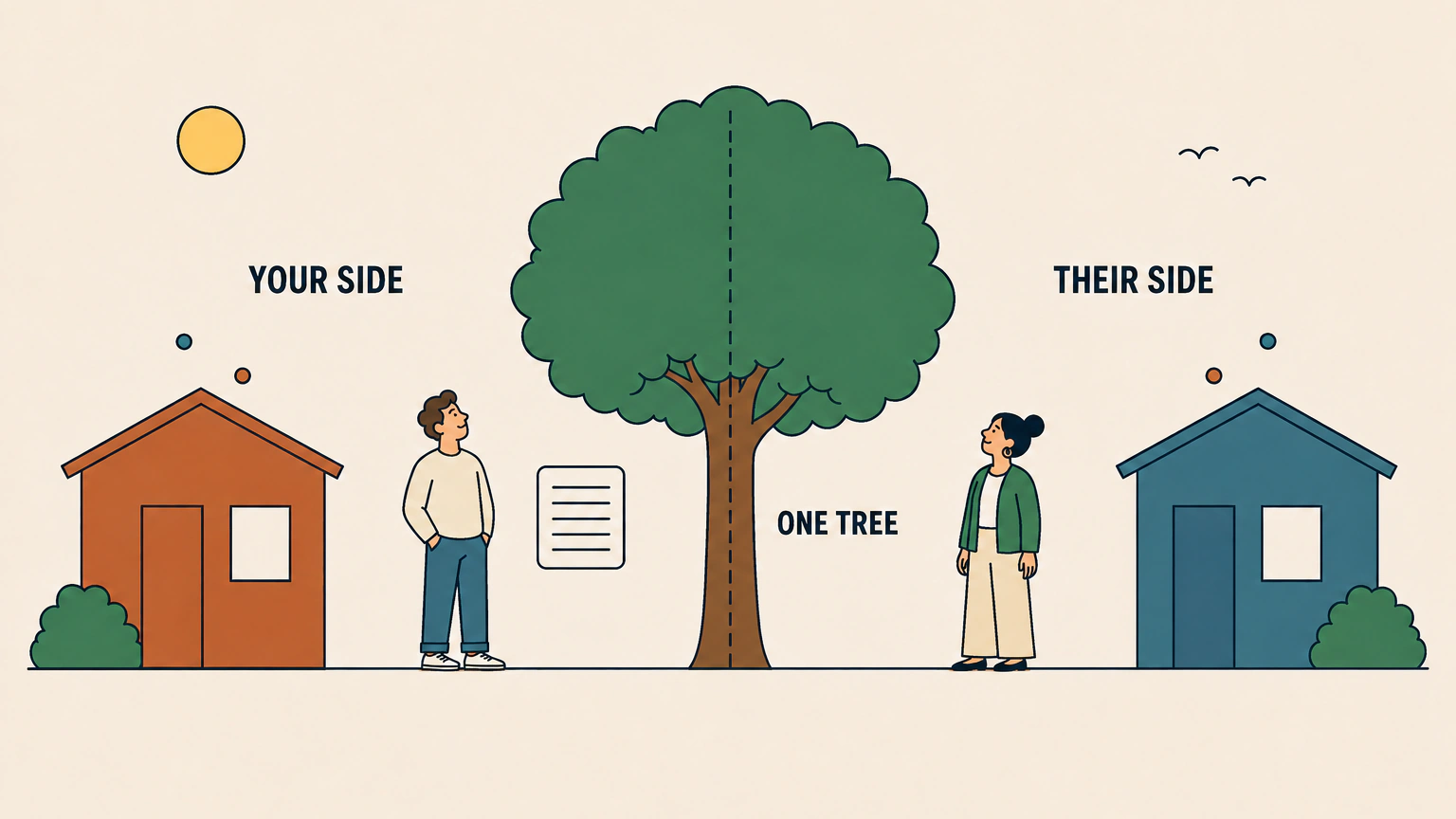
In Toronto, Mississauga, Ottawa and Vancouver, a tree over the local size threshold usually needs a written permit before work starts. Toronto also protects some smaller trees planted under approval or permit conditions. Skip the permit in Toronto and the fine runs from $500 to $100,000 per tree. In Calgary, the Tree Protection Bylaw doesn't reach a tree on private land at all. And in Ontario, if any part of the trunk crosses your neighbour's line, the tree is common property. Cutting it without their consent is an offence, and no city permit forgives that.
So the honest answer to "can I cut down a tree on my property" is: check whether you need two separate yeses. One from your municipality, if its rules catch the tree. One from anybody who co-owns the trunk.
On this page
First question: is the tree actually yours?
You bought the house and the tree came with it. You've never thought of it as anybody else's business, and that instinct is what gets homeowners in trouble. Before a city asks whether your tree is big enough to need a permit, there's a quieter question underneath. Where does the trunk stand? Inside your lot, across the line you share with the neighbours, or in the ground near the road that isn't yours at all.
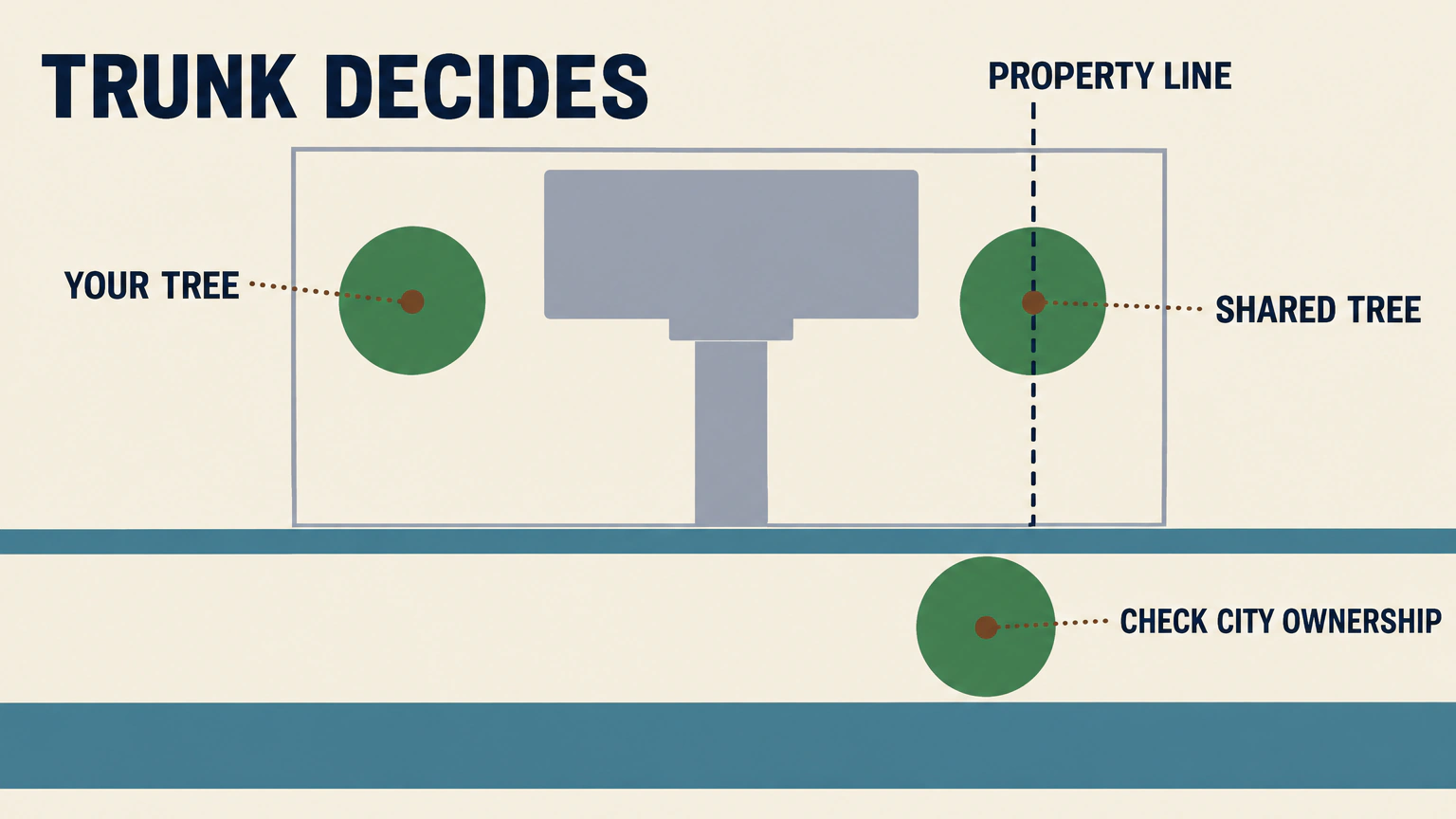
The trunk decides, not the branches
For Ontario's boundary-tree rule, canopy and roots are red herrings. A maple can drop every one of its keys on your side of the fence and still belong entirely to your neighbour. Common ownership starts when the trunk crosses the property line.
Where diameter is a permit trigger, these cities measure the trunk at a set height. Toronto, Mississauga and Vancouver use 1.4 metres. Ottawa uses 1.3 metres. Toronto says to wrap a tape around the trunk, read the circumference in centimetres and divide by 3.14. Multi-stem trees differ by city. Toronto takes the largest stem, so a clump with one 30 cm stem is protected entirely. Vancouver adds the largest two or three together.
Where the trunk sits is the harder measurement. Near a fence, a driveway or the sidewalk, only a survey settles it. Don't have one? A land surveyor is a smaller expense than a $100,000 mistake.
| Where the trunk sits | Who owns it or how to check | Whose yes you need | Where that comes from |
|---|---|---|---|
| Entirely inside your lot | You | Your municipality, if the tree is big enough to be caught by its by-law | Municipal Act, 2001, s. 135(1): a local municipality "may prohibit or regulate the destruction or injuring of trees" |
| Any part of the trunk crosses the line, in Ontario | You and your neighbour, jointly | Both owners, plus any permit the municipality requires | Forestry Act, s. 10(2): "Every tree whose trunk is growing on the boundary between adjoining lands is the common property of the owners of the adjoining lands" |
| In the boulevard, or in the part of a front yard nearest the road | Check the survey or call 311 to confirm ownership | The City, if it is a street tree, plus any co-owner if the trunk crosses a property line | Toronto: street trees may sit near the road, but the City tells owners to use a survey or call 311 to confirm who owns the tree |
| Majority of the trunk on public land, in Halifax | Halifax Regional Municipality | HRM's Director | By-law T-600, s. 2(j) and s. 3(1): "No person shall alter or remove a public tree without first obtaining a permit or written consent from the Director" |
The last two rows use different municipal tests, not one national rule. Toronto regulates a tree when any part of it is on, above or below a City street. Halifax calls a tree public only when most of its trunk is on public land. Toronto still tells owners to use a survey or call 311 to confirm ownership near the road.
The tree in your front yard may belong to the city
The boulevard is the strip between the sidewalk and the road, and it's usually municipal land. Fair enough. Toronto's permit page says street trees "may be located in the boulevard between the sidewalk and the road, or in a portion of a front yard next to the road or sidewalk." That location is a clue, not proof of ownership. The City tells owners to use a survey or call 311 to confirm.
There's no size threshold on a street tree. Toronto prohibits any activity that could harm or remove one without a permit. So the small ornamental you were going to take out in an afternoon is protected in a way the big maple out back might not be. Without a survey, call 311 and ask who owns it.
In Ontario, a tree on the line belongs to both neighbours
Almost nobody reads the Forestry Act until it's too late, and the section that matters here is short enough to quote in full. Section 10(2): "Every tree whose trunk is growing on the boundary between adjoining lands is the common property of the owners of the adjoining lands."
Common property. Not mostly yours, not yours to decide, not a question of who planted it.
Section 10(3) supplies the teeth: "Every person who injures or destroys a tree growing on the boundary between adjoining lands without the consent of the land owners is guilty of an offence under this Act." Note the word injures. You don't have to take the tree down to be offside. Under s. 19(1), a person convicted of contravening the Act is "liable to a fine of not more than $20,000 or to imprisonment for a term of not more than three months, or to both."
The Act requires consent, but it doesn't say whether silence counts as consent. Get it in writing before anyone books a date. That paper also protects you from a version of events invented six months later.
What six Canadian cities ask before you cut
Each of these six cities publishes its own answer to two questions. Does the by-law reach a healthy tree on private land, and what does permission take? We've left out development sites, heritage designations, conservation authority areas, and the rules that switch on once a planning application is in play.
The permit fee is rarely the expensive part. The replanting condition is. Mississauga requires one replacement tree for every 15 cm of diameter removed, so a 45 cm tree costs you three new ones, planted on your own property, with a deposit held until they survive their first year.
| City | Regulated? | The trigger | Dead, dying or dangerous | Fee and replanting |
|---|---|---|---|---|
| Toronto | Yes | 30 cm or more in diameter at 1.4 m above ground, or any size if planted under certain approvals or permit conditions; a multi-stem tree counts if one stem reaches 30 cm | Exempt, but only once the Executive Director certifies it | Replacement planting required as a permit condition; fine on conviction is $500 minimum, $100,000 maximum per tree |
| Mississauga | Yes | 15 cm (6 inches) or more in diameter, dead and dying trees included | Still needs a permit, but no fee | $399.77 base fee including HST, $139.72 per extra healthy tree; one replacement tree per 15 cm of diameter removed |
| Ottawa | Yes | 30 cm or more on an urban lot of 1 hectare or less; 10 cm or more on a lot over 1 hectare or under a planning application | No permit application needed for a dead, hazardous or ash tree, or a tree that is an immediate threat to public health and safety | $200 per tree for a non-development removal, capped at five trees; 1 to 1 replacement outside development |
| Vancouver | Yes | 20 cm in diameter and 64 cm in circumference at 1.4 m; hedges and multi-stem groups counted too | Arborist certification required | Replacement tree for anything over 20 cm; permit expires six months after issue |
| Calgary | No | The tree protection bylaw covers only trees on land the City owns or controls | Not applicable | None |
| Halifax | Only if it is a public tree | Majority of the trunk on public land makes it a public tree, whatever side of the fence the work happens on | Director's permit or written consent still required | Set by the Director |
Six municipalities is six municipalities. We took every figure from that city's own by-law or permit page. Any other municipality sets its own thresholds and fees, so don't read a Toronto number as a Canadian one.
The same maple, three different answers
Take one entirely ordinary tree. A backyard maple, 25 cm across at 1.4 metres, standing well inside the lot with nothing crossing any line. Move it between three of those cities and the answer changes three times.
Worked example: one 25 cm maple, three cities. Mississauga. Over the 15 cm trigger, so you need a permit and the $399.77 base fee, and replanting is a condition. Toronto. Under the 30 cm trigger, so the private-tree rule usually doesn't reach it. A smaller tree is still protected if it was planted under certain approvals or permit conditions. Every tree is also protected in a ravine or natural feature protection area. Calgary. The Tree Protection Bylaw doesn't apply to trees growing on private property, so that by-law doesn't require City authorization for this tree.
Same tree, same afternoon of work. The only variable is the postal code.
Dead trees do not get the same pass everywhere
A dead tree is not a free pass everywhere, and it is almost never one you get to declare yourself.
Toronto's Municipal Code exempts "removal of a terminally diseased, dead or imminently hazardous tree certified as such by the Executive Director," and the certification is the whole clause: the City asks owners to request and receive a permit exception confirmation before the work. Ottawa uses a different gatekeeper, exempting a tree "dead as confirmed by an arborist." Vancouver keeps dead, dying and hazardous trees inside the permit system altogether, and wants a report from an ISA-certified arborist.
Then there's Mississauga, whose private tree by-law covers dead and dying trees explicitly. The permit is still required. The City waives the fee and doesn't ask for an arborist report, but skipping the application isn't on offer.
The trap is self-certification. A contractor in your driveway saying "that one's dead anyway" is not a City certification, not an arborist's confirmation, and not a defence. If a tree genuinely is hazardous, get a written opinion from one of the certified arborists near you first.
If your city is not one of the six
Six cities cover a lot of Canadian homeowners and nothing like all of them. If yours isn't on the list, we can't tell you what your by-law says, and we won't guess.
The gap exists because tree rules in Canada are municipal, sitting on a provincial foundation. In Ontario, s. 135(1) of the Municipal Act, 2001 says a local municipality "may prohibit or regulate the destruction or injuring of trees." May. The province hands over the power and each council decides what to do with it, which is how one city regulates at 15 cm, its neighbour at 30 cm, and a third leaves private trees alone. Toronto's power comes from its own statute, s. 104 of the City of Toronto Act, 2006. In two-tier regions, an upper-tier woodlands by-law covering a hectare or more displaces the lower-tier one for those woodlands.
The permit rules in this comparison are municipal, and your municipality is the first place to call. Federal and provincial wildlife laws can still affect when work goes ahead, including protections for migratory birds, their eggs and their nests. And if a deck is next on your list, it's the same city, a different permit.
The five things to have in front of you when you call 311
What separates a two-minute call from three days of voicemail is whether you can answer the questions coming back at you.
Five facts that get you an answer in one call 1. The trunk diameter in centimetres, measured at the height your by-law specifies. Toronto, Mississauga and Vancouver use 1.4 metres. Ottawa uses 1.3 metres. If you measure circumference, divide it by 3.14. 2. Whether any part of the trunk crosses a property line, and how you know. A survey is how you know. A fence is not. 3. How far the trunk sits from the sidewalk or the road edge, and whether you have a survey showing it. 4. Your municipality, and whether the property is in a ravine, floodplain or conservation authority regulated area. That second approval is a separate process with its own timeline. 5. Whether the tree is dead, dying or damaged, and whether anyone qualified has said so in writing.
What a permit does not do
You can do everything right at city hall and still be in the wrong. A permit answers the public question, whether the municipality will allow the tree to come down. It says nothing about the private one, which is whether the tree was ever yours to remove.
A city permit is not your neighbour's consent
The City of Toronto puts it in two sentences on its own permit page, and nothing else on the subject is as useful. A permit "does not determine ownership of a tree and does not authorize an applicant to encroach or enter upon another person's private property or to remove a tree owned by another without their consent." Then: "It is the responsibility of the applicant to resolve any civil disputes."
That second sentence is the one that costs money. The City takes your fee and hands you a permit without deciding who owns the tree. If the trunk turns out to sit on the line, you're the one holding a permit and a lawsuit.
Toronto does put the neighbour in the loop: once an application involves a boundary tree, the Executive Director has to notify every co-owner in writing. Vancouver asks earlier, and wants a written letter of consent from the other owner inside the application package.
So the order of operations is the reverse of what most people do. Settle the ownership, get the consent in writing, apply, then book the crew. We are not your lawyer, and a boundary tree that has already come down is a dispute worth taking to one.
Overhanging branches are the same principle from the other side. Growth crossing onto your land isn't the tree itself. In Toronto, pruning in line with good arboricultural practice to keep a tree healthy needs no permit. But a tree whose trunk grows wholly on your neighbour's land is what the City calls a neighbour tree, and if the work needs a permit, you're the one who applies. Once any part of that trunk touches the line, the branches come with the tree.
Hiring the tree company, and what the work costs
Permission settled, this becomes a hiring problem. Most permits arrive with conditions attached, usually replanting, and a good tree company handles those as a matter of course. Hiring the crew does not shift the by-law risk away from you. Permit conditions bind the permit holder, and enforcement can reach the person who breaks the by-law.
What tree work runs in Canada
Our own numbers first. We collect cost profiles from jobs booked through our directory, so these are our figures rather than a national survey. What we publish about how we work applies to them too.
Across the 921 cost profiles behind our tree removal and stump grinding companies category, the typical price range runs $418 to $1,250, the average sits at $823, and the outer edges are $167 and $2,290. Lighter work costs less. Our 636 tree services profiles give a fair price range of $199 to $834, and our 697 arborist profiles $185 to $694.
The band is wide for physical reasons. Height and spread drive everything, because a big removal is a rigging job rather than a felling job. Access decides whether a chipper reaches the trunk or every piece is carried through a side gate. Anything near a hydro line changes the crew and the equipment. And the stump is a separate machine, so confirm whether grinding is in the quote.
What to ask before anyone puts a rope in the tree
Four sentences homeowners hear often, and what to do with each.
Four answers worth getting in writing 1. "You don't need a permit for that one." Ask which by-law and which threshold that comes from, then check it against your city's own page before anyone starts. Do not assume hiring a crew shifts the by-law risk. 2. "We'll take care of the paperwork." Good, and get it in writing which of you is the applicant, because the permit holder has to meet the conditions attached to the permit. 3. "It's dead, so it's exempt." In Toronto that exemption only exists once the City certifies the tree. A contractor's opinion that a tree is dead is not a certification. 4. A quote with no proof of liability insurance and no named certification. Ask for the certificate and the company's coverage before a rope goes up, because a dropped limb becomes your problem fast.
Getting the timing right
The permit clock is the real scheduling constraint, not the crew's calendar. Mississauga has 30 business days to review a complete application, so the review clock does not start until the City has everything. Vancouver's deadline sits at the other end: the permit is void if the removal isn't done within six months of issue, and a copy has to be posted where it can be seen from the street.
Autumn is the practical window. Leaves off, the defects a full canopy hides become visible, and crews free up as the roofing and landscaping seasons close. That's our own read rather than a rule anybody publishes.
One last thing to weigh. Removal isn't the only answer to a difficult tree: pruning, cabling and crown reduction are what tree services companies do, and that's often what a municipality prefers when it refuses a permit. A big tree over the roof is also why your gutters fill, so keeping the eavestroughs clear underneath it is part of the same decision. Measure first, call your municipality second, book the arborist third. The crew is the last call, not the first.
Common questions
How do I measure a tree to see whether it needs a permit?
Measure at the height your city's by-law specifies. Toronto, Mississauga and Vancouver use 1.4 metres, while Ottawa uses 1.3 metres. Wrap a tape around the trunk and divide the circumference by 3.14. On a multi-stem tree, Toronto takes the largest stem and Vancouver adds the largest two or three.
Who owns a tree that grows on the property line?
In Ontario, both of you. The Forestry Act makes a tree whose trunk grows on the boundary the common property of both owners, and injuring or destroying it without their consent is an offence. It doesn't matter who planted it, who paid for the pruning, or which side gets the shade. The trunk at ground level decides.
Do I need a permit to take down a dead tree?
It depends on the city, but almost nowhere on your own say-so. Toronto exempts a dead, terminally diseased or imminently hazardous tree only once the City certifies it, and asks owners to get that confirmation first. Ottawa's exemption runs on a tree dead as confirmed by an arborist. Mississauga still wants a permit, though it waives the fee.
Does a city permit mean my neighbour has to agree?
No. Toronto says plainly that a permit doesn't determine ownership, and that it doesn't authorize removing a tree owned by another person without their consent. Resolving the civil dispute is the applicant's problem. If any part of the trunk sits on the line, you need your neighbour's consent as well as any permit the municipality requires. Put that consent in writing before work starts.
What is the fine for cutting down a protected tree without a permit?
In Toronto, conviction carries a minimum fine of $500 and a maximum of $100,000 per tree, plus a special fine. Ottawa's by-law sets the same $500 minimum and $100,000 maximum. Separately, under Ontario's Forestry Act, injuring or destroying a boundary tree without consent can bring a fine of up to $20,000, three months in jail, or both.
Can I cut the branches that hang over my side of the fence?
Careful. Pruning in line with good arboricultural practice to keep a tree healthy needs no permit in Toronto. But a tree whose trunk grows entirely on your neighbour's land is what the City calls a neighbour tree, and if the work needs a permit, you're the one who applies. If any part of that trunk touches the line, the branches are jointly owned too.