

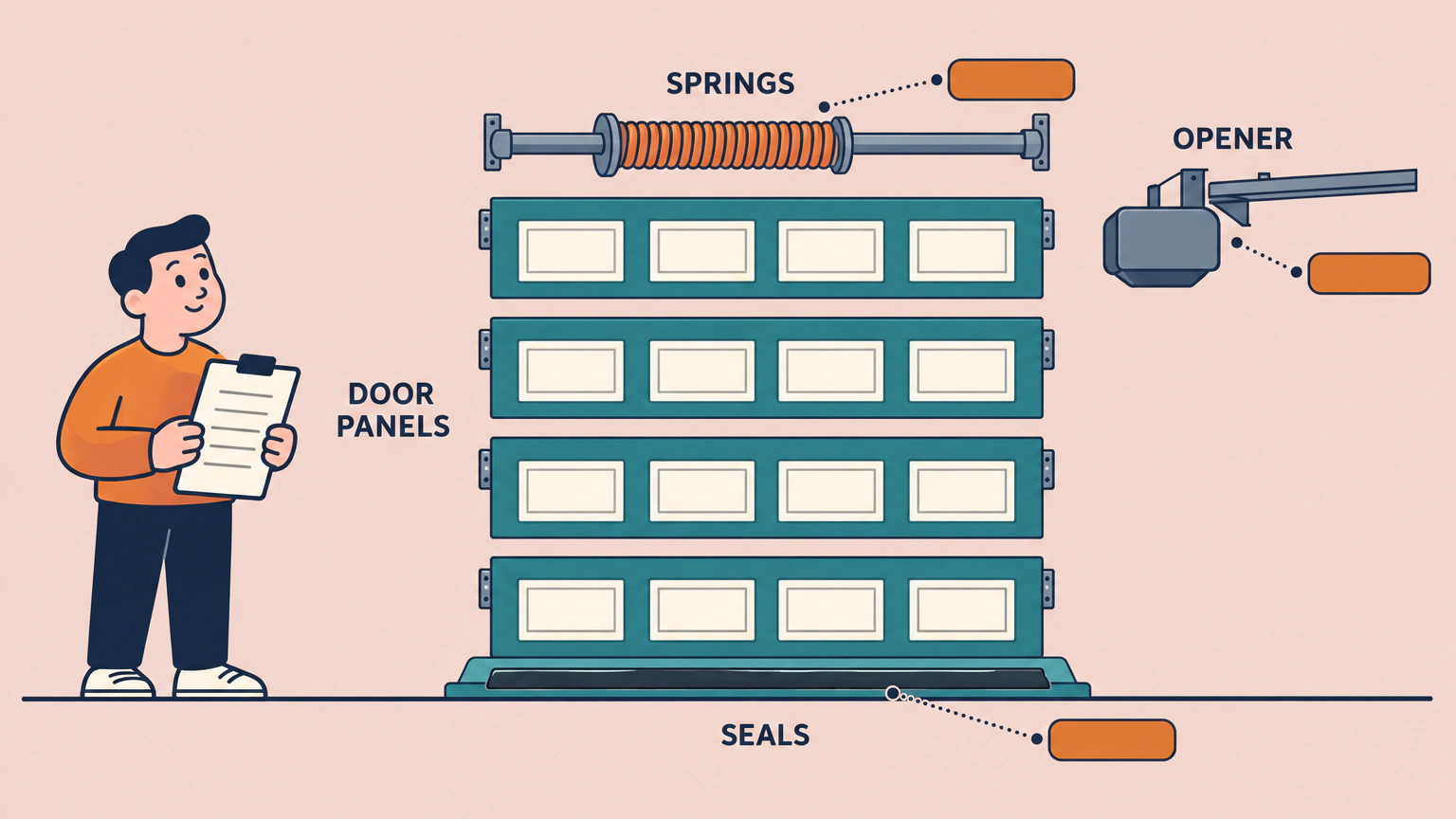
On this page
What a new garage door costs in Canada
Those garage door cost figures come from five sources, and they don't all price the same thing.
What five Canadian price sources publish for a new garage door
| Source | Where | Single door, installed | Double door, installed | What the figure covers |
|---|---|---|---|---|
| Home Depot Canada installation program | Ontario pricing | $1,000 to $1,300 on average | $1,500 to $3,500 | Before tax. Labour is about $350 a door, including removal and disposal of the old door |
| Dodds Garage Doors | Southern Ontario | From $1,700, $1,850 or $2,100, plus HST | From $2,900, $3,250 or $3,600, plus HST | Three insulated steel tiers, professionally installed |
| Amigo Door | Ottawa | $1,500 to $3,500 | $2,200 to $5,500 | The door and professional labour. Custom and oversized doors run $4,000 to $10,000 and up |
| Green Building Canada | Canada | $1,200 to $2,500 | $2,000 to $4,500 | Steel doors, installed. Wood runs $3,500 to $7,000 single and $6,000 to $12,000 double |
| RenoQuotes | Canada | $2,000 to $5,000 | $4,000 to $10,000 | Installed, with basic steel at the low end and custom wood and carriage-house doors at the top |
These are the ranges each source publishes, not quotes. Home Depot excludes tax, Dodds adds HST, and the remaining pages don't state their tax treatment.
Green Building Canada, Amigo Door and Dodds all land inside the single and double ranges we opened with. Home Depot Canada's installation guide comes in lower, at $1,000 to $1,300 on average for a single door on its Ontario pricing. RenoQuotes starts higher, at $2,000 for a single and $4,000 for a double, because its national ranges run all the way up to custom wood and carriage-house doors.
RenoQuotes also offers a handy rule of thumb. A double typically costs 60% to 80% more than a single, not twice as much, because much of the labour and hardware is shared.
Why two quotes for the same opening don't match
The door itself moves a quote first: its material, insulation, windows and steel gauge. RenoQuotes notes that a lower gauge number means thicker steel, and a 24-gauge door dents far less readily than a 28-gauge one.
Then comes the hardware. Home Depot Canada's guide says the cost may be lower if some parts can stay, "such as the track or the garage door opener." Installers often see it the other way. A new door's sections are built for that maker's track, so many would rather pull the old track and start fresh. Ask which one your quote assumes, and why.
After that come the opener, removal and disposal of the old door, and aluminum capping on the frame. Structural work is the wild card. RenoQuotes calls structural modifications "the item most often excluded."
Dodds shows what moves a price when the size doesn't. Its single door starts from $1,700, $1,850 or $2,100. The Good door is insulated with a limited warranty. Better and Best step up to polyurethane and a lifetime warranty. That's $400 for the core and the warranty, on the same opening.
What the extras add
Most of the gap between a base door and a finished job sits in a handful of add-ons.
What the extras add to a garage door quote
| Extra | Published price | Source |
|---|---|---|
| Insulation, R-6.5 | $281 single, $473 double | Home Depot Canada, Ontario pricing, before tax |
| Insulation, R-12.9 | $486 single, $763 double | Home Depot Canada |
| Insulation, R-18.4 | $589 single, $862 double | Home Depot Canada |
| Chain-drive opener | $250 to $450 installed | RenoQuotes |
| Belt-drive opener | $350 to $600 installed | RenoQuotes |
| Direct-drive opener | $400 to $700 installed | RenoQuotes |
| Wall-mounted (jackshaft) opener | $500 to $900 installed | RenoQuotes |
| Windows in the door | $100 to $500 | RenoQuotes |
| Aluminum capping around the frame | $250 to $500 | RenoQuotes |
| High-cycle springs | $100 to $200 more | RenoQuotes |
On Home Depot Canada's numbers, the insulated garage door cost climbs about $100 from its middle option to its top one on a single door, from $486 to $589. It adds about $100 on a double too, from $763 to $862. That's cheap. It's also exactly why it pays to know what the bigger number buys.
The R-value on your quote describes one panel, not your door
Garage door makers report heat loss two ways, and their own trade group says the two don't mix. DASMA, the association of North American garage door manufacturers, says in a technical sheet that "these two methods are not comparable".
The R-value is a calculation, and it covers "the door section only". Picture a slice through the middle of one section: a thin steel skin, the foam, another skin, and a film of air on each face. The number comes from the foam's thickness and how well it insulates. It leaves out the joints between sections, the section ends, the hardware and the edge seals. DASMA says the calculation "should not be used for garage door assemblies."
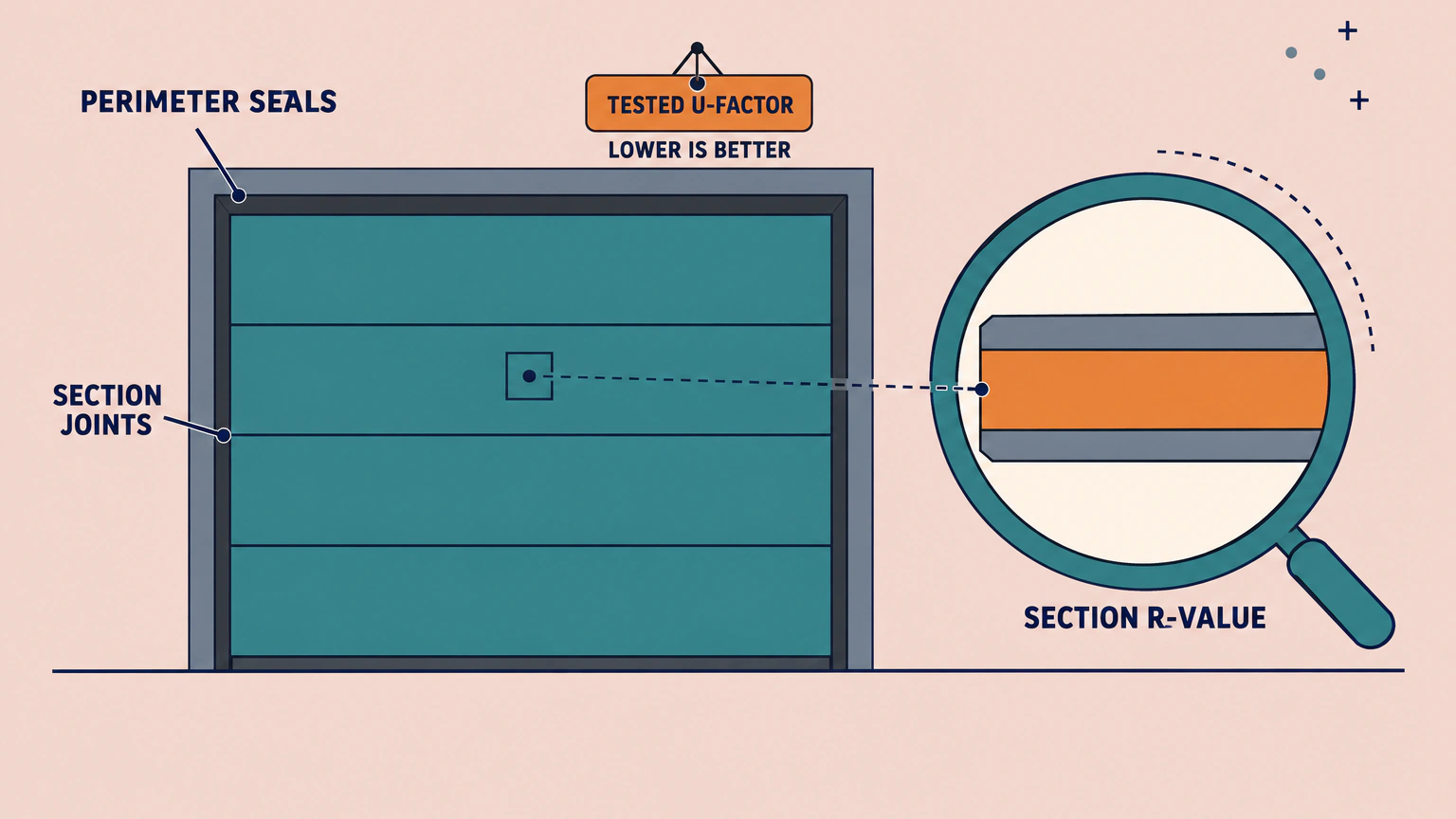
The U-factor is measured instead. A lab mounts "the entire, installed garage door assembly" in a test chamber under a standard called ANSI/DASMA 105. It warms one face, cools the other and measures the heat that gets through. Lower is better. And it isn't simply one divided by the R-value. DASMA's newer sheet calls that "a common misconception" and adds, "That is not the case."
In an attic or a wall, an R-value describes insulation you can measure, and our guide to what an R-value means in your attic and walls covers that job. On a garage door, it describes the middle of one section and nothing around it.
The tested number that compares doors fairly
DASMA runs a voluntary Thermal Performance Verification Program. Manufacturers send U-factor results from approved third-party labs to ICC-ES, a testing and certification company in the International Code Council family. ICC-ES reviews the reports, keeps the records and runs audits, and participants can then publish their U-factors. DASMA's list includes Garaga, the Quebec door maker, along with Clopay, Amarr, Wayne Dalton, Overhead Door, Haas, Hormann, C.H.I., Raynor, Midland and Garex.
One participant's current ICC-ES listing shows why the tested number matters. On it are two polyurethane-insulated steel doors, 1 1/4 and 1 5/16 inches thick. They tested at U-factors of 0.27 and 0.13. DASMA's own scale says "A garage door with a U-factor of 0.20 is twice as thermally efficient as one with a U-factor of 0.40." So the first door lets through about twice the heat of the second. In our view, foam thickness alone would have rated those two doors about the same.
To find the tested number, look for the program's badge, label or icon, which DASMA says "can only appear with models that participate in the program." Or ask for the listing. On the program's label, an R-value may appear only after the U-factor, in smaller type. Nice touch.
If a model has no U-factor, we'd compare R-values only within one maker's line, where the calculation is done the same way. Windows are simpler, because they carry the U-factor on a window's certification label. A garage door's tested number comes from a voluntary program, so you have to ask for it.
How much insulation your garage actually needs
Garaga publishes the plainest guide we found. It suggests at least R-10 for an attached garage, at least R-12 if you heat the garage to 8 to 10°C, and at least R-16 for a workshop or home gym. A detached, unheated garage can get by with a lightly insulated door or none. RenoQuotes agrees that a detached garage used only for parking or storage is fine without insulation.
Then Garaga says something we didn't find on most of the price pages: "The thermal resistance value of a garage door doesn't mean much if the door isn't equipped with effective thermal breaks and suitable weatherstripping around and between the door sections." It even asks whether the perimeter weatherstripping stays "soft and flexible even at -15°F (-25°C)?"
On the foam, Garaga says polystyrene performs at "about half that of polyurethane" for the same thickness. Polyurethane is injected and fills the whole panel. Our advice on an attached garage: pay for polyurethane, a thermal break and good seals before you pay for the last few R points. And buy the insulation with the door. A foam kit glued into an uninsulated pan door adds weight its springs were never sized for, and they wear out sooner.
If you heat or work in the garage, the door is one surface of several, so plan for insulating the rest of the garage too. And an attached garage is one of the triggers in Ontario's carbon monoxide alarm rule.
Red flag: When the R-value is doing the selling
Two sales lines deserve a follow-up question. The first is that a door with twice the R-value keeps the garage twice as warm. Each figure is calculated for one slice of one section, and DASMA says a tested U-factor is what gives fair comparisons "between brands and sectional door types". The second is that a higher R-value will fix a draft. Garaga, a door maker, says the R-value doesn't mean much without thermal breaks and weatherstripping around and between the sections. Ask for the model's tested U-factor, or its listing in DASMA's verification program.
Keep your old opener, or replace it with the door?
Often you can keep it, with conditions. RenoQuotes says a working opener under ten years old, with working sensors, may only need reprogramming. A fairly new opener is worth reconnecting. An old one may not last long on a new door, and replacing both together saves a second visit. Weight matters too. Most residential openers are half-horsepower, and RenoQuotes says a heavy wood or fully insulated door needs three-quarter horsepower or more.
LiftMaster's installation manual sets the real condition. It says to install an opener "ONLY on properly balanced and lubricated garage door", because "An improperly balanced door may NOT reverse when required". So the price of keeping your opener is a proper re-test on the new door, and the quote should say so.
One more thing people get backwards. The opener isn't the counterweight. The springs are. An opener strong enough to haul up a door with a broken spring is a hazard, not a feature.
Springs and cables on a garage door hold enough tension to injure someone, so treat every check below as one to watch, never one to adjust.
Three checks to watch before the installer leaves
The LiftMaster manual, in the copy its Canadian distributor publishes, lays out three tests. Ask the installer to run them while you watch.
- Reversal. A 2x4 goes flat on the floor under the door, and the door closes on it. The manual says the door "MUST reverse on contact with a 1-1/2" (3.8 cm) high object (or a 2x4 laid flat) on the floor."
- Photo eyes. The sensor beam sits "NO HIGHER than 6" (15 cm) above garage floor." With something blocking the beam, the door shouldn't close. In the manual's own test, it moves no more than an inch (2.5 cm).
- Balance. Before the opener is connected, the door is lifted halfway by hand and let go. "If balanced, it should stay in place, supported entirely by its springs."
Watch, don't touch. The same manual says to "NEVER try to loosen, move or adjust" the door, springs, cables, pulleys or brackets, which are all under "EXTREME tension". A door that drifts up or down at the balance check is out of balance, and that's the installer's to fix before leaving.
Check the opener for a Canadian certification mark
Ontario's Electrical Safety Authority, or ESA, is blunt: "Before any electrical product is used, sold, displayed, or advertised in Ontario, it must be evaluated and approved by an accredited certification or field evaluation agency." ESA publishes the list of marks it recognizes, including CSA, Intertek, Underwriters Laboratories and ULC. It also says "The use of unapproved equipment or products is against the law in Ontario."
For garage door openers, the safety standard is ANSI/CAN/UL 325. It's a joint Canada-US standard, a National Standard of Canada since 2017, and it covers the entrapment protection that makes a closing door reverse.
If you're supplying your own opener, or the quote names one you can't find in a Canadian store, look for a recognized mark on the motor unit's label before it goes up. That's Ontario's rule. Elsewhere, ask your own province's electrical safety regulator.
Permits, wiring and who's allowed to do the work
Permit requirements turn on the work and the jurisdiction. The checked examples below separate same-opening replacement from changed openings and new wiring.
When a garage door job needs paperwork, in the places we checked
| The job | Where | What applies |
|---|---|---|
| New door in the same opening | Toronto, for a detached, semi-detached or row house or its garage | No building permit, as long as the opening's size, location and structural support don't change and no new exit is created |
| Wider or moved opening | Toronto | A building permit, because the city lists enlarging or relocating existing doors as work that needs one |
| New outlet or circuit for the opener | Ontario | A licensed electrical contractor, or the homeowner in their own home with an ESA notification |
| Connecting the overhead door in a detached garage | Calgary | An electrical permit |
| Hiring a contractor to install doors and door openers | Quebec | An RBQ contractor licence. Subclass 8.0 covers doors and motorized closing systems such as door openers |
Toronto's exemption is narrow: same size, same location, same structural support, and no new exit. The city lists "enlarging or relocating existing windows or doors" as work that needs a permit. A wider opening also needs a new header above it, which is framing work, so you'd hire a carpenter to reframe the opening.
A new outlet or circuit for the opener is electrical work. In Ontario, ESA says only licensed electrical contractors, with a few exemptions, may legally do electrical work in your home. So if you're hiring, hire a licensed electrical contractor. Otherwise, the homeowner can do the work and file the required notification with ESA.
Calgary requires an electrical permit to connect the overhead door in a detached garage. In Quebec, licence subclass 8.0 from the Régie du bâtiment du Québec (RBQ) covers doors and "motorized closing systems (door openers, etc.)". Check your installer's licence on the RBQ register before you book.
One negative is useful in Ontario. Garage door installation isn't among the province's 23 compulsory trades, so there's no garage door licence to look up. What's left is what you can verify yourself: the quote, the mark on the opener and the install-day tests. Those are the places we checked. Check the rules for your own city and province.
Repair, reseal or replace
Before you price a whole door, price the part that failed. RenoQuotes lists a pair of torsion springs at $300 to $550, one panel at $300 to $700, cables at $100 to $250 and sensor realignment at $75 to $200. It says to replace instead when the repair approaches half the price of a new door, or when the door on an attached garage is uninsulated.
Springs are the most common failure. They're rated in cycles, one open plus one close, typically 10,000 of them. RenoQuotes works that out as roughly fourteen years at two cycles a day and about four and a half at six. Its own FAQ says seven to ten years, which is about what three or four cycles a day gives you. High-cycle springs cost $100 to $200 more and, RenoQuotes says, last two to three times longer.
Drafts can be cheaper still. Daylight along the edges of a door that isn't old usually means the vinyl weather seal has gone brittle. A new seal set a little tighter, with the adjustable track nudged toward it, fixes the draft without a new door.
When to book
Spring and fall are the busiest seasons for garage door installations, in an Ottawa dealer's own words. Amigo Door adds that booking in winter or mid-summer "may offer more flexibility and potentially better pricing." Delivery takes time, too. RenoQuotes says standard doors typically ship in one to three weeks and custom orders in six to twelve.
Our view: if insulation on an attached garage is the reason, order in early fall, so a custom door isn't still on its way at the first snow. If the old door still works and the reason is looks, winter may be the easier booking.
What a complete garage door quote lists
You can check each of these lines on paper before you sign.
- The door's make, model and size, and whether it's a single or a double.
- The insulation type (polyurethane or polystyrene) and, if the model has one, its tested U-factor, not only its R-value.
- Whether the old track, springs and hardware are replaced or reused, and the reason if they're reused.
- The spring type and cycle rating, and the price of high-cycle springs as an option.
- Weatherstripping: the bottom seal, the seals between sections and the perimeter seal.
- The opener: kept and re-tested on the new door, or a new model named with its drive type.
- A recognized Canadian certification mark on any new opener.
- Removal and disposal of the old door, and aluminum capping if the frame needs it.
- Any framing or electrical work, who does it, and which permits, notifications and completion records the job requires.
- The price before tax with GST or HST on its own line, and the installation warranty in writing.
Frequently asked questions
Short answers to the questions people search most.
How long does a garage door last?
Usually well over a decade. RenoQuotes puts a well-maintained door at 15 to 30 years, and Green Building Canada gives steel doors 20 to 30. Springs wear out sooner, because they're rated in cycles, typically 10,000 opens and closes. That's roughly 14 years at two a day and under five at six a day, and a worn spring is a repair, not a reason to replace the door.
Do I need a permit to replace my garage door?
Toronto, for example, doesn't require a building permit to replace a door in the existing opening of a detached, semi-detached or row house or its garage, as long as the opening's size, location and structural support stay the same. Widening or moving the opening is different, and Toronto requires a permit for it. Check your own city's list before any framing changes.
Can I keep my old garage door opener with a new door?
Often, if it's in good shape. RenoQuotes says a working opener under ten years old, with working sensors, may only need reprogramming. A heavier insulated door can need a stronger one, though. Whatever you keep, the installer should balance the new door and re-test the opener's reversal before leaving, because an unbalanced door may not reverse when it should.
What R-value should a garage door have in Canada?
Garaga, a Quebec door maker, suggests at least R-10 for an attached garage, R-12 if you heat it to 8 to 10°C and R-16 for a workshop or home gym. A detached, unheated garage can go without. Those are section numbers, though. To compare doors from different brands, ask for each model's tested U-factor, where lower is better.
Is polyurethane or polystyrene better in a garage door?
Polyurethane, if you're paying for insulation. Garaga says polystyrene insulates about half as well as polyurethane at the same thickness, and RenoQuotes notes that injected polyurethane fills the panel and stiffens it. Polystyrene doors cost less and suit a detached garage used for parking. Either way, the seals between and around the sections matter as much as the core.
How much does a garage door opener cost installed in Canada?
RenoQuotes puts an installed chain-drive opener at $250 to $450, a belt drive at $350 to $600, a direct drive at $400 to $700 and a wall-mounted jackshaft unit at $500 to $900. Belt and direct drives run quieter, which matters with a bedroom over the garage. Size it to the door: most homes use a half-horsepower unit, and a heavy insulated door may need more.
When is the best time to replace a garage door in Canada?
Before the cold, if insulation is the reason. An Ottawa dealer says spring and fall are the busiest installation seasons, and winter or mid-summer can offer more scheduling room. Custom doors take longer: RenoQuotes says standard doors ship in one to three weeks and custom orders in six to twelve, so a custom door ordered in late fall may arrive after the first snow.
Two quotes that name the same door model, the same track and spring plan and the same opener can be compared on price. Two that don't are different jobs, and we list garage door companies near you you can ask for the missing lines.