

On this page
- What a heat pump costs installed in Canada
- The four sizing options, and what each does to the price
- How the rebate follows the size you pick
- What the provinces pay toward a heat pump right now
- The costs that sit outside the heat pump's price
- Before you sign: the quote lines to ask for, and the pitches to walk away from
- Questions people ask about heat pump costs in Canada
What a heat pump costs installed in Canada
Ask how much a heat pump is in Canada and the answer depends on who's publishing. A utility program, a renovation marketplace, a contractor and the federal government each print their own price, and they don't line up.
What Canadian price pages publish for an installed heat pump
| System | Installed price published | Who publishes it |
|---|---|---|
| Ductless, one indoor unit | From about $3,000 | takeCHARGE, the efficiency program of Newfoundland Power and Newfoundland and Labrador Hydro |
| Ductless, wall-mounted | $2,000 to $9,000 | RenoQuotes, a national renovation marketplace |
| Ductless, one zone | $3,500 to $7,000 | Aire One Peel, a Mississauga HVAC contractor |
| Ductless, several indoor units | $4,500 to $15,000 | RenoQuotes |
| Ductless, several indoor units | $8,000 to $15,000 | Aire One Peel |
| Central ducted | $8,000 to $15,000 | RenoQuotes |
| Central ducted, cold-climate | $6,000 to $14,000 | Aire One Peel |
| Central ducted | Up to $20,000 or more | takeCHARGE |
| Ground source (geothermal) | $20,000 to $45,000 | Aire One Peel |
| Any heat pump system, national average | About $18,400 | Natural Resources Canada, December 2023 |
These are the figures each organization publishes, before any rebate. None is a quote for your house.
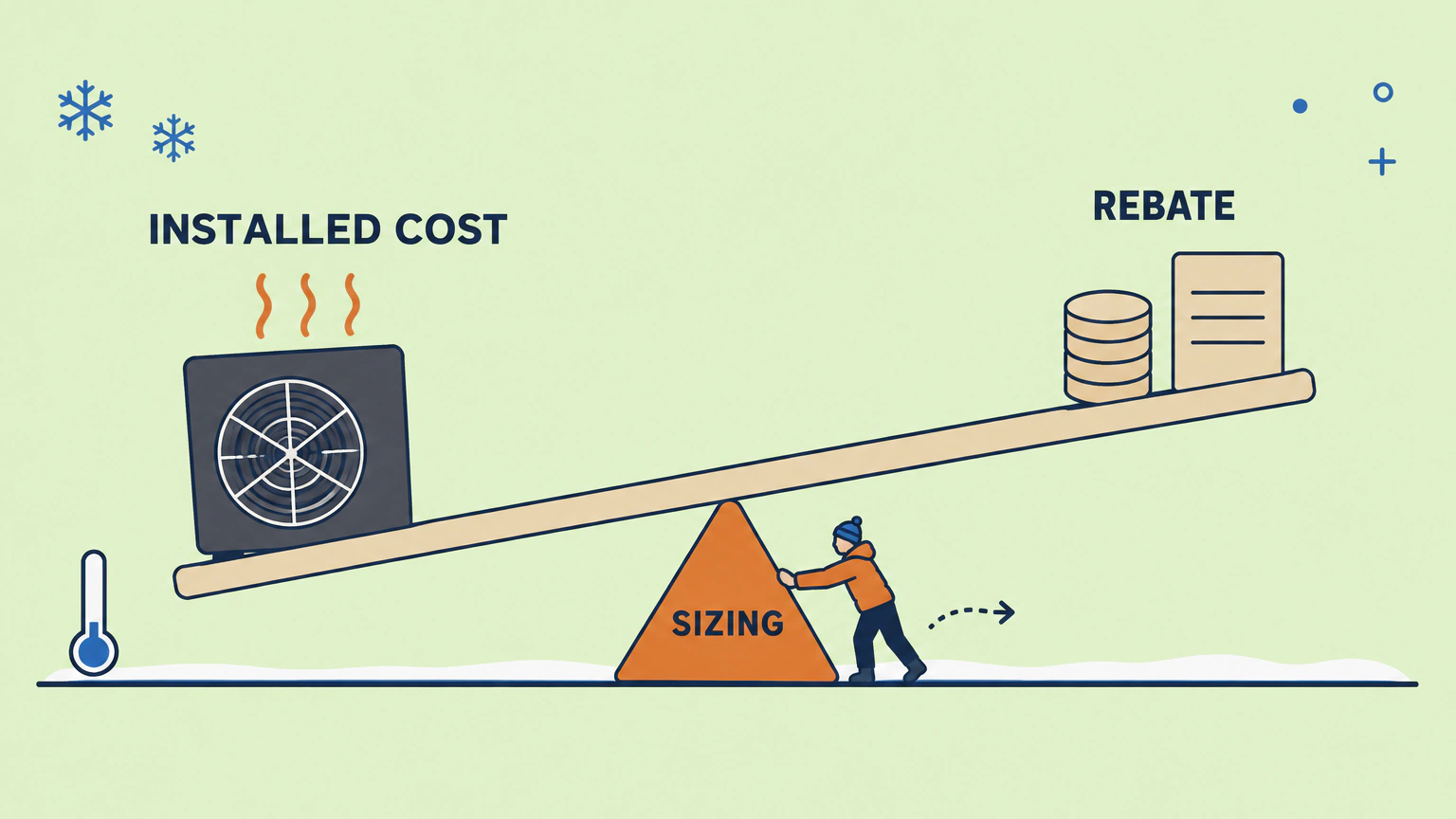
Five things pull a heat pump cost apart: the type of system, its capacity, whether the model is rated for cold climates, your ducts and the electrical work. One wall unit for one room and a ducted system built for a Prairie winter are both sold as a heat pump. They're different purchases.
The federal figure for heat pump installation cost is the sobering one. In December 2023, Natural Resources Canada said "the upfront and average cost of purchasing and installing a heat pump system in Canada is still about $18,400". That's higher than the top of most of these published ranges, so we'd read the low end of any range as the price of the simplest job.
Ductless, ducted or ground source: what your house can take
Your house picks the type before your budget does. A home with baseboards or radiators has no ducts, so the heat comes from wall-mounted heads, and each head warms the area around it. Newfoundland and Labrador's takeCHARGE program puts a number on the limit: "less than 1% of houses can achieve whole home heating with a single mini-split". That's why prices climb once a system needs several heads.
A forced-air house has two routes: add a ducted heat pump to the furnace you already have, or replace the furnace entirely. If the heat pump is really taking over from a dying air conditioner, our guide to replacing a central air conditioner covers that half of the decision.
Ground source costs the most up front and lasts the longest. Natural Resources Canada gives the unit about 20 to 25 years and the buried loop close to 75. An air-source heat pump gets 15 to 20.
The four sizing options, and what each does to the price
Natural Resources Canada (NRCan) publishes the sizing guide contractors work from, and it gives them four options. Option A sizes the heat pump mainly for cooling, with some heat in mild weather. Option B balances heating and cooling. Option C puts the emphasis on heating: the unit is sized to your home's heat loss at −8.3°C (17°F), and a backup covers the coldest days. Option D is sized to the full design heating load, the heat your house needs at the coldest temperature it's designed for, so the heat pump carries all or nearly all of the heat.
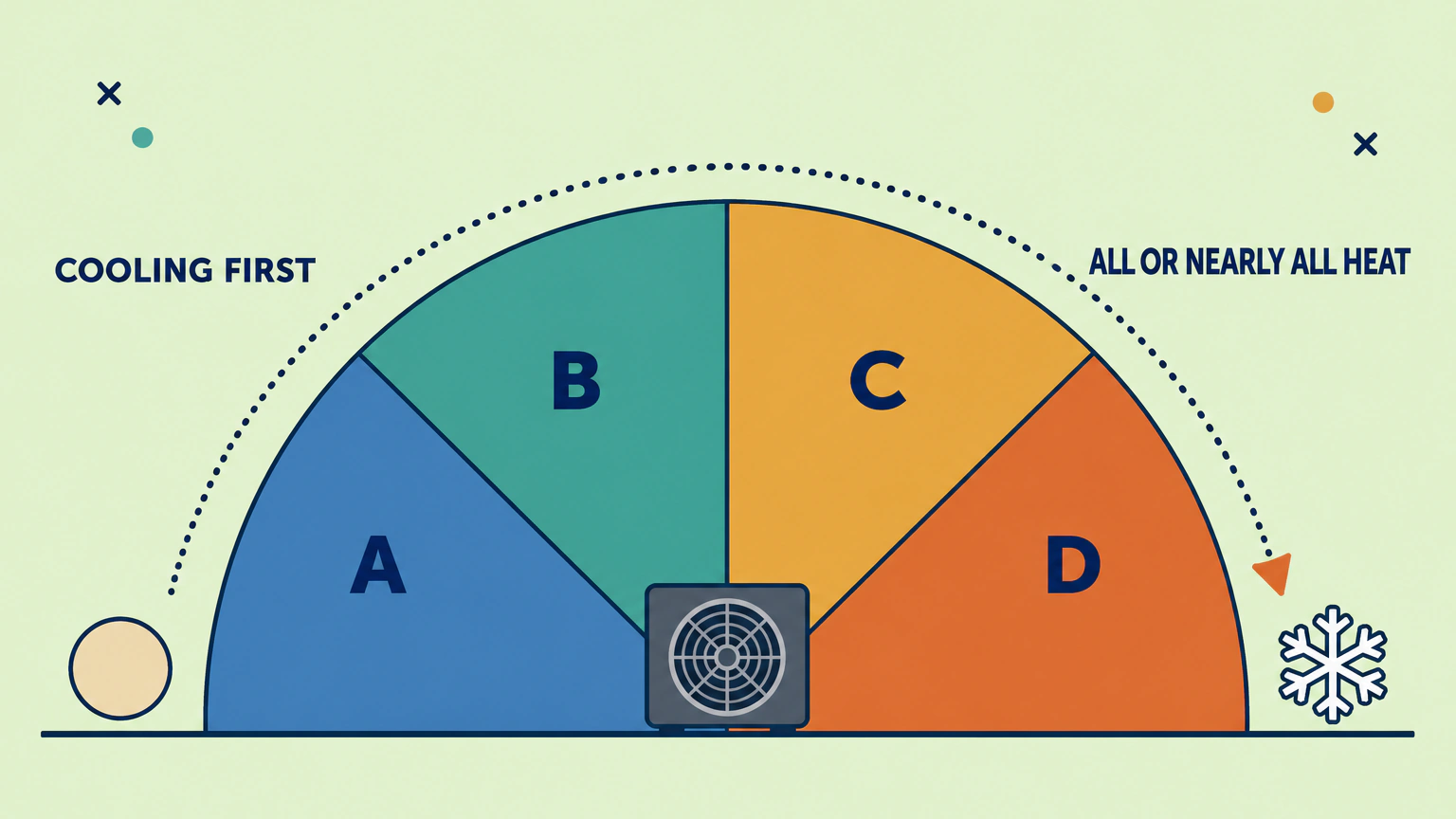
The guide doesn't crown a winner. It says no single approach fits every home, and the right option depends on what you want the heat pump to do. Moving from cooling-focused A or B toward heating-focused C or D generally buys more capacity. That can mean a bigger, costlier unit and sometimes duct work, and NRCan warns that option D "may not be feasible" on ducts designed for a furnace.
Bigger isn't automatically better. A heat pump sized for the coldest night needs enough turn-down range to avoid cycling in milder weather. Where a big furnace sits beside a small air conditioner, sizing to the cooling load can also spare you duct and panel changes.
The cheapest capacity is the capacity you never need. NRCan says tackling air leaks and poor insulation first "can allow you to use a smaller heat pump size". So think about cutting heat loss before you size, starting with how much attic insulation your house should have.
Which option suits a gas furnace, and which suits baseboards
Efficiency Manitoba spells out who should pick what, and it's talking about its own province. "Most Manitobans will likely benefit the most" from option B or C, it says. A home keeping its gas furnace "may lean toward Option B". An electrically heated home leans toward C or D.
The reason is the price of fuel. In Manitoba, natural gas has recently cost about 20% to 40% as much as electricity for the same energy. A gas home's bill may barely move, and it can even rise, depending on how the system is sized and set up.
A hybrid system is the fix. The heat pump works until the outdoor temperature falls to a set point, and then the furnace takes over. NRCan's name for the point where gas becomes the cheaper heat is the economic balance point. Efficiency Manitoba gives −10°C or −15°C as typical switch-over settings. With a furnace behind it, option C shows how much of the winter the heat pump can carry before the gas comes on.
Homes on electric baseboards, oil or propane are a different story. There, Efficiency Manitoba expects a heat pump to cut the bill.
How to see the sizing option on your quote
Ask for four things, in an order a contractor can answer.
First, the heat-loss calculation behind the size. Our furnace guide explains how a heat-loss calculation sizes the equipment. Second, the sizing option letter, or the printout from NRCan's sizing tool. Ontario's rebate program requires that form before installation, so a participating contractor there has to produce one anyway.
Third, two capacity numbers from the model's spec sheet: the rated heating capacity at 8.3°C (47°F) and at −8.3°C (17°F). The first is what Ontario's rebate is calculated on. The second is what option C is sized to, and it's close to the figure Quebec pays on.
Last, the switch-over or cut-off temperature the installer will set.
How the rebate follows the size you pick
Ontario's Home Renovation Savings program pays $500 per ton, up to $2,000, for a cold-climate air-source heat pump in a home heated by Enbridge natural gas, and $1,250 per ton, up to $7,500, where the home is heated by electricity, oil, propane or wood.
The tons don't come from the nominal size printed on your quote. They come from the heat pump's rated heating capacity at 8.3°C (47°F), counted in BTU/h, the trade's unit of heat output, at 12,000 to the ton. Ask your contractor which capacity figure went on the pre-approval application.
The sizing option matters here too. Oil, wood and electrically heated homes qualify only with option C or D. Gas and propane homes can use any of the four.
Pre-approval is mandatory, the contractor must be a participating one, and the model must be on NRCan's cold-climate list. Existing heat pump replacements don't qualify, and a new home must have been occupied for at least six months. Homes heated by electricity, oil, propane or wood must connect to Ontario's IESO-controlled grid.
Ontario's heat pump rebate, worked out by size
| Rated heating capacity at 8.3°C | Tons | Home heated by Enbridge natural gas | Home heated by electricity, oil, propane or wood |
|---|---|---|---|
| 24,000 BTU/h | 2 | $1,000 | $2,500 |
| 36,000 BTU/h | 3 | $1,500 | $3,750 |
| 48,000 BTU/h | 4 | $2,000, the cap | $5,000 |
| 60,000 BTU/h | 5 | $2,000, the cap | $6,250 |
| 72,000 BTU/h, such as two 3-ton units | 6 | $2,000, the cap | $7,500, the cap |
Cold-climate air-source heat pumps only. A ground-source system earns $3,000 flat in a gas-heated home and $2,000 per ton up to $12,000 otherwise, and a rented air-source heat pump earns $500 per ton up to $2,000 whatever the fuel.
The headline $7,500 takes six tons of rated capacity. In the program's own example, that's two 3-ton units. One 3-ton unit earns $3,750.
Quebec pays for capacity at minus 8°C
Hydro-Québec's LogisVert program pays on heating capacity measured at −8°C. An ENERGY STAR certified heat pump earns $50 per 1,000 BTU/h. A model classified as cold climate earns $120 per 1,000 BTU/h. The base grant tops out at $6,700, before any bonus for eligible multi-unit dwellings or combined measures.
Hydro-Québec gives its own example. A high-efficiency unit with 15,000 BTU/h of capacity at −8°C earns $1,800, and a 30,000 BTU/h model earns up to $3,600.
Check eligibility before you buy. The grant rate depends on the date the heat pump is installed. The model has to be on Hydro-Québec's list of eligible heat pumps. It must be a new, complete system. Replacing one component or a failed heat pump doesn't qualify. You apply after installation, through a French-only web portal.
B.C. pays for how much of the house the heat pump heats
BC Hydro's standing rebates don't count tons. They depend on how much of the house the heat pump can heat. Temporary bonuses have separate terms. A heat pump replacing electric heat earns $4,000 when it meets 100% of the home's heating needs at −5°C. That means holding 22°C indoors with no electric resistance heat, proven by a load calculation done to the CSA F280 standard. Meet 50% or more and the rebate is $1,500.
The installer must belong to BC Hydro's Home Performance Contractor Network, and the new variable-speed heat pump must be on the eligible-product list. Apply within six months of the invoice. Replacing an existing heat pump doesn't qualify.
Households under the province's income limits can apply to the CleanBC Energy Savings Program instead. Its heat pump rebates reach $13,000, and a rebate for an electrical service upgrade can be added.
What the provinces pay toward a heat pump right now
Start with Ottawa, because most of its programs have closed. The Canada Greener Homes Grant is closed. So is the Canada Greener Homes Loan: its funding is fully committed, and new applications can't be approved.
The federal Oil to Heat Pump Affordability program took its last applications on July 31, 2026 in Alberta, Manitoba, Saskatchewan, Quebec and the Northwest Territories, and households approved there have until January 31, 2027 to upload their receipts. British Columbia, New Brunswick, Newfoundland and Labrador, Nova Scotia, Ontario, Prince Edward Island and Yukon deliver that program through their own agencies, on their own timelines.
One federal route is still open. Lower- and median-income households can get no-cost upgrades, heat pumps included, through the Canada Greener Homes Affordability Program. It runs through provincial partners: BC Hydro and FortisBC, Efficiency Manitoba, Efficiency Nova Scotia's HomeWarming, Prince Edward Island and Hydro-Québec.
Where the heat pump money is, province by province
| Province | The main heat pump money | The condition that trips people up |
|---|---|---|
| Ontario | Home Renovation Savings: $500 per ton up to $2,000 in an Enbridge gas-heated home, $1,250 per ton up to $7,500 in a home heated by electricity, oil, propane or wood | Approval before installation, a participating contractor, and sizing option C or D in oil, wood and electrically heated homes |
| Quebec | Hydro-Québec LogisVert: $50 per 1,000 BTU/h at −8°C for an ENERGY STAR model, $120 if it's rated cold climate, with a base grant up to $6,700 | The model must be on Hydro-Québec's eligible list, and the rate depends on the installation date |
| British Columbia | BC Hydro: standing rebates of $4,000 when the heat pump meets all the home's heating at −5°C and $1,500 when it meets at least half; a limited bonus adds $1,000 for whole-home or $500 for partial-home air-source systems completed, invoiced and fully paid from August 1 through October 31, 2026; CleanBC Energy Savings Program: income-based rebates up to $13,000 | BC Hydro's rebates are only for replacing electric heat, with an installer from its contractor network; submit a complete bonus application by November 30, 2026, while funds last |
| Manitoba | Efficiency Manitoba: $2,000 for a centrally ducted cold-climate heat pump, $1,500 for a ductless one | A registered contractor, who files within 90 days of installation; replacing an existing heat pump doesn't qualify |
| Nova Scotia | Efficiency Nova Scotia home energy assessment: rebates up to $5,000 across the upgrades it recommends, with a $199 fee waived for moderate-income households | The oil-to-heat-pump program stopped taking new applicants on July 2, 2026, and the assessment has to come before any work starts |
| Newfoundland and Labrador | Oil to Electric Incentive Program: up to $22,000 to move an oil-heated home to electric heat, set by income and household size | Pre-approval, a participating installer, whole-home heating, and backup heat installed with a central heat pump |
| Saskatchewan | SaskEnergy's current home rebates cover natural gas equipment, not heat pumps | The federal oil-to-heat-pump intake closed on July 31, 2026; check SaskPower's programs before you buy |
| Alberta | Clean Energy Improvement Program: financing for up to 100% of the project, repaid on your property tax bill, in participating municipalities including Calgary and Edmonton | It's a loan, not a rebate, and the federal oil-to-heat-pump intake closed on July 31, 2026 |
New Brunswick and Prince Edward Island run the federal oil money through their own provincial programs, so their current terms sit with Save Energy NB and the PEI government. In Alberta, check your city before you count on the financing. Calgary has closed residential intake until winter 2026/2027, and Edmonton is putting new applicants on a waitlist.
The costs that sit outside the heat pump's price
Four lines can turn the heat pump cost on your quote into a bigger bill.
The first is electrical. NRCan says an add-on heat pump usually doesn't need a service upgrade. Going all-electric is different: "A 200 ampere electrical service is normally required" for an all-electric air-source heat pump or a ground-source one. If your house has 100-amp service and you're leaving gas or oil, expect an electrician's line on the bill. Before you sign, an electrician can tell you whether your service needs an upgrade. B.C.'s Energy Savings Program has a rebate add-on for that work.
The second is ducts. Heat pumps move more air than furnaces, so your ductwork may need changes, most of all at option D.
The third is backup heat. Most air-source installations need it. Newfoundland and Labrador's oil-to-electric program requires it with a central heat pump, and warns that going without "may void your home insurance". Electric resistance backup is less efficient than the heat pump, so ask how often yours will come on.
Last comes the old oil tank. Ontario's program makes oil-heated homes use a contractor registered with the Technical Standards and Safety Authority to deal with it. The federal oil program counted tank removal as an eligible cost.
Before you sign: the quote lines to ask for, and the pitches to walk away from
A good quote answers seven questions in writing. The AHRI certificate in the first one is the industry listing that shows the outdoor and indoor units were rated as a pair. Ask for each line. Then watch for the three pitches that deserve a slower answer.
Seven lines to ask for on a heat pump quote
- The outdoor and indoor model numbers, and the AHRI certificate that lists them as a matched pair.
- Whether the model is on Natural Resources Canada's cold-climate list, if you're counting on a rebate.
- Which of NRCan's four sizing options the system is built to, and the heat-loss calculation behind it.
- The rated heating capacity at 8.3°C (47°F) and at −8.3°C (17°F), in BTU/h.
- What heats the house below the switch-over temperature, and the temperature the installer will set.
- The electrical work, itemized, including whether your service needs an upgrade.
- The rebate program by name, and its pre-approval confirmation before any work starts where the program requires one.
Red flag: Three heat pump pitches worth a pause
- A knock or a call offering a government heat pump rebate. NRCan says the Government of Canada and its brands "never solicit over the telephone, or by email or go door-to-door", and Ontario's program says its contractors "will never show up at your door without an appointment". Close the door and start from the program's own website.
- A quote that subtracts federal money. The Greener Homes grant and loan are closed. Ask which program each dollar comes from.
- "$7,500 back" on one mid-sized unit. In Ontario that needs six tons of rated capacity. Ask for the per-ton arithmetic.
Questions people ask about heat pump costs in Canada
Six questions tend to follow the quote home.
Do you need backup heat with a heat pump in Canada?
Usually, yes. NRCan says most air-source installations need a supplementary heat source for the coldest days, and sometimes during defrost. Newfoundland and Labrador's oil-to-electric program goes further: a central heat pump's backup must be installed and working, and it warns that going without "may void your home insurance". Sizing to option D means the backup runs less often. NRCan's guide drops it only where a heat pump with no cold-weather cut-off exceeds the home's full design load.
Can a ductless heat pump heat a whole house?
One indoor head rarely can. Newfoundland and Labrador's takeCHARGE program says fewer than 1% of houses can get whole-home heating from a single mini-split, because each head heats the area around it. A multi-split with a head in each main area, or a ducted system, is how a whole house gets covered. It's also why multi-zone systems cost so much more than one head.
Is a heat pump cheaper to run than a natural gas furnace?
Not always. Efficiency Manitoba notes that in Manitoba, natural gas has recently cost about 20% to 40% as much as electricity for the same energy. A gas home may see little saving, and its bill can even rise, depending on sizing and setup. Homes heated by electricity, oil or propane usually save. In a gas home, the switch-over temperature is where the saving is won or lost.
Does a propane-heated home in Ontario get the bigger rebate?
Yes, if the home is connected to Ontario's IESO-controlled grid. Home Renovation Savings puts propane with electricity, oil and wood: $1,250 per ton of rated heating capacity, up to $7,500, for a cold-climate air-source heat pump. A propane home can use any of NRCan's four sizing options, while oil, wood and electric homes need C or D. Your contractor also files a tank attestation form that you sign, and approval still has to come before installation.
Can I get Ontario's rebate if the heat pump is already installed?
No. Home Renovation Savings is blunt about it: "Pre-approval is mandatory. Installations done before approval are not eligible for rebates." A participating contractor submits the pre-installation application, including the NRCan sizing form, and installs only after written approval. If the heat pump went in first, the Ontario rebate is gone, whatever its size.
How long does a heat pump last in Canada?
NRCan puts an air-source heat pump's service life at 15 to 20 years, and a ground-source unit's at about 20 to 25, with the buried loop lasting close to 75. Warranties are shorter: typically one year on parts and labour, plus five to ten years on the compressor for parts only. Read that fine print before you compare two quotes on price.
Get two quotes that name the same sizing option and the same capacity at 8.3°C. Only then compare the prices. When you're ready, our directory lists HVAC contractors near you.