

On this page
The short answer, and the number actually worth shopping on
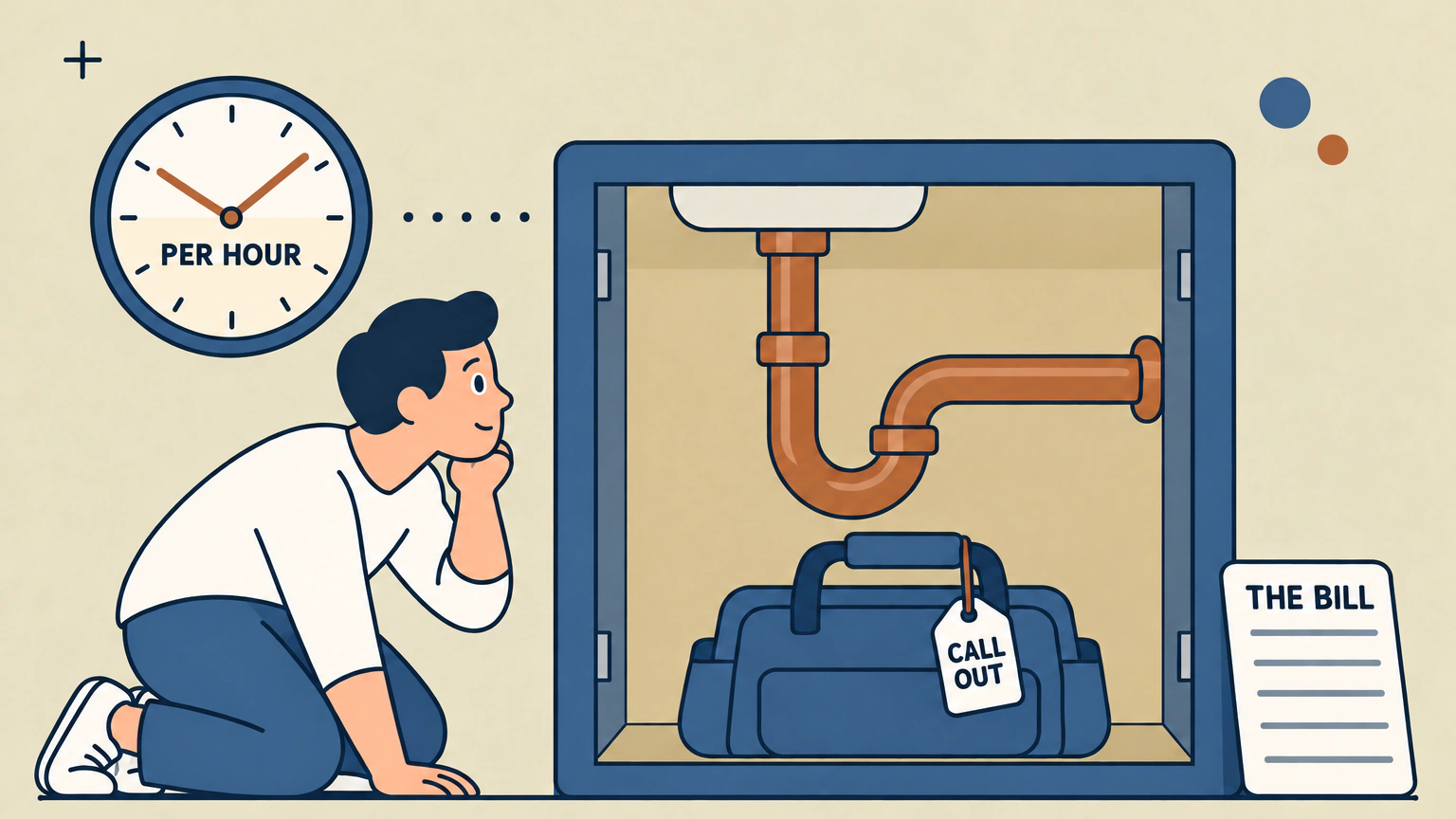
You phoned three shops, got three hourly rates, and you still can't tell which one is cheaper. That's normal, because the hour is only one of three numbers that decide your bill. A shop at $110 an hour with a $150 service call and a two hour minimum costs you more for a twenty minute fix than a shop at $160 an hour with no trip charge and a one hour floor. Shop the combination, not the rate. And ask for all three in the same text message, so you're comparing like with like.
What Canadian plumbing companies publish
Plenty of Canadian shops publish their rates, and reading a stack of them is the closest thing to a market picture anyone has. Plumbwize quotes $110 to $145 an hour in regular hours and $200 to $350 after hours. Galaxy Plumbing publishes $90 to $175. Dr. Pipe puts downtown Toronto work at $200 to $300 an hour.
The fees sit in a narrower band. Safari Plumbing lists a service call of sixty to one hundred dollars. Everest says diagnostic or trip fees typically run $65 to $110. Plumbwize lists $90 to $150 for a diagnostic or inspection.
Those are companies describing their own prices, not an independent survey. We couldn't find an audited national plumbing rate.
Why the hourly rate on its own tells you almost nothing
Run a twenty minute repair through two shops and watch what happens. Shop A charges $110 an hour, a $150 service call that isn't credited back, and bills a two hour minimum, so the invoice reads $370. Shop B charges $160 an hour, no trip fee, one hour minimum, so the invoice reads $160. The cheaper hourly rate cost more than twice as much.
Now flip it to a four hour job. Shop A comes to $590. Shop B comes to $640. The ranking swaps, because fixed charges stop mattering once the hours pile up.
There's a second number worth chasing: the rate after the first hour or minimum. Ask for it as well, because one number without the other doesn't tell you what the job costs.
What your plumber earns, province by province
The rate sheets never show what the person in the van takes home. Job Bank publishes it for every province, and the distance between that figure and the one on your invoice is the part nobody explains. The gap isn't evidence you're being fleeced. It means you're buying a business, not an hour of somebody's labour.
| Province or territory | Median wage ($/h) | Low to high ($/h) | Trade certification |
|---|---|---|---|
| Canada | 34.00 | 21.00 to 46.00 | Compulsory in seven provinces |
| British Columbia | 32.00 | 23.00 to 48.00 | Voluntary |
| Alberta | 30.00 | 20.00 to 43.00 | Compulsory |
| Saskatchewan | 35.00 | 22.00 to 43.00 | Compulsory |
| Manitoba | 30.11 | 21.00 to 43.00 | Voluntary |
| Ontario | 32.50 | 20.00 to 50.38 | Compulsory |
| Quebec | 40.00 | 24.50 to 45.00 | Compulsory |
| New Brunswick | 26.00 | 16.50 to 34.00 | Compulsory |
| Nova Scotia | 33.00 | 18.00 to 38.38 | Compulsory |
| Prince Edward Island | 30.00 | 20.00 to 38.00 | Compulsory |
| Newfoundland and Labrador | 27.50 | 18.50 to 36.03 | Voluntary |
These are wages paid to plumbers, not the rate a shop bills you. Job Bank publishes them from Statistics Canada's Labour Force Survey, covering 2023 and 2024.
Job Bank prices all ten provinces the same way. The three territories come from a different modelled estimate for a different year, so their figures don't sit on the same footing and aren't shown.
The wage behind the rate
The national median plumber's wage is $34.00 an hour. Quebec pays the most, at a median of $40.00, and New Brunswick the least, at $26.00. Fourteen dollars separates them, which is a wide spread for one trade in one country.
Only two provinces pay above the national median: Quebec, and Saskatchewan at $35.00. The other eight sit below it, Ontario included at $32.50.
Quebec's $40 median sits beside a different regulatory setup. Plumber certification is compulsory there, and Act R-20 sets province-wide labour rules for construction work. That is one province's arrangement, not a rule about what a certificate is worth everywhere else.
Where the rest of the money goes
Start at $34.00 an hour and add. The employer pays payroll costs on top of the wage. Then the van, the fuel, and a few thousand dollars of fittings riding around in the back so your job finishes today instead of Thursday. Then liability insurance, workers' compensation coverage, the phone that answers at seven in the morning, and the warranty that sends somebody back for free when the repair fails in March.
Then the arithmetic that surprises people most. A plumber who's paid for eight hours doesn't bill eight hours. Driving, parts runs, quoting, paperwork and the job that got cancelled all come out of the same day, and many shops bill far fewer hours than they pay for. Every unbilled hour gets carried by the ones you do get charged for.
That's the formula a trade business actually runs on. Wages, plus overhead, plus the profit the owner wants, divided by the hours anyone can realistically bill. The answer is your hourly rate.
The lines on the bill that are not the hour
A plumbing invoice usually carries more lines than the quote did. Most of them are ordinary: the trip, the minimum, the parts, the after-hours uplift. None of them is a scam on its own. They turn into a problem in exactly one situation: when the first you hear of a charge is the invoice. So ask about each of them before the van is dispatched, rather than after.
| Line on the bill | What it pays for | What these companies publish | What to ask before you book |
|---|---|---|---|
| Service call, trip or diagnostic fee | Getting a van and a worker to your door, and the first look at the problem | Roughly $60 to $200 on a weekday, higher out of hours | Is it credited against the repair if I go ahead, or charged on top? |
| Minimum billed time | The shop's floor on any visit, however short the job turns out to be | One to two hours on the pages that publish a minimum | What is your minimum, and do you bill in fifteen minute or half hour steps after it? |
| Labour, hourly or flat rate | The time on site, or a book price for a named job | About $80 to $200 an hour in regular hours, with some Toronto pages quoting more | Is this an hourly rate or a flat rate, and which one am I being quoted? |
| Parts and the markup on them | The fittings and fixtures, plus the shop's margin for stocking and warranting them | Rarely published. Ask how the shop prices parts | Will you show the parts as separate lines, with the price of each? |
| After hours, weekend and holiday uplift | Paying somebody to come out when they are not rostered | Commonly quoted at one and a half to two times the regular rate | When does billed time start, and is travel separate or built into the rate? |
Column three is what Canadian plumbing companies publish about their own prices. Those are the best figures anyone publishes for Canada, and they aren't audited market data.
The service call, the trip fee and the diagnostic fee
Three names, one idea, and a small difference between them. A service call or trip fee pays for getting a van and a worker to your door. A diagnostic fee pays for the first look, where somebody works out what's wrong and tells you what the repair will cost.
One question decides whether any of them costs you real money. Is the fee credited against the repair if you go ahead, or charged on top? Everest Plumbing says many local companies waive the fee or apply it to the balance when the work is authorized on the spot. Ask, and get the answer in writing, because a credited fee and an added fee sound identical on the phone.
The minimum billed time, and how twenty minutes becomes two hours
This is the line that produces the angriest phone calls. A drain clears in fifteen minutes, the invoice says two hours, and nothing was done wrong. The shop has a minimum, and that floor applies to any visit at all.
Minimums and billing increments are a business setting, not a rule. Some shops bill a full hour whether the job runs ten minutes or the whole sixty. After that, some round every visit up to the next half hour, and some bill in fifteen minute steps. The shop sets that number, which is exactly why it's worth asking for.
It bites hardest on short work, so it's worth asking drain cleaning specialists for a flat price on the named job instead. Two questions cover it: what's your minimum, and what do you round to after it?
Parts, the markup on them, and the tax line
Shops mark up parts. That margin pays for stocking the fitting, for bringing it to you and for warranting it when it fails, and a plumber who carries nothing bills you an hour of driving instead. The markup isn't unfair by itself. Not being able to see it is.
So ask for parts as separate lines with a price beside each one, which Ontario requires for covered future performance agreements over $50. Sales tax differs by province, and it belongs on the quote rather than arriving at the end as a surprise.
One warning about fixtures. If the job involves a rented water heater, your bill is a contract question before it's a plumbing one.
After hours, weekends and holidays
Nights, weekends and statutory holidays cost more, and Canadian shops commonly quote one and a half to two times the regular rate for them. Plumbwize publishes $200 to $350 an hour after hours against $110 to $145 in regular hours, which is the top of that band and a little past it.
Water running where it shouldn't is an emergency. Shut the valve, then call. A slow drip into a basement laundry tub, a toilet that keeps running, a tap that won't quite stop: those wait until morning and save you the premium.
One question settles the rest. When does the clock start? Ask whether travel time is billed separately or already built into the rate.
Who is legally allowed to send you that bill
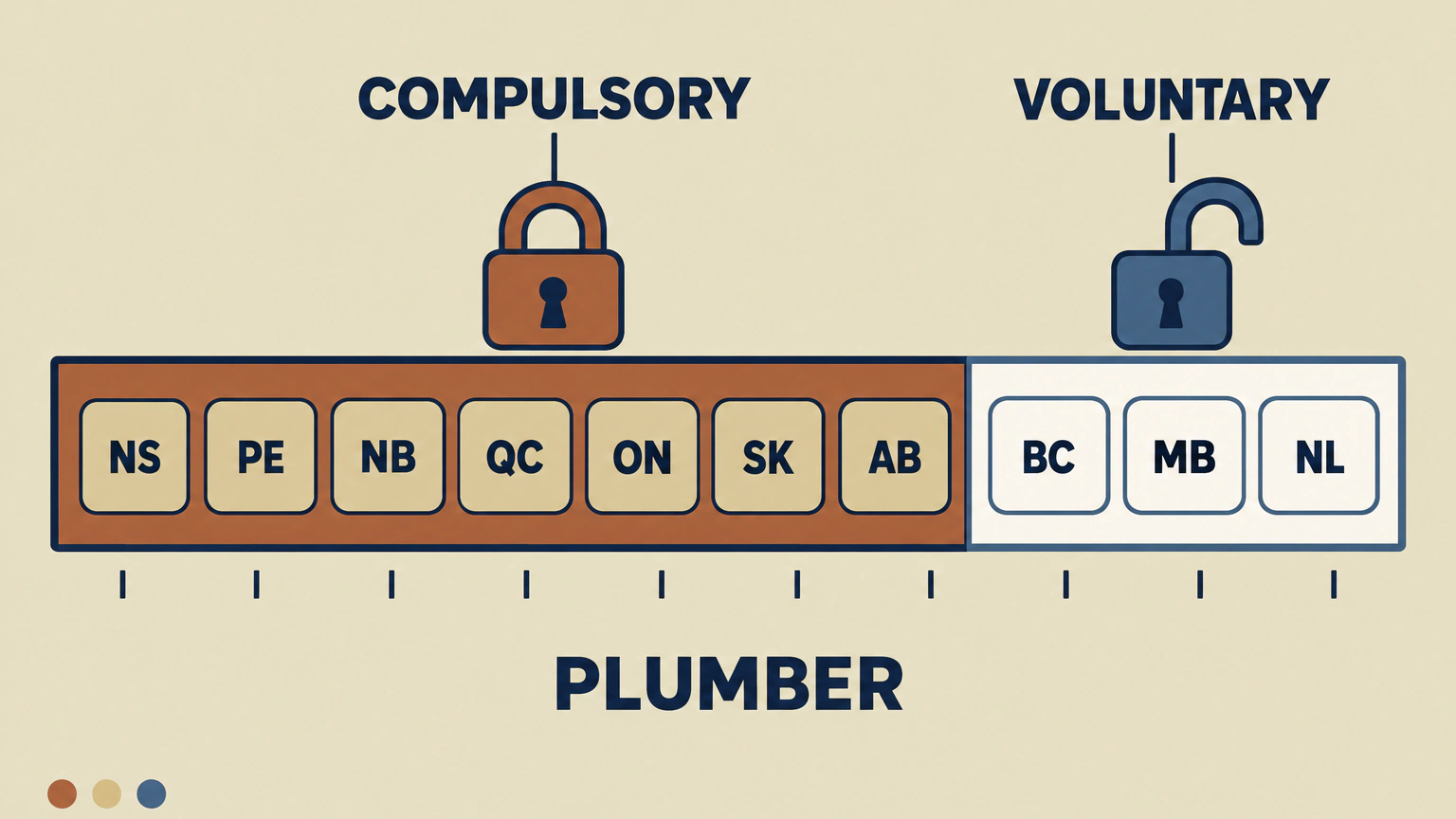
Here's the question most price guides skip. Trade certification is compulsory in seven provinces and voluntary in the other three and the territories. That isn't a trade-politics argument, and it isn't a small detail. It changes what you should ask for before you let somebody open a wall in your house. Job Bank sets the certification split out in a single sentence. Provincial plumbing codes, permits and local licensing can still restrict who may do particular work.
Seven provinces where plumber certification is compulsory
The seven are Nova Scotia, Prince Edward Island, New Brunswick, Quebec, Ontario, Saskatchewan and Alberta. In those seven, plumber trade certification is compulsory rather than voluntary.
Ontario runs it through Skilled Trades Ontario. Plumber is one of the province's 23 compulsory trades. A worker may hold a Certificate of Qualification, a Provisional Certificate of Qualification or a Registered Training Agreement. Journeypersons renew their certificates every year. Alberta's Tradesecrets regulates the trade through journeyperson certification or a registered apprenticeship.
One practical consequence: a provider advertising handyman services can't take on work reserved to the plumbing trade unless they meet the province's certification rules.
Three provinces where trade certification is voluntary
In British Columbia, Manitoba and Newfoundland and Labrador, plumber trade certification is available but voluntary. It's voluntary in all three territories too. That classification doesn't override plumbing-code, permit or local licensing rules about who may do particular work.
Certified plumbers still work throughout those provinces, and plenty of the best ones took the ticket because they wanted it. British Columbia does run compulsory certification, just not for this trade. Its seven designated trades are two electrician tickets, powerline, steamfitting and pipefitting, refrigeration and air conditioning, gasfitting and sheet metal work. Plumber isn't on it.
Voluntary trade certification changes what you need to check. Ask whether the worker is certified, whether the job needs a permit and whether local licensing rules apply.
How to check credentials and permits
Two provinces make it easy. Skilled Trades Ontario runs a public register you can search yourself. Quebec has two layers: the Régie du bâtiment du Québec licenses the company, and you can look that licence number up in its Licence holders' repertory, which shows the classes, the guarantor and any claims against it. For ordinary work in a home, rather than on a construction site, Quebec also requires a provincial qualification certificate in plumbing, and working without a valid certificate or apprentice card is an offence that carries a fine.
Everywhere else, four checks do most of the work. Ask for the permit where the job needs one. Ask for a workers' compensation clearance letter. Ask for the liability insurance certificate, with the dates showing. And get the warranty on the repair in writing, in the same document as the price.
What covered written agreements have to contain, and what happens if they do not
Most people never find out that some consumer agreements have contents set by law. Ontario and British Columbia both prescribe information for covered agreements. If the paper in your hand is missing required pieces, cancellation rights may open. Both provinces are really protecting one thing: a price you can prove afterwards.
Ontario: the ten per cent rule and the one year cancellation right
Ontario's Consumer Protection Act, 2002 is blunt where it counts. "If a consumer agreement includes an estimate, the supplier shall not charge the consumer an amount that exceeds the estimate by more than 10 per cent." Go over by more than that and the remedy arrives in the next breath: the consumer "may require that the supplier provide the goods or services at the estimated price."
Read the first word of that, though. It says if. The ten per cent cap applies when an estimate was given, and it doesn't force anyone to give you one. The parties may amend the estimate if you ask for additional or different work. So ask for the estimate in writing before the work starts.
A separate rule covers future performance agreements. If your total potential payment is more than $50 and the work or full payment comes later, the deal has to be in writing with prescribed contents. If you don't receive a compliant copy, you have one year from the date you entered the agreement to cancel. That's also the ground you'd be standing on if you're wondering what happens if you refuse to pay.
What an Ontario future performance agreement over $50 has to say, by law
- Your name, the company's legal name and any name it trades under, a phone number and the street address of the premises it works from.
- A description of the work precise enough that you could hand it to a second plumber and get a comparable price.
- An itemized price for every part and every service, with the tax shown.
- Every additional charge that applies or might apply, with the amount where the company can reasonably work it out.
- The total the company knows you will owe, and the terms and method of payment.
- When the work starts, when it finishes, where it happens, and the name of a specific person the company says will do it.
Red flag: Four things should stop you signing tonight. A price given only out loud, when the job is a booked visit rather than an emergency in progress. A refusal to put the service call fee and the minimum billed time in the same document as the hourly rate. A demand for the full amount in cash before anyone opens a wall. And a certificate number the person won't repeat slowly enough for you to write down. None of those four is about the price being high. Each one is about the price being unprovable afterwards.
British Columbia: the same idea, a different statute
British Columbia addresses the same disclosure problem through the Business Practices and Consumer Protection Act. A covered consumer contract has to carry an itemized purchase price, other costs including taxes, and the total price. It also has to state the supplier's return, exchange, cancellation and refund policies. Above a prescribed amount, the supplier owes you that information before you sign rather than after.
The teeth are shaped like Ontario's. Leave the required information out and a cancellation right opens up. And a future performance contract you were never handed a copy of within 15 days can be cancelled for a year.
If you are anywhere else
Ontario and British Columbia are the two provinces we read for this, and both prescribe contents for covered consumer agreements. Rules elsewhere differ, so the practical move changes. Ask for everything on the Ontario list anyway, in writing, and keep the message you asked in. A shop that won't put its own prices in a document has told you something.
Every province and territory runs a consumer affairs office, and that's where a complaint goes when the bill and the quote stop matching. We're not your lawyer, and consumer law here is provincial, so check your own province's rules before you lean on a deadline.
Frequently asked questions
Do all plumbers charge a service fee?
No, but most Canadian shops charge something for the visit, whether it's called a service call, a trip fee or a diagnostic fee. Published fees run roughly $60 to $200 on a weekday. The bigger question is whether the fee is credited against the repair or added on top, and that varies shop by shop.
How much does a plumber charge per hour in Ontario?
The Ontario pages we opened publish roughly $80 to $200 an hour for regular hours. Dr. Pipe quotes downtown Toronto at $200 to $300. Don't confuse that with pay. The median Ontario plumber earns $32.50 an hour, on Job Bank's figures. The billed rate covers a business. The wage covers a person.
Why is there a minimum charge when the job took twenty minutes?
Because the shop has a floor on any visit, however short the repair. The pages we opened that publish a minimum use one to two hours, and it's a business setting rather than a legal one. Ask for the minimum and the rounding increment before you book, and ask whether a flat price for the named job is available instead.
Can a plumber charge more than the quote in Canada?
It depends on your province, and on whether you got an estimate. In Ontario, where a consumer agreement includes an estimate, the final bill can't exceed it by more than 10 per cent, and if it does, you can require the work at the estimated price. That cap only applies once an estimate exists, and the parties may amend it if you ask for additional or different work. Get the estimate in writing first.
Is a plumber allowed to bill me for travel time?
A shop may include travel in its price. It may appear as a separate line or sit inside the hourly rate. Ask which method the shop uses and when billed time starts.
Does a plumber have to be licensed in my province?
Trade certification is compulsory in Nova Scotia, Prince Edward Island, New Brunswick, Quebec, Ontario, Saskatchewan and Alberta. It is voluntary in British Columbia, Manitoba, Newfoundland and Labrador and the three territories. That doesn't answer every licensing question. Plumbing codes, permits and local rules may still control who can do a particular job. Ontario's public register and Quebec's Licence holders' repertory let you check credentials.
One message, before you book: what's your service call fee, is it credited against the repair, what's your minimum billed time, and is this rate hourly or flat for the job? Send that to every shop you're considering. Our listings of plumbers in your area are a reasonable place to start.