

On this page
What a bathroom renovation costs in Canada
These are four different jobs, not four price levels of one job. A full main bathroom rebuilt on its existing layout runs $17,000 to $35,000. A two-piece powder room, just a toilet and a sink, runs $8,000 to $25,000. Trading an old alcove tub for a basic acrylic shower runs $3,500 to $5,500. A new three-piece bathroom in the basement runs $8,000 to $18,000, but only when it's built as part of finishing the basement. Each figure comes from the planning table on our page for bathroom renovation contractors, fine print attached.
Four bathroom jobs and what we budget for each
| Job | Planning budget | What's included | Budget separately |
|---|---|---|---|
| Powder-room renovation | $8,000 to $25,000 per two-piece powder room | A new toilet, vanity, floor and wall finishes, mirror and lighting, with the fixtures staying where they are | A bathtub or shower, moving any plumbing, and hidden damage |
| Full renovation, layout kept | $17,000 to $35,000 per standard main bathroom | Demolition, waterproofing, specified tile, one tub or shower, a vanity and a toilet, in the same room and plumbing locations | Enlarging the room, moving plumbing, luxury ensuite features and hidden damage |
| Basic acrylic tub-to-shower conversion | $3,500 to $5,500 per completed conversion | The old alcove tub removed, an acrylic shower base and walls on the same drain, a basic faucet and debris removal | A glass enclosure, upgraded fixtures, moving plumbing, concealed repairs and condo access charges |
| New three-piece basement bathroom | $8,000 to $18,000 per bathroom added during basement finishing | A toilet, sink and shower with basic to midrange fixtures, ordinary rough-in connections, framing and finishes | Major slab excavation, a pump or stack relocation, and the rest of the basement |
Planning budgets from our bathroom renovation category, in Canadian dollars, with the sales tax to confirm on your written quote. They draw on published Canadian provider prices and cost guides, so they aren't a national average or a quote from any company we list.
For scale, a like-for-like toilet swap isn't a renovation at all. Our page for plumbers puts fitting a standard toilet you've bought to sound existing connections at $225 to $450, during regular hours. That's a plumber's visit.
Why two quotes for the same bathroom can be thousands apart
Our category page names three things that move the price. First on its list is keeping or moving the drains and fixtures. Then come waterproofing, tile area and fixture allowances, and then hidden damage, slab work and condo access rules.
An allowance is a placeholder, a dollar figure written in for something you haven't picked yet, like the vanity. We're blunt about it on our category page: "Replacing an allowance with your actual selection changes the price." A low quote with a bargain vanity allowance and a high quote with the vanity you want aren't pricing the same bathroom. Allowances are where a cheap quote keeps its secrets.
Waterproofing can fall between trades. We price it as its own scope on our page for tile installers: "Leveling, board replacement or waterproofing specified separately." The main-bathroom budget includes it. A quote stitched together from a tile-only price may not.
In a basement, we'd want slab cutting, the drain connection, ventilation and any pump priced as their own lines, and our basement finishing guide covers the permit side.
No contractor can price a bathroom from a walk-through, either. Clearance tile from a big-box store and imported stone that needs sealing are two different jobs. Bring a budget and a rough scope to the first meeting.
The fix for drifting quotes is holding both to the same list.
What the quote should say before you sign
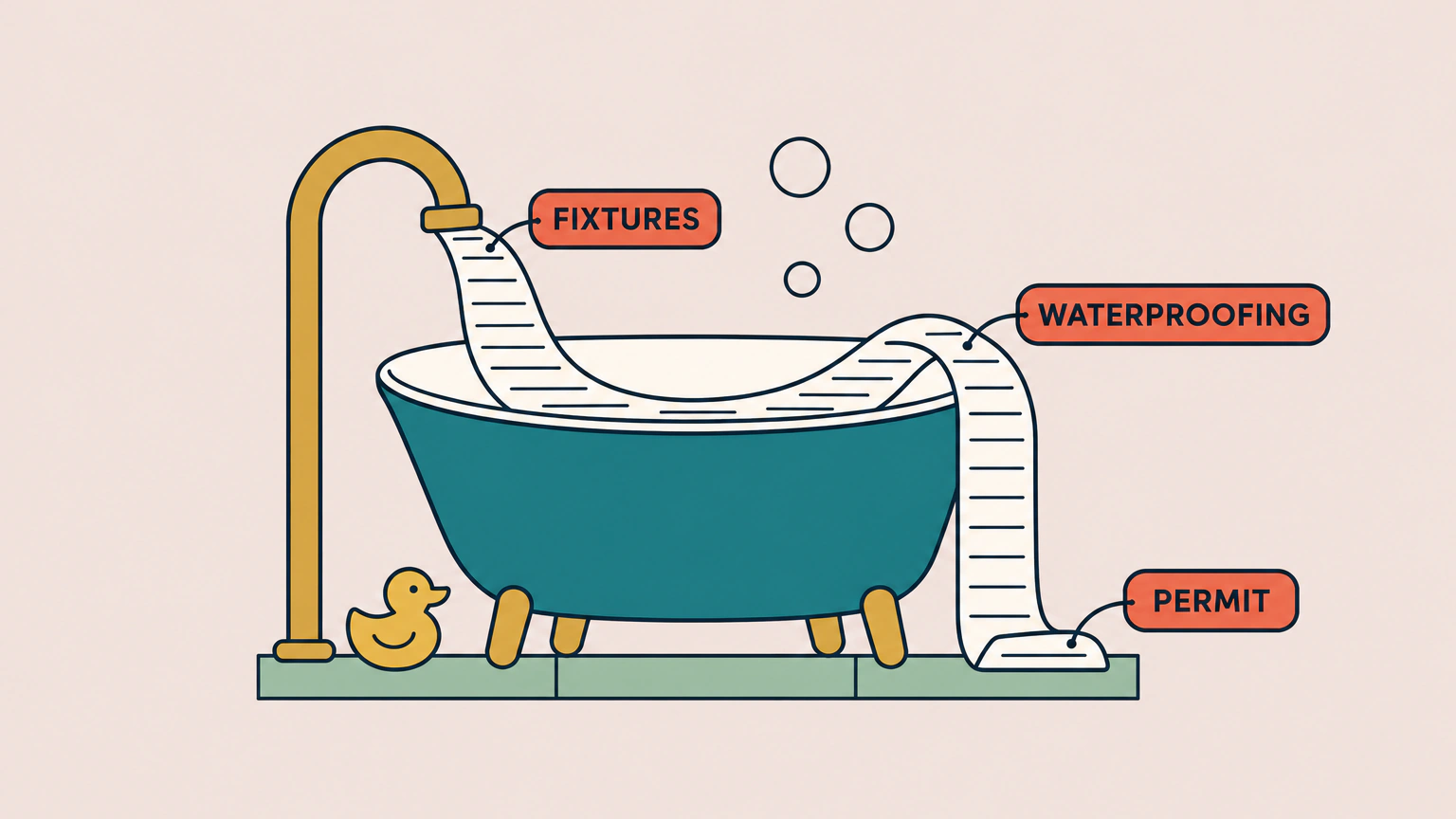
A quote is only comparable when it names the same things as the other one. In a bathroom, nine of them decide the price.
Before you sign, the quote should show:
- A dollar allowance for each fixture you're choosing: toilet, vanity, tub or shower, tile and glass.
- How many square feet of tile, and which walls get it.
- The waterproofing system by name, covering the shower walls, the floor and every seam.
- Whether the toilet and drains stay where they are, and the price if they move.
- Who applies for any permit, and who pays for it.
- The licensed plumber doing the plumbing and, in Ontario, the licensed electrical contractor doing the wiring.
- An exhaust fan ducted outdoors, not into the attic.
- How hidden damage and changes get priced and approved before that work starts.
- The sales tax and the final total.
The deposit and the payment schedule belong in writing too, and our lien guide covers how much to hold back from each payment.
Permits, and who's allowed to do the plumbing and wiring
The City of Toronto's permit page says you need a building permit to "Install or modify heating and or plumbing systems". You don't need one for "Repairing and replacing plumbing fixtures", or for "Installation of cabinetry and millwork". So swapping a toilet, sink or tub in the same spot is permit-free in Toronto. Moving a drain isn't.
Other cities write their own rules, and our basement guide compares five of them, so ask yours before demolition. Wherever you are, as we say on our category page, "a renovation quote should identify who obtains and pays for required approvals."
Wiring in Ontario is licensed work. The Electrical Safety Authority (ESA) says "only Licensed Electrical Contractors (with some exemptions, such as HVAC installers) are legally authorized to do electrical work in your home." A general contractor can't do it either "unless they hold an electrical contractor's licence." Homeowners may wire their own homes, if they file the required notifications with ESA.
Plumber certification is compulsory in Ontario and several other provinces. Our plumber guide covers which provinces license plumbers and how to check a certificate.
Red flag: A contractor who says the plumbing or electrical doesn't need a permit is telling you how the rest of the job will go.
Two things to see before the tile goes on
Tile and grout aren't waterproof. The protection sits behind them: a membrane on the shower walls, a sloped pan below, and a sealed seam where the two meet. A membrane is a waterproof sheet or coating that goes on before the tile. Ask to see it before any tile covers it. That's item 3 on the checklist, made physical.
Then check the fan's duct. Natural Resources Canada's Keeping the Heat In guide is plain: "Exhaust fans should always discharge to the outside but not directly below the soffit vents." It names bathroom vents as a usual leak point for moist house air into the attic, and wants the ducts kept under the insulation or wrapped in it. In January, wet air dumped into a cold attic turns to frost, and the frost drips back through the ceiling in a thaw.
While the wall is open, ask for blocking (solid lumber between the studs) wherever a grab bar might go later. It's cheap now and costly once the tile is up. It's also exactly the kind of safety work Canada's renovation tax credits help pay for.
The tax credits that pay back part of a safer bathroom
Maybe your mother can't step over the tub anymore. Maybe you're planning a walk-in shower before you need one. Either way, part of the bill can come back at tax time. The federal Home Accessibility Tax Credit pays part of permanent work that helps someone 65 or older, or eligible for the disability tax credit, get around the home or stay safer in it. British Columbia and New Brunswick add accessibility credits of their own, and Saskatchewan's general renovation credit covers bathroom renovations too. The credits stack. The Canada Revenue Agency (CRA) says the federal credit "is not reduced by government assistance, including grants, forgivable loans, or tax credits, from the federal or a provincial or territorial government."
Tax credits for bathroom work, by where you live
| Where you live | Credit | What it's worth | Who can claim it |
|---|---|---|---|
| Anywhere in Canada | Federal Home Accessibility Tax Credit | 14% of up to $20,000 of costs for 2026, so at most $2,800 | Someone 65 or older by December 31 or eligible for the disability tax credit, or a spouse or relative who claims for them |
| British Columbia | Home renovation tax credit for seniors and persons with disabilities | 10% of up to $10,000, so at most $1,000, paid even if you owe no tax | Seniors, people with a disability, and family members who live with them |
| New Brunswick | Seniors' home renovation tax credit | 10% of up to $10,000, so at most $1,000 | Seniors 65 or older, and family members who live with them |
| Saskatchewan | Home renovation tax credit | 10.5% of what you spend above $1,000, on up to $4,000 of it, so at most $420, or $525 for seniors | Any homeowner, for lasting work on their principal residence, bathrooms included |
| Ontario | No renovation credit on the 2025 form | The seniors' home safety tax credit ran in 2021 and 2022 only | No one, for now |
From CRA's pages and each province's 2025 credit forms. Newfoundland and Labrador, Prince Edward Island, Nova Scotia, Manitoba and Alberta list no renovation credit. Quebec residents file their provincial return with Revenu Québec.
The federal accessibility credit, in plain numbers
The credit is built around a "qualifying individual": someone 65 or older by the end of the year, or eligible for the disability tax credit at any time in the year. That person can claim it. So can a spouse or certain relatives who support them, and they can split the claim.
The home has to be owned, alone or jointly, by that person and lived in by them, or by a relative who claims and lives there with them. A co-op housing share counts. Renters can't claim.
The work has to be "of an enduring nature and integral to the eligible dwelling", in the Income Tax Act's words. It has to help the person "gain access to, or to be mobile or functional within" the home, or "reduce the risk of harm". CRA adds that an item "that will not become a permanent part of your dwelling is generally not eligible." Routine repairs, appliances, financing costs and work done mainly to raise or keep up the home's value don't count. The credit won't buy the marble. It will help with the grab bar.
CRA's page on the credit allows up to $20,000 of costs a year for each qualifying person, and $20,000 in total for a home where two people qualify. The credit is those costs times the lowest federal tax rate: 14% for 2026, so at most $2,800. For 2025, a year the rate was cut midway, it was 14.5%, for a maximum of $2,900.
Say you spend $12,000 on qualifying work in 2026. That cuts the claimant's federal tax by $1,680 ($12,000 × 14%), as long as they owe at least that much. The credit is non-refundable, so it lowers the tax you owe and pays nothing past zero.
Doing it yourself? Materials, fixtures, equipment rentals, plans and permits count. Your own labour and tools don't. A relative's bill counts only if they're registered for GST/HST.
From 2026, one cost can't go on both the medical and accessibility credits
The medical expense credit can reach the same bathroom, for someone with a severe and prolonged mobility impairment or who lacks normal physical development. The work can't be the kind that typically adds value to a home, or that people without that condition would normally do.
Through the 2025 tax year, one cost could count toward both credits. CRA's page on the accessibility credit, written for 2025, still says "you can claim the expense as a medical expense and a home accessibility expense." For 2025, that's right.
From January 1, 2026, it isn't. The Budget 2025 Implementation Act, No. 1 took out the clause that allowed both, and the accessibility credit's section of the Income Tax Act now shuts out any cost claimed as a medical expense.
Both credits use the same rate, so the question is which dollars count. The medical credit counts only costs above a floor of 3% of your income or a yearly indexed amount, whichever is less, and it has no $20,000 ceiling. The accessibility credit has no floor and stops at $20,000.
For most seniors' projects, like grab bars or a walk-in shower for someone without a severe mobility impairment, only the accessibility credit fits anyway. On a big job for someone with a severe impairment, work out both. British Columbia, New Brunswick and Saskatchewan let one cost go on their own credit and the medical credit together.
We're not tax preparers, and on a claim this size it's worth five minutes with whoever does your return.
What your province adds, and the receipts to keep
British Columbia spells out the work it means: walk-in bathtubs, wheel-in showers, grab bars "and related reinforcements around the toilet, tub and shower", raised toilets, non-slip flooring and hand-held showers on adjustable rods. The B.C. credit is refundable, so it pays even if you owe no tax. An invoice you get in December and pay in January counts in the year you got it.
New Brunswick's list is close: comfort-height toilets, walk-in bathtubs, wheel-in showers, and grab bars around the toilet, tub and shower.
Saskatchewan's credit isn't about accessibility at all. CRA's list of eligible work for it starts with "renovating a kitchen, bathroom, or basement", and it's a family claim on your principal residence.
Ontario's seniors' home safety credit appeared on its 2021 and 2022 forms, and not since.
CRA wants none of the paperwork with your return, and it can ask for all of it later.
To claim a credit, each invoice or receipt should show:
- The contractor's or seller's name, business address and GST/HST number, if they have one.
- What was bought, and the date you bought it.
- What work was done, and the address where it was done.
- When the work was done, or when the goods were delivered.
- The amount of the invoice.
- Proof you paid in full, such as a receipt, a card slip or a cancelled cheque.
Ask the contractor for an invoice that shows the first five before the final payment. Chasing it in April is harder.
Frequently asked questions
Is $10,000 enough to renovate a bathroom?
For some jobs, yes. Our planning budgets put a basic acrylic tub-to-shower conversion at $3,500 to $5,500, and a two-piece powder room starts at $8,000. A standard main bathroom rebuilt on its existing layout starts at $17,000. So $10,000 usually buys a conversion or a powder room at the low end. It rarely buys a full rebuild.
Do you need a permit to renovate a bathroom?
It depends on what changes. In Toronto, replacing a toilet, sink or tub in the same spot needs no building permit, while installing or changing plumbing does. Other cities set their own rules, so ask yours before demolition starts. In Ontario, anyone you hire for the wiring has to be a licensed electrical contractor, and the work gets filed with the Electrical Safety Authority.
How much does a tub to shower conversion cost?
Our planning budget for a basic acrylic conversion is $3,500 to $5,500. That covers taking out an alcove tub, an acrylic base and wall system on the same drain, a basic faucet and debris removal. A glass enclosure, upgraded fixtures, moving the drain and anything found behind the old tub cost extra. Ask whether a door or curtain is included.
Can you claim the same bathroom work as a medical expense and for the accessibility credit?
Not since 2026. Through the 2025 tax year, one cost could count toward both. From January 1, 2026, a cost you put in a medical expense claim can't also count toward the federal home accessibility credit. The medical route only covers renovations for someone with a severe and prolonged mobility impairment, or who lacks normal physical development. So many seniors' bathroom projects fit only the accessibility credit anyway.
Does a walk-in shower qualify for the home accessibility tax credit?
It can. The work has to be permanent, and it has to help someone who's 65 or older, or eligible for the disability tax credit, get around the home or stay safer in it. A shower rebuilt mainly to add value to the house doesn't count. British Columbia and New Brunswick both name wheel-in showers and walk-in bathtubs in their own lists of eligible work.
Is a bathroom renovation tax deductible in Canada?
Usually not as a deduction. For the home you live in, the help comes as credits: the federal accessibility credit when the work helps someone 65 or older or eligible for the disability tax credit, plus provincial credits in British Columbia, New Brunswick and Saskatchewan. Quebec has its own credit for people 70 or older, and a walk-in tub or shower qualifies. If part of your home earns rental income, the federal credit covers only the part you live in, and shared work like a ramp gets split.
Once two quotes answer the same nine questions, compare them, and if you need a third, start with the bathroom renovation contractors near you.