

On this page
- What a hot water tank replacement costs in Canada
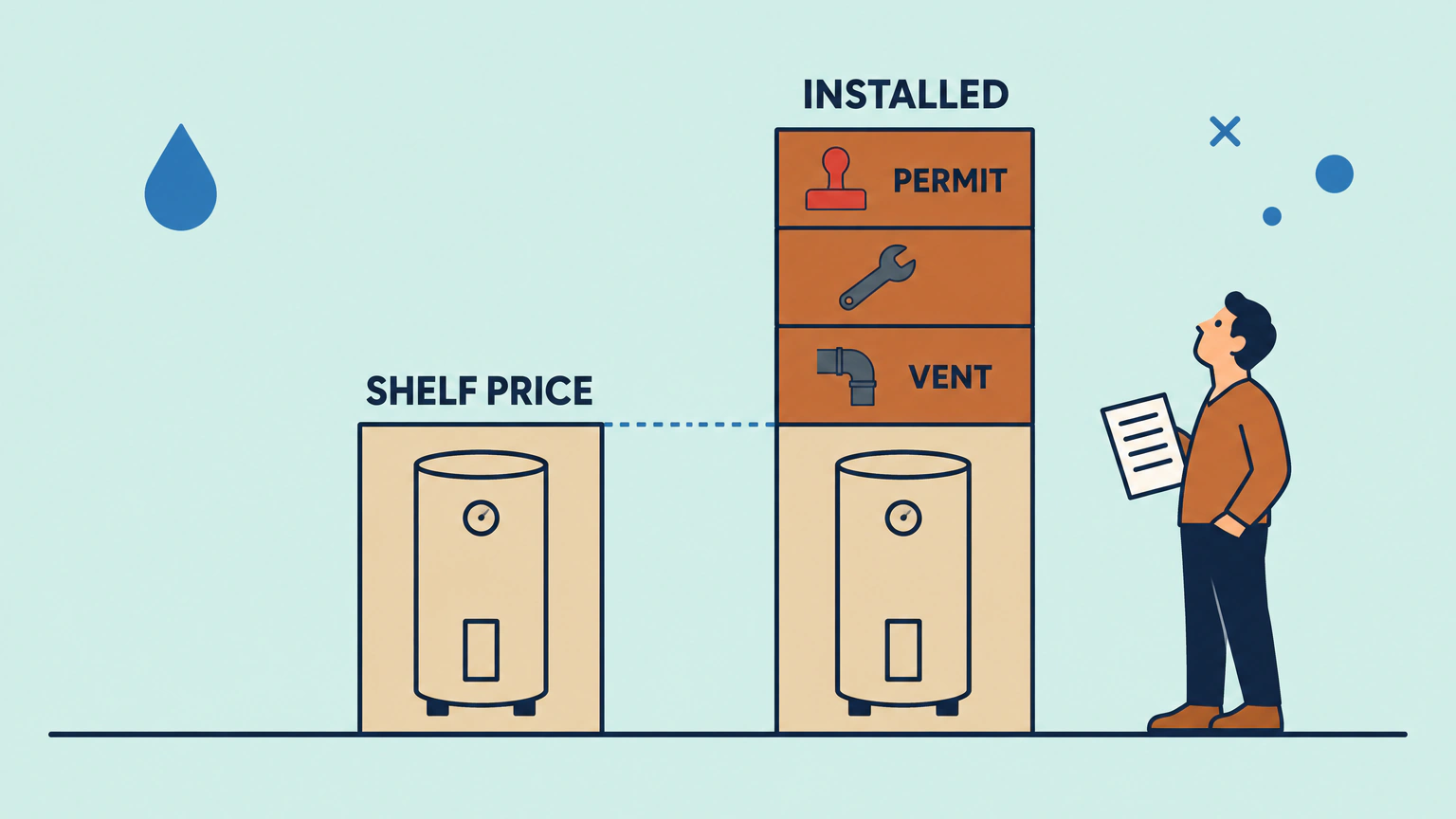
- Why installing the tank can cost as much as the tank
- The vent rule that catches power-vent tanks
- Does a tank swap need a permit? It depends where you live
- What the warranty years on your quote really cover
- Before you sign: the lines to ask for, and the pitches to walk away from
- Questions people ask about hot water tank replacement
What a hot water tank replacement costs in Canada
Plenty of Canadian installers now post their prices, which makes the first check easy: see where your quote lands. Here's what eleven businesses publish for their own work.
What Canadian installers and suppliers publish for a tank swap
| Tank | Published installed price | Who publishes it |
|---|---|---|
| Gas, 40 gallon, chimney vented | $1,995 plus GST | Advanpro, a Calgary heating contractor |
| Gas, 40 gallon | About $2,199, permits and removal included | Furnace Family, Calgary and Edmonton |
| Gas, 40 gallon | From $2,414 | Action Furnace, Calgary, Edmonton and Red Deer |
| Gas, power vent | $3,000 to $3,500 | Comfort Union, Calgary |
| Gas, 40 gallon, like for like | $1,500 to $2,200 | Hydro Pro Plumbing, Vancouver |
| Gas, power vent or new venting | $2,500 to $4,500 | CANRO, Metro Vancouver |
| Gas, 40 gallon | From about $1,850, removal included | Lynn's Plumbing, Heating and Cooling, Winnipeg |
| Gas, 40 gallon, chimney vented | $2,200 to $3,200 | Tornado Plumbing, Toronto |
| Gas, 40 to 50 gallon, conventional | $1,200 to $2,900 | Reliance, an Ontario rental company, for buying instead of renting |
| Electric, 40 to 50 gallon | $1,000 to $2,500 | Reliance |
| Electric, 40 to 60 gallon | $600 to $1,200 | RenoQuotes, a Quebec renovation marketplace |
| Any tank, bought and installed | About $2,500 | Home Depot Canada's installation pages |
Each figure is what that business publishes for its own work. Tax and rebate treatment isn't clear for every figure, and none is a quote for your house.
Read the spread, not any single number. Fuel and venting move the price most. Size moves it less than you'd expect: Advanpro charges $200 more for a 50-gallon tank than for a 40, and Furnace Family about $150 more. Advanpro's $1,995 plus GST is the only one of these prices that names a tax, so ask everyone else whether tax is in their number.
Check what each price includes, too. Furnace Family's covers permits and removal, and Lynn's covers taking the old tank away. Hydro Pro says its ranges include permits in one paragraph, then adds permit fees on top in another. The others vary or do not say.
Home Depot's city installation pages put buying and installing a tank at "approximately $2,500", the same figure on all four we read: Calgary, Winnipeg, Toronto and Vancouver.
Chimney vent, power vent or electric: why the tank type sets the price
Your house picks the tank before your budget does. A chimney-vented gas tank (the trade calls it atmospheric) sends its exhaust up an existing chimney, and it's the cheapest gas swap. A power-vent tank has a fan on top that pushes exhaust out through plastic pipe in a side wall.
The fan needs power, which is why AirZone lists an electrical outlet among the things that change its quote. It's also why Comfort Union prices power-vent installs at $3,000 to $3,500 in Calgary. Electric tanks skip venting altogether. Home Depot's buying guide says that makes them easier and usually cheaper to install, though running one can cost more than gas, depending on your utility prices.
If you've already moved to a high-efficiency furnace, your tank may now be alone on the old chimney, and our furnace guide covers what happens to the chimney after a furnace upgrade. Gas tank swaps are heating work as much as plumbing, so heating contractors who install and vent gas tanks quote them too. Tankless is a different job. Hydro Pro notes that tankless units need a larger gas line than most tanks, which is why the time to change type is before the old tank fails, not the morning it does.
Why installing the tank can cost as much as the tank
Look at the businesses that split their prices, and the installation half is no rounding error. Reliance, an Ontario rental company, puts a conventional 40-to-50-gallon gas tank at $700 to $1,400 for the equipment and $500 to $1,500 to install it. RenoQuotes' Quebec table prices an electric 40-to-60-gallon tank at $300 to $700 for the unit and $300 to $500 for the work. On the shelf, Home Depot's 2024 regular prices in Ontario put a 40-gallon gas tank at $939 and a 50-gallon at $1,116.
So what does the installation half pay for? Natural Resources Canada's water heater guide lists what a written contract should spell out. It starts with the venting, the inspections and any extra parts, naming heat traps, a drain pan, a chimney liner and piping. Then come removing the old tank and the total cost of parts and labour "including taxes".
Treat that list as the outline of a fair quote. Every item on it is parts or someone's time on top of the tank, and we cover the hourly side in a separate guide: what a plumber's hour actually costs.
The extra lines that depend on your house
Some lines appear on one quote and not the other because houses differ, not because one installer is padding the bill.
Expansion comes first. Water expands as it heats. If your water supply has a check valve, a backflow preventer or a pressure-reducing valve, that extra volume has nowhere to go. The National Plumbing Code requires protection against it.
The code's own note names the usual fixes: a suitably sized expansion tank or a thermal expansion relief valve. GSW's and John Wood's warranties also go void in a closed system without "adequate provision for thermal expansion". That's why some quotes carry an expansion tank and others don't.
Leaks are next. GSW's warranty requires the tank to be installed so that a leak "will not cause damage" to the area around it. John Wood's calls for "a properly sized drain pan" wherever a leak would do damage. Both want the relief valve piped to a drain, and John Wood's requires a new CSA-certified valve.
In British Columbia, earthquakes add a line. Where the local seismic risk passes the code's threshold, the BC Building Code requires a water heater to be secured to the structure so it can't tip over. Straps on a BC quote are real.
Natural Resources Canada also lists a chimney liner among the extra parts a contract should name. If your furnace was replaced recently, read what happens to the chimney after a furnace upgrade before you accept or refuse that line. Removal of the old tank and the tax line round out the list.
The vent rule that catches power-vent tanks
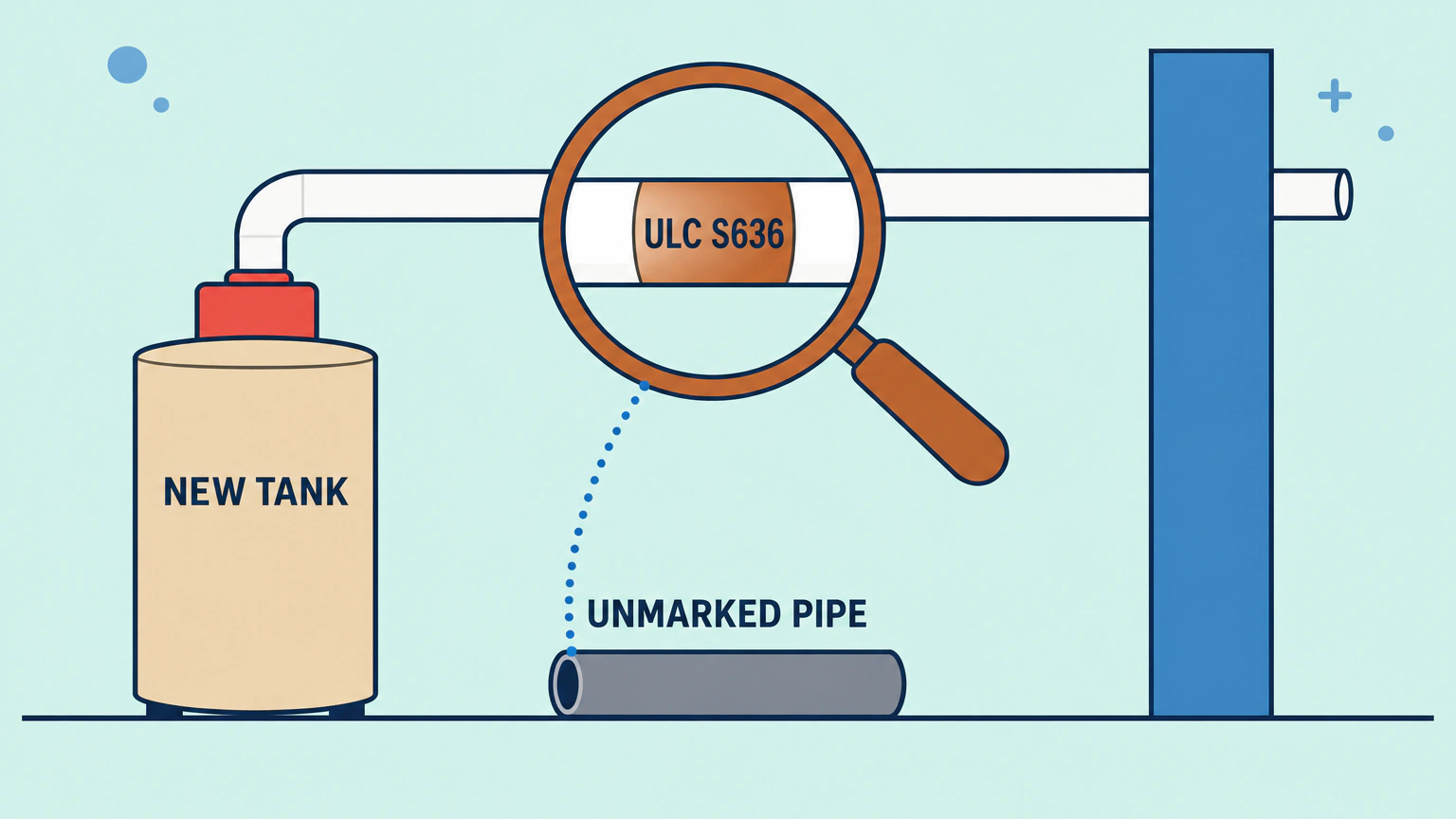
If your tank has a power vent, this is the line you probably didn't see coming. Canada's gas installation code requires plastic vent pipe to be certified to a standard called ULC S636, and TSSA, Ontario's fuel-safety regulator, explains why. It found failures in existing plastic vents, mostly ABS pipe and fittings, including "stress cracking and melting" that "could result in a carbon monoxide (CO) safety hazard". The rule isn't retroactive, so an old vent is left alone until the appliance it serves is replaced. Then, in TSSA's words, "the existing plastic venting must be completely replaced with a certified ULC S636 plastic venting system."
Technical Safety BC's directive says the same thing. So the upgrade waits until the appliance is replaced, and that's exactly when the vent lands on your quote. Enercare's support page dates Ontario's adoption to August 1, 2007, and tells you what to look for: the new pipe is "marked", while the old was "unmarked PVC, CPVC or ABS".
There's an exception for houses where the whole vent can't be replaced. The first five feet from the tank get new certified pipe, and the rest stays only if it passes a visual inspection and a pressure test (the vent is pressurized to prove it holds). In Ontario that takes a TSSA variance, and the old section has to be inspected and pressure tested again every five years. In BC, the holder of the installation permit can keep the old vent on the same conditions.
Technical Safety BC draws one hard line, though. Any cellular core vent (plastic pipe with a foam layer inside its wall) has to be replaced along with the appliance. A failed vent is a carbon monoxide risk, which is also why carbon monoxide alarm rules matter in any house with a gas tank.
Does a tank swap need a permit? It depends where you live
We checked six places against each authority's own page and fee schedule.
Permits for a gas tank swap, in the six places we checked
| Where | Permit for a gas tank swap | Fee in 2026 | Who can pull it |
|---|---|---|---|
| Toronto | No city building permit is needed to install a hot water tank in a house. Only a TSSA certificate holder, or someone working in their presence, may do the gas work. | None from the city | There's no permit to pull. Check the contractor's TSSA registration instead. |
| British Columbia, where Technical Safety BC issues gas permits | Yes. Replacing a gas water heater needs a gas permit. | $150 for a contractor's permit, $158 from January 1, 2027. A homeowner's permit is $164, then $172. | Your licensed gas contractor, or you, with a homeowner permit. Strata, duplex and home-business owners can't get one. |
| Vancouver | Yes. The city issues its own gas permits. | $66.70 for a replacement water heater | A licensed gas contractor, or you, on a single detached house you own and live in. |
| Calgary | Yes. The city says all plumbing and gas installations need permits, renovations included. | From $116.50: $112, plus $9.79 per $1,000 of job value, plus the 4% Safety Codes Council fee. Starting work before the permit doubles it. | The contractor. A homeowner can get a gas permit only as a certified journeyman gasfitter. |
| Edmonton | Yes. The Safety Codes Act requires a gas permit to install or alter a water heater. | $120 plus a $4.80 safety codes fee, the rate set until December 31, 2026 | A contractor licensed with the city. Edmonton's page conflicts on homeowner permits, so ask the city before doing your own work. |
| Winnipeg | No city plumbing permit is needed to swap a tank in the same spot with no plumbing changes. A gas tank still needs Manitoba's gas permit. | Set by the province. Ask your fitter for the amount. | A licensed gas fitter, who may install a like-for-like replacement first and then apply. |
Each authority sets its own rules and fees, and they change. In BC, Burnaby, Richmond, Kelowna, Maple Ridge and both North Vancouvers issue their own gas permits too.
So a gas tank swap needs a gas permit in five of the six places, issued by the city or the province. Toronto is the exception, and there the check is the installer's certificate.
Electric tanks don't need a gas permit, but plumbing-permit rules still vary by city. Calgary says "all plumbing and gas installations require permits", so if you're comparing plumbers in Calgary, ask each one whether your electric swap needs a plumbing permit. Winnipeg skips its plumbing permit when the new tank goes in the same spot with no changes to the pipes. Anywhere in BC that issues its own gas permits, yours comes from city hall, not Technical Safety BC.
Calgary has two more details worth knowing. Starting work before the permit is issued doubles the fee, and the city raises its fees every January 1. Be wary, too, of any sales page that says a permit "generally" isn't needed for a tank replacement. One national retailer prints that same sentence for Calgary, Winnipeg, Toronto and Vancouver alike, so it describes no city in particular. Ask the city, or ask your installer who's pulling the permit.
How to check the permit was actually pulled
Ask for the permit number before the old tank leaves the house. In BC, Technical Safety BC's online Permit Lookup Tool shows whether the work is permitted, and a homeowner permit needs at least one inspection request within 180 days of issue. In Manitoba, a licensed gas fitter can swap in a similar gas appliance first and apply for the permit "as soon as is reasonably practicable" afterward. The gas utility then has to get the installation inspected within 60 days of the permit being issued.
Toronto has no city building permit to look up for a hot water tank in a house, so check the contractor instead. TSSA keeps an online registry you can search. Its registered fuels contractors are "the only businesses that are legally authorized to do fuels related work in Ontario".
What the warranty years on your quote really cover
The warranty years printed on a quote tell you less than they seem to. The manufacturers' own Canadian warranty sheets show three layers.
The first is the tank and its parts. GSW's sheet lists 6, 9 and 12 years on the inner tank for its G6, G9 and G12 models, 6 years on component parts and 1 year on other component parts. John Wood's lists 6 years on the tank and 6 on parts for its standard models, and 8 and 8 for models ending in "M". It excludes anode rods (the metal rod inside the tank that corrodes so the steel doesn't) as "consumable maintenance parts". How fast an anode wears depends on your water, and one replaced early can extend a tank's life.
The second layer is labour, and it's yours. Both makers supply a replacement heater or part, and you pay to have the old one taken out and the new one put in. John Wood's sheet also puts "any materials and/or permits" on your side of the bill, and GSW's says much the same. Both warranties are void if the tank wasn't installed to local codes, and both cover only the original owner, which matters when you sell.
The third is the installer's own labour warranty, which is separate. Home Depot's installation pages offer one year, and one Winnipeg package lists two.
Natural Resources Canada's water heater guide is blunt: the warranty "is not always a good measure of reliability". When two tanks differ mainly in warranty years, ask what else changes.
Renting, buying out, or buying new in Ontario
If your tank is rented, the math shifts. Natural Resources Canada's water heater guide says that over the life of the tank, renting "will be more costly than purchasing one". Home Depot's installation pages compare about $2,500 to buy and install with rent averaging "about $40 per month". Even Reliance, which rents tanks, says buying is typically cheaper over a 14-to-16-year life.
Its own table puts renting a standard electric or gas tank at $20 to $57 a month, with repairs included, and that's what the extra money buys. Ontario also bans offering or selling a water heater contract at your door unless you contacted the business first. If you rent now, leaving the contract has its own costs, covered in our guide to getting out of a water heater rental.
Before you sign: the lines to ask for, and the pitches to walk away from
Hold every quote against these seven lines before you sign. If you found the installer through our directory, our satisfaction guarantee means we'll work with you and the contractor if something goes wrong.
Seven things to see on a hot water tank quote
- The tank's maker, model and size, with its tank and parts warranty years.
- How it vents: into the existing chimney, or through new plastic pipe marked ULC S636.
- Who pulls the permit, and whether its fee is in the price.
- The installer's gas licence or TSSA registration, and a labour warranty in writing.
- The code items your house needs, such as an expansion tank, a drain pan or earthquake straps in BC.
- Removal and disposal of the old tank.
- One total, with GST, HST, PST or QST shown.
Red flag: Three tank-swap pitches worth a pause
- "You don't need a permit for a tank swap." In BC, Calgary, Edmonton and Manitoba a gas tank does. Ask for the permit number before the old tank goes out the door.
- A cash price that skips the paperwork. TSSA warns about unregistered "trunk slammers" who work cheap with substandard materials. Look the company up before anyone touches the gas line.
- A knock at the door saying your tank is unsafe. Ontario says not to rely on a salesperson's opinion that your water heater is unsafe or should be replaced. Close the door and call an installer you chose.
Questions people ask about hot water tank replacement
Short answers to the questions that come with an aging tank.
How long does a hot water tank last?
Plan around ten years. Natural Resources Canada's ENERGY STAR advice is to upgrade once a water heater passes 10 years. Its water heater guide adds that water quality is "the single most important factor affecting the life of the water heater." The manufacture date is on the rating plate, and some makers code it into the serial number. Replacing before it fails lets you choose the tank instead of taking whatever's on the truck.
Do you need a permit to replace a hot water tank?
It depends on where you live and on the fuel. A gas tank swap needs a gas permit in British Columbia, Calgary, Edmonton and Manitoba. Toronto doesn't require a building permit to install a hot water tank in a house, though only a TSSA certificate holder may do the gas work. Winnipeg needs no city plumbing permit for a same-spot swap. Ask your installer who pulls the permit, and for its number.
Can I replace my own gas hot water tank?
It depends where you live. Ontario keeps gas work for TSSA certificate holders. Calgary gives a homeowner a gas permit only if they're a certified journeyman gasfitter, and Manitoba wants a licensed installer and a permit. In British Columbia, a homeowner can get a homeowner gas permit and book the inspection. Strata units, duplexes and homes with a business don't qualify. Edmonton gives conflicting guidance on homeowner permits, so ask the city before replacing your own tank.
Is it better to rent or buy a hot water tank?
Over the life of a tank, buying usually costs less. Natural Resources Canada's water heater guide says renting costs more than buying over that span, and Home Depot's installation pages compare about $2,500 to buy and install with rent of about $40 a month. Renting does cover repairs, and that's what the extra money buys. If you rent now, read our guide to getting out of a water heater rental first.
Is a hot water tank warranty transferable?
Usually not. The two Canadian tank warranties we read, from GSW and John Wood, both say they aren't transferable, and GSW's also requires the original buyer to keep living in the house where the tank was first installed. Both leave the labour to remove and reinstall a tank under warranty to the owner. If you're buying a house with a young tank, assume the coverage left with the seller.
Why do power vent water heaters cost more?
There's more to buy and more to install. A power-vent tank has a fan that pushes exhaust through plastic pipe in a side wall, so it needs an electrical outlet and its own vent run. In Calgary, Comfort Union prices power-vent installs at $3,000 to $3,500, against $2,400 to $3,200 for a chimney-vented tank. Replacing one can also mean replacing an uncertified plastic vent.
Get two quotes that name the same tank, the same vent and the same permit, then compare the totals with tax. Our plumbing category page lists plumbers near you.